
As the Q2 earnings season wraps, let’s dig into this quarter’s best and worst performers in the renewable energy industry, including Sunrun (NASDAQ: RUN) and its peers.
Renewable energy companies are buoyed by the secular trend of green energy that is upending traditional power generation. Those who innovate and evolve with this dynamic market can win share while those who continue to rely on legacy technologies can see diminishing demand, which includes headwinds from increasing regulation against “dirty” energy. Additionally, these companies are at the whim of economic cycles, as interest rates can impact the willingness to invest in renewable energy projects.
The 17 renewable energy stocks we track reported a satisfactory Q2. As a group, revenues beat analysts’ consensus estimates by 2.4% while next quarter’s revenue guidance was 6.7% below.
Amidst this news, share prices of the companies have had a rough stretch. On average, they are down 10.5% since the latest earnings results.
Sunrun (NASDAQ: RUN)
Helping homeowners use solar energy to power their homes, Sunrun (NASDAQ: RUN) provides residential solar electricity, specializing in panel installation and leasing services.
Sunrun reported revenues of $870 million, up 52.8% year on year. This print exceeded analysts’ expectations by 19.2%. Overall, it was an incredible quarter for the company with a beat of analysts’ EPS estimates and an impressive beat of analysts’ ARR estimates.
“The need for affordable, reliable power has never been more evident, and our storage-first offering is meeting it — customers attached batteries at the highest rate in our history this quarter. We are positioning the business for strong growth, bringing on some of the best talent in the industry and scaling deliberately, with a focus on customer experience and asset quality. And as that engine scales, we're aiming to unlock new ways to monetize the network we've already built, from distributed power plant programs to emerging data center and grid edge applications, creating new streams of Cash Generation,” said Mary Powell, Sunrun’s Chief Executive Officer.
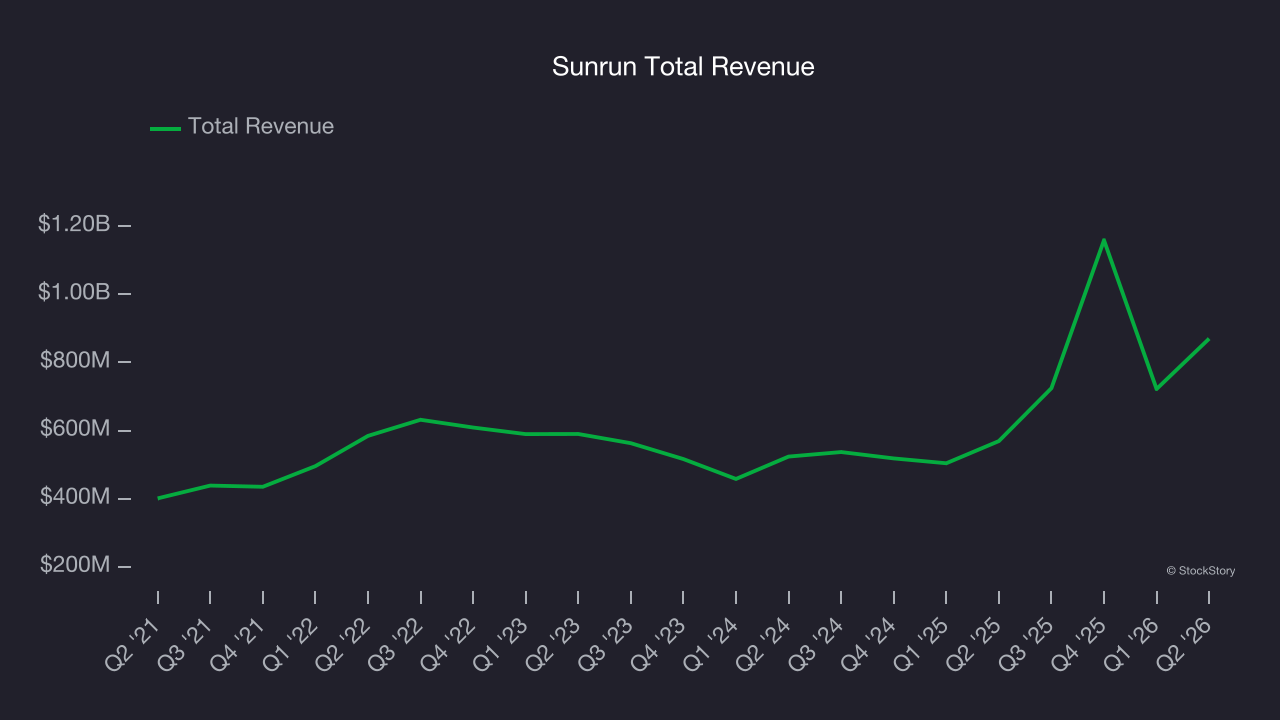
Investor expectations, however, were likely higher than Wall Street’s published projections, leaving some wishing for even better results (analysts’ consensus estimates are those published by big banks and advisory firms, not the investors who make buy and sell decisions). The stock is down 28.1% since reporting and currently trades at $7.54.
We think Sunrun is a good business, but is it a buy today? Read our full report here, it’s free.
Best Q2: Bloom Energy (NYSE: BE)
Working in stealth mode for eight years, Bloom Energy (NYSE: BE) designs, manufactures, and markets solid oxide fuel cell systems for on-site power generation.
Bloom Energy reported revenues of $1.07 billion, up 166% year on year, outperforming analysts’ expectations by 27.7%. The business had an incredible quarter with a beat of analysts’ EPS estimates and a solid beat of analysts’ EBITDA estimates.
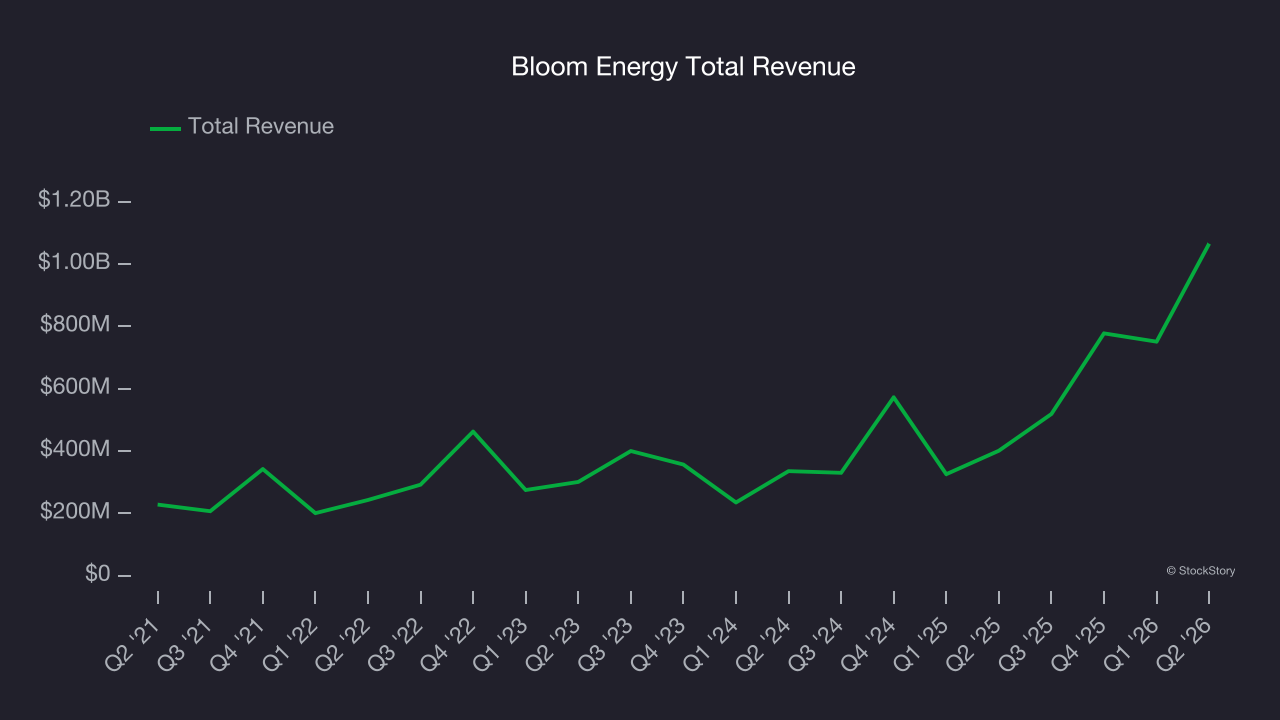
Bloom Energy scored the biggest analyst estimate beat, fastest revenue growth, and highest full-year guidance raise of the whole group. The market seems happy with the results as the stock is up 55.4% since reporting. It currently trades at $259.25.
Is now the time to buy Bloom Energy? Access our full analysis of the earnings results here, it’s free.
Weakest Q2: Fluence Energy (NASDAQ: FLNC)
Pioneering the use of lithium-ion batteries for grid storage, Fluence (NASDAQ: FLNC) helps store renewable energy sources with battery systems.
Fluence Energy reported revenues of $649.8 million, up 7.9% year on year, falling short of analysts’ expectations by 18.8%. It was a disappointing quarter as it posted full-year revenue guidance missing analysts’ expectations significantly and full-year EBITDA guidance missing analysts’ expectations significantly.
Fluence Energy delivered the weakest performance against analyst estimates and weakest full-year guidance update among its peers. As expected, the stock is down 50.3% since the results and currently trades at $7.07.
Read our full analysis of Fluence Energy’s results here.
ChargePoint (NYSE: CHPT)
The most prominent EV charging company during the COVID bull market, ChargePoint (NYSE: CHPT) is a provider of electric vehicle charging technology solutions in North America and Europe.
ChargePoint reported revenues of $116.1 million, up 17.7% year on year. This result beat analysts’ expectations by 10.3%. It was an exceptional quarter as it also produced a beat of analysts’ EPS estimates and an impressive beat of analysts’ EBITDA estimates.
ChargePoint scored the highest guidance raise in the group. The stock is up 38.7% since reporting and currently trades at $7.20.
Read our full, actionable report on ChargePoint here, it’s free.
EnerSys (NYSE: ENS)
Supplying batteries that power equipment as big as mining rigs, EnerSys (NYSE: ENS) manufactures various kinds of batteries for a range of industries.
EnerSys reported revenues of $935.6 million, up 4.8% year on year. This number topped analysts’ expectations by 0.8%. Overall, it was a very strong quarter as it also recorded EPS guidance for next quarter exceeding analysts’ expectations and a beat of analysts’ EPS estimates.
The stock is down 5% since reporting and currently trades at $177.45.
Read our full, actionable report on EnerSys here, it’s free.
Market Update
Over the past year, investors have been forced to repeatedly answer the same question: what is the market’s biggest risk? The answer has changed several times, and each shift has reshaped market leadership.
Late in 2025 and early 2026, artificial intelligence became the market’s primary uncertainty. Investors questioned whether AI would erode software pricing power and weaken competitive moats as AI made it easier to replicate once-differentiated products.
By the spring, technology took a back seat to geopolitics. The U.S. conflict with Iran briefly became the market’s dominant narrative, raising concerns about oil prices, inflation, and global growth. But as energy markets remained orderly and fears of a prolonged supply disruption faded, investors quickly turned their focus back to fundamentals.
Want to invest in winners with rock-solid fundamentals? Check out our Top 5 Quality Compounder Stocks and add them to your watchlist. These companies are poised for growth regardless of the political or macroeconomic climate.