
Global financial services firm Morgan Stanley (NYSE: MS) beat Wall Street’s revenue expectations in Q3 2026, with sales up 11.6% year on year to $20.34 billion. Its GAAP profit of $3.03 per share was 3.9% above analysts’ consensus estimates.
Is now the time to buy Morgan Stanley? Find out by accessing our full research report, it’s free.
Morgan Stanley (MS) Q3 2026 Highlights:
- Revenue: $20.34 billion vs analyst estimates of $19.92 billion (11.6% year-on-year growth, 2.1% beat)
- Efficiency Ratio: 67% vs analyst estimates of 68.2% (118.3 basis point beat)
- EPS (GAAP): $3.03 vs analyst estimates of $2.92 (3.9% beat)
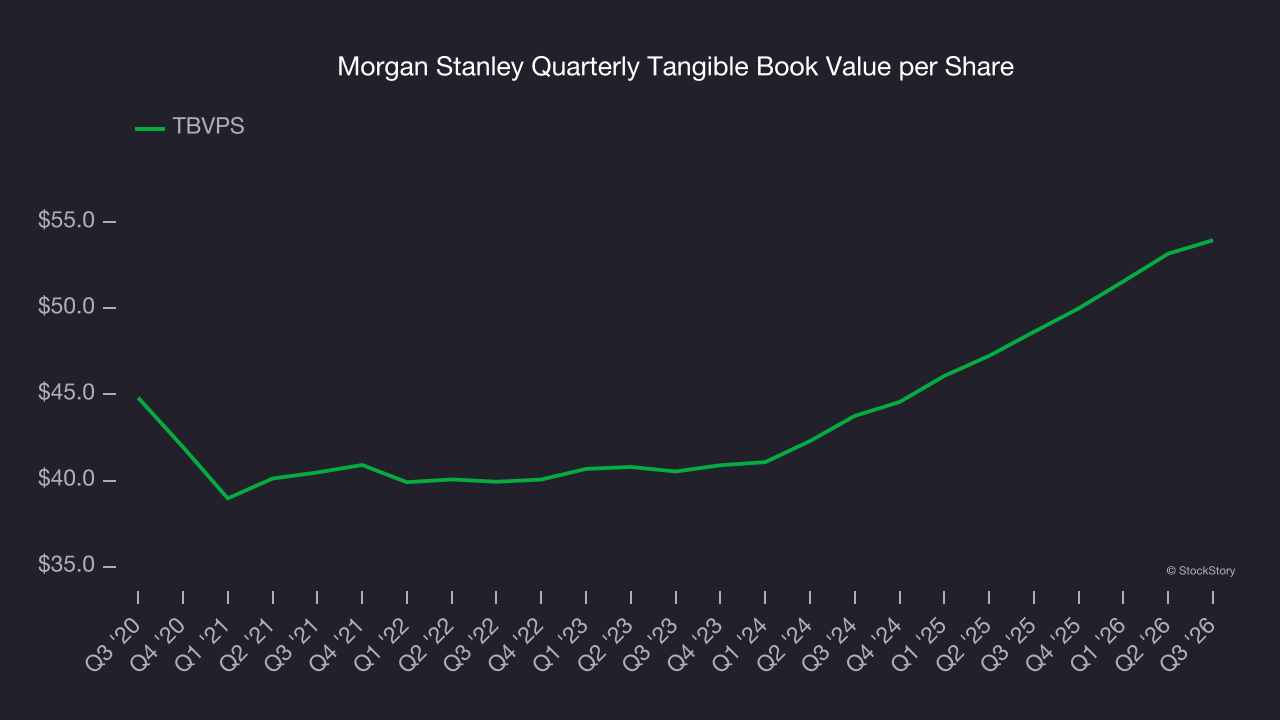
- Tangible Book Value per Share: $53.96 vs analyst estimates of $54.08 (10.9% year-on-year growth, in line)
- Market Capitalization: $293.1 billion
Company Overview
Founded in 1924 during the post-WWI economic boom by former JP Morgan partners, Morgan Stanley (NYSE: MS) is a global financial services firm that provides investment banking, wealth management, and investment management services to corporations, governments, institutions, and individuals.
Revenue Growth
Reviewing a company’s long-term sales performance reveals insights into its quality. Any business can put up a good quarter or two, but the best consistently grow over the long haul. Over the last five years, Morgan Stanley grew its revenue at a mediocre 6.4% compounded annual growth rate. This wasn’t a great result compared to the rest of the financials sector, but there are still things to like about Morgan Stanley.
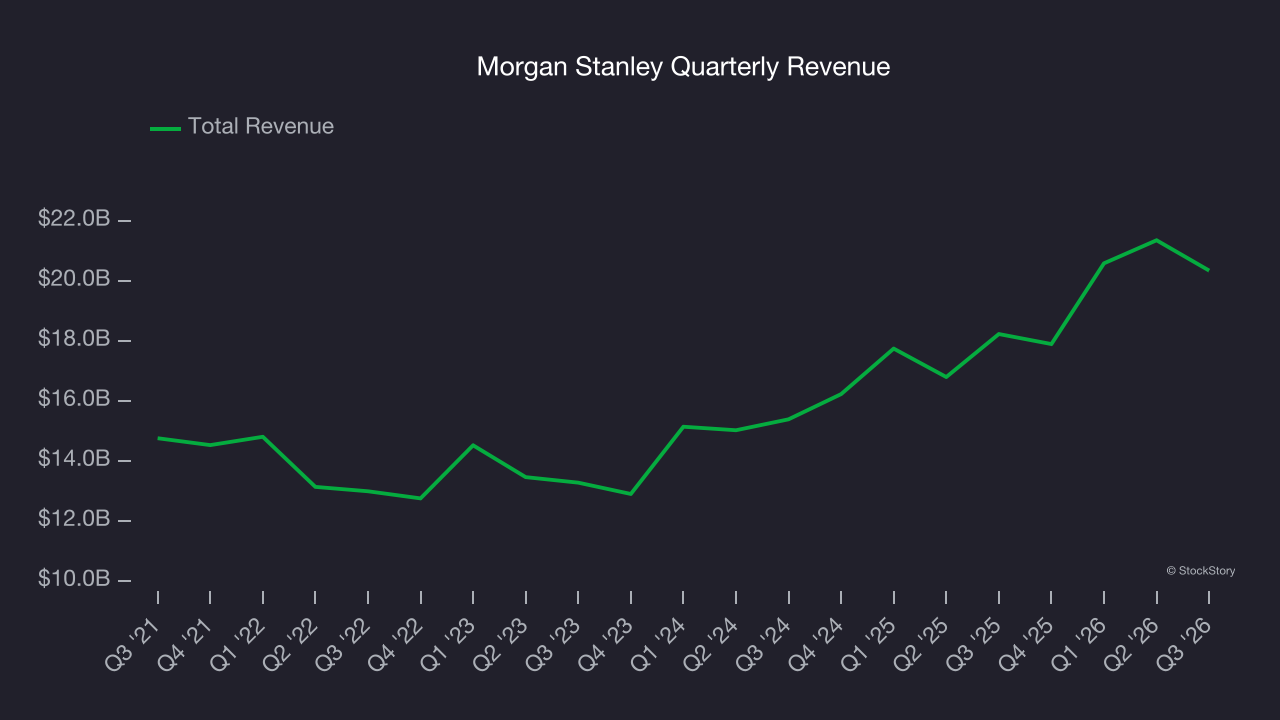
Long-term growth is the most important, but within financials, a half-decade historical view may miss recent interest rate changes and market returns. Morgan Stanley’s annualized revenue growth of 17.1% over the last two years is above its five-year trend, suggesting its demand recently accelerated. 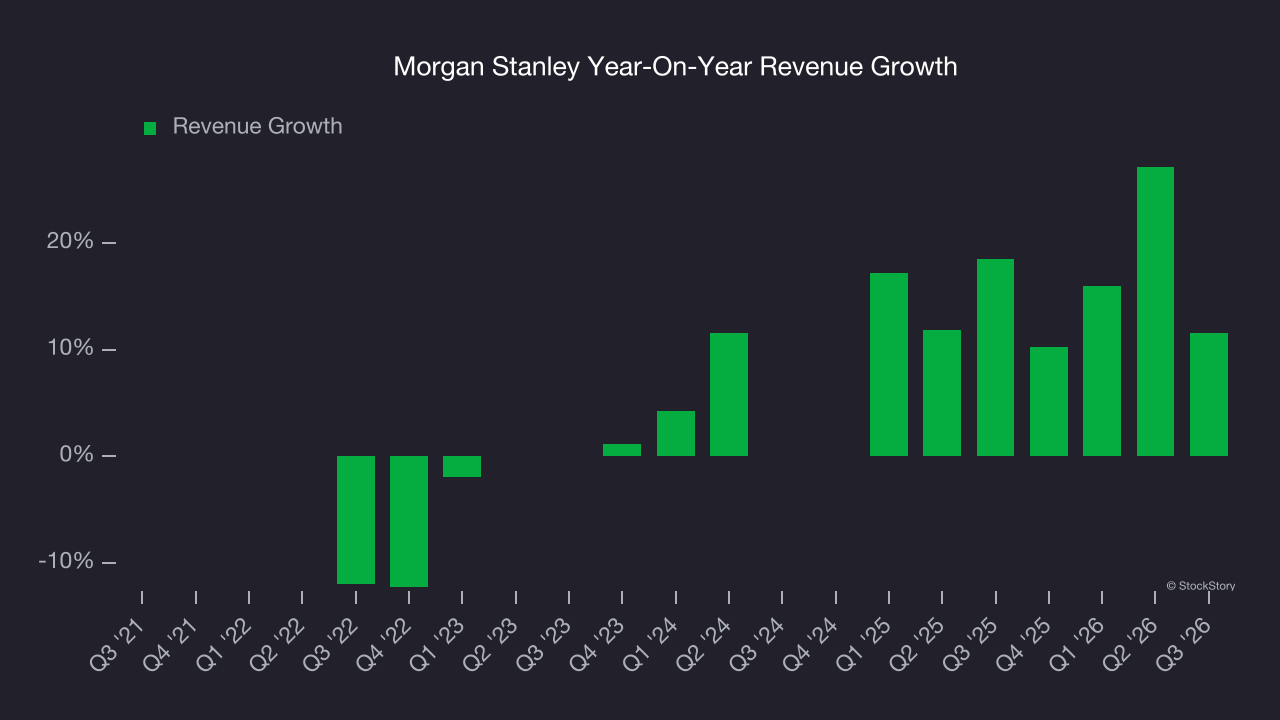 Note: Quarters not shown were determined to be outliers because they were impacted by outsized investment gains/losses that are not indicative of the recurring fundamentals of the business.
We can dig further into the company’s revenue dynamics by analyzing its most important segments, Institutional Securities and Wealth Management, which are 49.3% and 44.6% of total revenue. Institutional Securities revenue grew by 5.7% and 24.2% annually over the past five and two years, respectively. At the same time, Wealth Management revenue increased by 8.1% and 13.5% per year over the past five and two years, respectively. 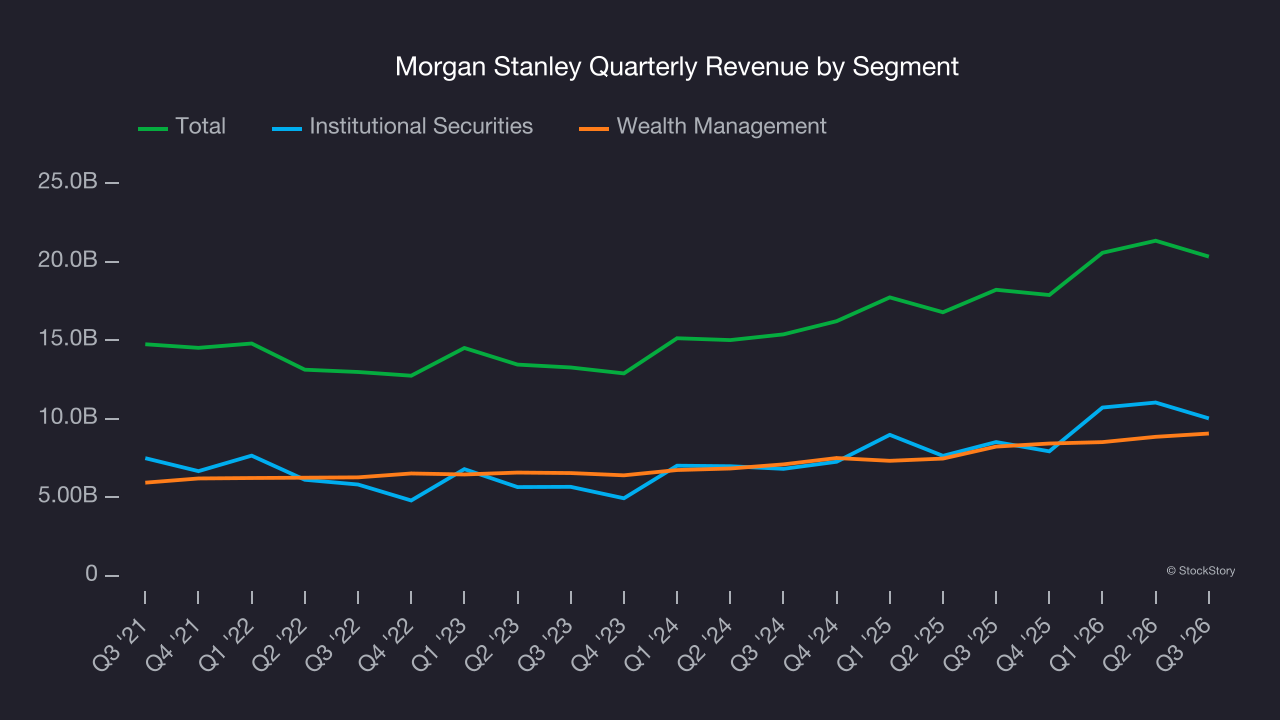
This quarter, Morgan Stanley reported year-on-year revenue growth of 11.6%, and its $20.34 billion of revenue exceeded Wall Street’s estimates by 2.1%.
WHILE YOU’RE HERE: The Next Palantir? One satellite company captures images of every point on Earth. Every single day. The Pentagon wants it. Hedge funds are using it to beat earnings. You’ve probably never heard of it.
This is what the early days of Palantir looked like before it became a giant. Same playbook. Different technology. If you missed Palantir, you need to see this. Claim The Stock Ticker for Free HERE.
Tangible Book Value Per Share (TBVPS)
Diversified financial companies operate across multiple business segments, from investment banking and trading to wealth management and specialized lending. Their valuations hinge on balance sheet quality and the ability to compound shareholder equity across these diverse operations.
This is why we consider tangible book value per share (TBVPS) an important metric for the sector. TBVPS represents the real net worth per share across all business segments, providing a clear measure of shareholder equity regardless of the complexity of operations. Other (and more commonly known) per-share metrics like EPS can sometimes be murky due to the complexity of multiple business lines, M&A activity, or accounting rules that vary across different financial services segments.
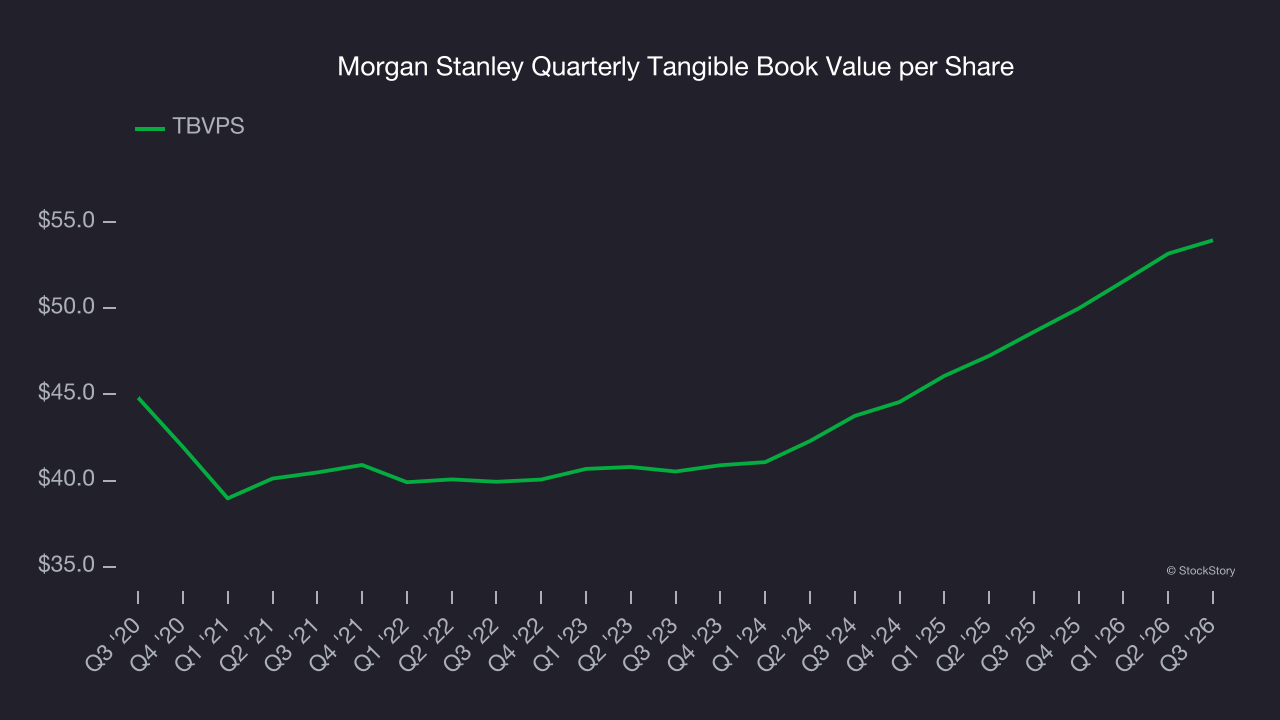
Morgan Stanley’s TBVPS grew at a tepid 5.9% annual clip over the last five years. However, TBVPS growth has accelerated recently, growing by 11% annually over the last two years from $43.76 to $53.96 per share.
Tangible Book Value Per Share (TBVPS)
The balance sheet drives profitability for financial firms since earnings flow from managing diverse assets and liabilities across multiple business lines. As such, valuations for these companies concentrate on capital strength and sustainable equity accumulation potential across their varied operations.
When analyzing this sector, tangible book value per share (TBVPS) takes precedence over many other metrics. This measure isolates genuine per-share value and provides insight into the institution’s capital position across diverse operations. EPS can become murky due to the complexity of multiple revenue streams, acquisition impacts, or accounting flexibility across different financial services, and book value resists financial engineering manipulation.
Morgan Stanley’s TBVPS grew at a tepid 5.9% annual clip over the last five years. However, TBVPS growth has accelerated recently, growing by 11% annually over the last two years from $43.76 to $53.96 per share.
Key Takeaways from Morgan Stanley’s Q3 Results
We were impressed by how significantly Morgan Stanley blew past analysts’ Institutional Securities segment expectations this quarter. We were also happy its revenue outperformed Wall Street’s estimates. On the other hand, its efficiency ratio missed and its Wealth Management segment fell slightly short of Wall Street’s estimates. Overall, this print was mixed but still had some key positives. The stock remained flat at $186.00 immediately following the results.
Is Morgan Stanley an attractive investment opportunity at the current price? What happened in the latest quarter matters, but not as much as longer-term business quality and valuation, when deciding whether to invest in this stock. We cover that in our actionable full research report which you can read here (it’s free).