Trade Compliance Records has published a primary-source reference library covering South Africa's 20 September 2026 PVoC deadline, the EU CBAM definitive phase, and the EU Digital Product Passport timeline. Each answer is cited to the official gazette, regulation, or agency document and accessible at tradecompliancerecords.com.
Clearwater, Florida--(Newsfile Corp. - May 26, 2026) - Trade Compliance Records (tradecompliancerecords.com) has published a primary-source reference library covering three trade-compliance regulatory regimes generating significant search activity from importers, exporters, brokers, and freight forwarders in 2026.
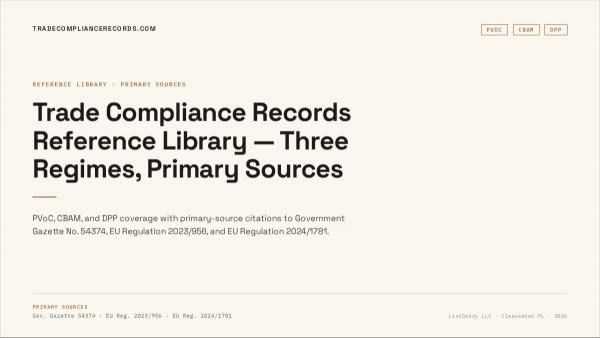
Trade Compliance Records Publishes Reference Library on PVoC, CBAM, and DPP
To view an enhanced version of this graphic, please visit:
https://images.newsfilecorp.com/files/8814/298891_93865edab4b07b24_002full.jpg
The library addresses the South African Pre-Export Verification of Conformity (PVoC) programme, the European Union Carbon Border Adjustment Mechanism (CBAM) definitive phase, and the European Union Digital Product Passport (DPP) timeline under the Ecodesign for Sustainable Products Regulation. Each answer page cites its source to the relevant Government Gazette, EU Regulation number, or agency document.
The South African PVoC Section
The PVoC reference section addresses the 20 September 2026 enforcement deadline established by Ministerial Directive in Government Gazette No. 54374 of 20 March 2026. The section covers the Phase 1 product list - toys, small electrical appliances, furniture, cosmetics, solar PV, gas appliances, and additional categories - and the role of the four inspection bodies authorised by the South African Bureau of Standards: China Certification & Inspection Group, SGS, Intertek, and Bureau Veritas.
Reference pages address the practical questions that customs brokers and freight forwarders handling Mainland China imports have raised: how the Certificate of Conformity workflow integrates with the SAD500 customs declaration; why the practical preparation window for sea freight via the Cape route is shorter than the headline six-month transition; and how the misalignment between Gazette product categories and Harmonised System tariff codes affects SARS risk assessment.
The CBAM Section
The CBAM reference covers the regime's definitive phase, which began 1 January 2026 under EU Regulation 2023/956. Pages address the 50-tonne mass-based threshold that determines reporting obligation, the role of accredited verifiers under ISO 14065, and the documentation flow between non-EU manufacturers and their EU buyers who carry CBAM Declarant status.
For non-EU exporters, the section explains the practical consequence of submitting default values rather than verified actual emissions data - EU default values are set at the 90th percentile of EU production and include a punitive mark-up, typically two to three times higher than actual production emissions, which the EU buyer pays for in CBAM certificates and frequently passes back to the supplier through contract.
The Digital Product Passport Section
The DPP reference addresses the phased ESPR timeline under EU Regulation 2024/1781. Pages cover the first mandatory product category - batteries under EU Regulation 2023/1542 Annex XIII, with February 2027 enforcement - and the subsequent categories scheduled through 2027 to 2030: textiles, furniture, iron and steel, electronics, and construction products under the Construction Products Regulation.
Each product category page addresses the relevant delegated act, the GS1 Digital Link identifier requirement, and the JSON-LD data carrier specification that the DPP must use.
Cross-Regulation Pages
A cross-regulation section addresses questions that span regimes - how Importer of Record liability under the South African Customs and Excise Act compares with EU CBAM Declarant liability; how the documentation retention periods differ across the three regimes (five years for South African import records under section 101 of the Customs and Excise Act; three years for CBAM declarations under Article 22 of the CBAM Regulation; fifteen years for DPP records under ESPR Article 10); and how customs brokers and freight forwarders integrate verification URLs into existing clearance workflows.
Anthony James Peacock, Founder of LinkDaddy LLC and architect of the platform, said the library reflects the underlying purpose of Trade Compliance Records. "Each of these regulations creates a documentation obligation that the regulator defines but does not host. The library exists because there is no single, primary-source-cited reference that addresses these three regimes together - which is the position importers and exporters with multi-regulation exposure actually occupy."
The reference library is accessible without registration at tradecompliancerecords.com. Record creation, hashing, and permanent verification URLs continue to be available under the platform's tiered subscription published at tradecompliancerecords.com.
About LinkDaddy LLC
LinkDaddy LLC is a Florida-registered company headquartered in Clearwater, founded by Anthony James Peacock. The company operates Trade Compliance Records as documentation infrastructure for regulatory regimes governments mandate but do not themselves host.
Contact
Anthony James Peacock, Founder, LinkDaddy LLC tony@linkdaddy.com · +1-727-350-8520 linkdaddy.com · tradecompliancerecords.com
Contact Info:
Name: Tony Peacock
Email: tony@linkdaddy.com
Organization: LinkDaddy LLC
Address: 509 N Prescott Avenue Suite B, Clearwater, Florida 33755, United States
Phone: +1-727-350-8520
Website: https://linkdaddy.com
To view the source version of this press release, please visit https://www.newsfilecorp.com/release/298891