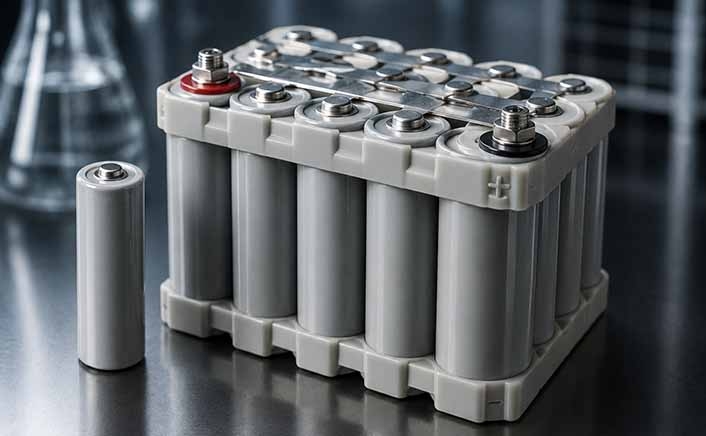
Not all backup power systems in modern AI data centers use lithium-ion batteries. Many still rely on nickel-cadmium technology—a chemistry that predates data centers but remains ideal for certain mission-critical applications. In 2025, the U.S. Market for Nickel-Cadmium Batteries reached 253 MWh and is expected to grow to 368 MWh by 2033, with a CAGR of 5.1%. Its market value is projected to increase to USD 226 million by 2033, with a CAGR of 5.4%. Although this growth is modest, it is notable given how dominant lithium-ion batteries have become in the overall battery industry.
Why This Old Chemistry Still Has a Job in 2033
This isn't about nostalgia — it's about specialized use. While lithium-ion batteries have become the standard for large-scale uninterruptible power supplies, nickel-cadmium (Ni-Cd) batteries still serve a crucial role in specific applications: switchgear, protection relays, emergency lighting, SCADA systems, generator start-up, and control monitoring. In these cases, reliability in harsh and sustained conditions is more important than energy density. Ni-Cd batteries are known for their ability to withstand wide temperature changes, handle frequent deep-discharge cycles, and last over 20 years with little performance loss — making them the practical choice for backup systems that can't afford to fail.
Access Full Report Here:https://marksparksolutions.com/reports/us-nickel-cadmium-battery-market
The AI Data Center Boom Is an Unexpected Tailwind
Here's a key connection often overlooked: as AI infrastructure expands to meet GPU and chip demands, the need for this long-standing battery chemistry also rises. As hyperscale, colocation, and enterprise data centers grow to support AI, cloud, and high-performance computing, operators rely on reliable backup power for auxiliary systems. Ni-Cd batteries remain a proven and trusted option for these subsystems, even in facilities where lithium-ion batteries handle the main UPS load.
In addition to new construction, there is substantial replacement demand. Many legacy data centers and utility-connected facilities across the U.S. still run Ni-Cd systems installed years or decades ago, and those installations are increasingly reaching end-of-life — creating steady retrofit and replacement demand independent of new data center construction entirely.
Download Free Sample Report Here:https://marksparksolutions.com/sample-reports?1030&Download_Free_Sample
What Size Battery Actually Wins in This Market
Capacity segmentation clearly shows where industrial demand is focused. The 100–500 Ah range holds the biggest market share, supporting utility substations, industrial UPS systems, data center control circuits, and telecommunications infrastructure—applications that prioritize durability over compactness.
The 50–100 Ah range is the second-largest segment, commonly used in commercial and military aircraft, railway signaling, and airport ground support equipment — all requiring a good balance of energy capacity, weight, and maintenance. Smaller 10–50 Ah batteries are typically installed in telecommunications cabinets and emergency lighting, especially in retrofit situations where matching existing systems is important. Although the Above 500 Ah category accounts for fewer shipments, it significantly impacts market revenue, as it is installed in power plants, nuclear facilities, and metro rail systems that demand long backup times and high operational reliability.
Pocket Plate Technology Leads for a Simple Reason: It Lasts
Pocket Plate Batteries are the most common type of battery construction, recognized for their outstanding durability and long lifespan in tough industrial environments. They are essential in sectors like electric utilities, transmission substations, railway signaling, and telecommunications, where reliable standby power is critical.
Sintered Plate Batteries rank second, catering to aerospace and defense markets. Their higher power density and compact form factor are ideal for commercial aircraft, military planes, and helicopters, where weight and quick power delivery are critical—unlike stationary utility substations. These batteries see consistent, predictable demand due to regular replacements aligned with aircraft maintenance schedules. Additionally, Fiber Plate and Plastic-Bonded Electrode batteries serve smaller, specialized sectors such as medical devices, portable industrial tools, and custom battery packs, where compactness and specific performance traits are more important than overall capacity.
A Market Driven by Performance Requirements, Not Price
A key observation across this market is that purchasing choices consistently prioritize performance and fit over cost. Industrial infrastructure operators opt for long-lasting pocket plate batteries because of their durability. In contrast, aviation and defense clients value the power density and reliability of sintered plate technology, especially during rapid discharge. Price considerations mainly drive neither segment. This focus on performance helps explain the market's steady, albeit modest, growth, despite lithium-ion batteries dominating broader industry attention and investment.
A Field of Established Industrial Battery Manufacturers
This market's competition is led by specialized industrial and aerospace battery manufacturers such as Saft Groupe, EnerSys, GS Yuasa Corporation, HBL Power Systems, Alcad AB, Power Sonic Corporation, Panasonic Holdings, VARTA AG, Cell-Con, MarathonNorco Aerospace, EaglePicher Technologies, and Ultralife Corporation. These companies focus on proven reliability and application-specific engineering, rather than just headline energy density figures.
What Comes Next
As more data centers are built and utilities upgrade grid connections for new AI-focused campuses, nickel-cadmium technology seems poised to keep its niche in critical infrastructure. It doesn't compete directly with lithium-ion batteries but remains essential for auxiliary and control power uses, thanks to its unique combination of durability and reliability that remains hard to match.
Data center operators, utilities, and industrial infrastructure buyers assessing backup power strategies can utilize Mark & Spark Solutions' comprehensive market study to access full capacity, technology options, and competitive segmentation.
Organizations focusing on particular applications, replacement cycle planning, or sourcing strategies for industrial batteries are encouraged to request a customized data excerpt that aligns with their strategic goals.
Media Contact
Company Name: Mark & Spark Solutions
Contact Person: Sushil
Email: Send Email
Phone: 9158340999
Address:2nd Floor, Panchsheel Park, Aundh
City: Pune
State: Maharashtra
Country: India
Website: https://marksparksolutions.com/reports/us-nickel-cadmium-battery-market