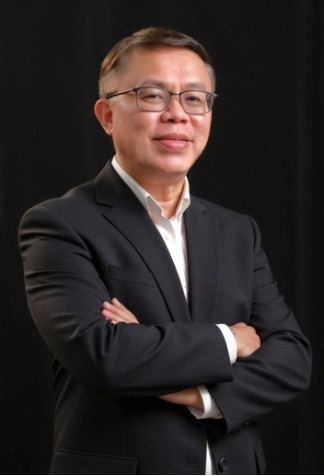
Singapore - November 17, 2026 - After decades in real estate, Roy Chang decided that conventional property analysis could not answer the question buyers most often skip: what is a property actually worth? So he built his own system.
Property investors have never had so much information. Transaction histories, neighbourhood data, rental yields, mortgage rates, development plans and market commentary are a few clicks away, and a buyer can compare several developments before visiting a single showroom.
Singapore property veteran Roy Chang doesn’t think that has solved one of the industry’s most important problems. Buyers still have to work out which numbers matter.
Over nearly three decades in Singapore real estate, and more than 20 years investing in property himself, Roy has built 26 proprietary financial calculators to answer questions he felt conventional analysis handled poorly. Five of them are built around the idea at the centre of his method: intrinsic value.
Roy does not treat the calculators as productivity tools, and they are not designed to forecast where the market goes next. They are his attempt to turn property investing into a disciplined, repeatable process driven by numbers, in a field where decisions often rest on stories, expectations and headline prices.
Behind all of it sits one question: what is this property actually worth?
The Problem With the Traditional Property Checklist
Most investors know the standard checklist. Is the location good? What infrastructure is planned nearby? Are new employment centres coming? How strong is rental demand? Who might buy the unit from you later? Can the rent cover the mortgage? Is the area being transformed?
Roy still asks many of these questions himself. Location, future demand, infrastructure, employment, rental conditions and the profile of the next buyer can all make a property more or less attractive.
His complaint is that they can leave the main question open: what is the property worth at the price being asked today?
A development with a strong location, a good transformation story and plenty of amenities can still be a poor investment if the buyer overpays. A large discount from the seller does not, by itself, make a property a good buy either.
Roy has said that mainstream property analysis, used on its own, gives him roughly 10 to 15 per cent of the picture he wants before he decides. The figure is his own estimate of how he works. He is not saying the usual indicators are only 10 to 15 per cent accurate, only that they are useful and incomplete.
What he finds missing is a disciplined link between the story told about a property and the numbers that decide whether the investment works.
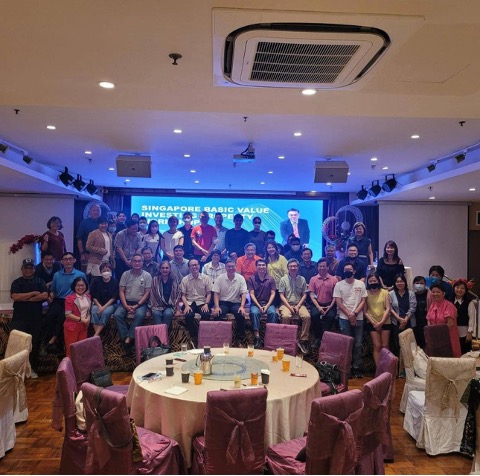
Roy Chang with participants at a value investing property workshop in Singapore. He still weighs location, infrastructure and rental demand, but argues these factors alone do not answer what a property is worth at today's price.
Why Roy Turned to Intrinsic Value
A case involving a client at The Icon shows why Roy stopped relying on any single market reference.
The client was considering a unit on the 34th floor priced at about S1,000persquarefoot.Roy’sonlytransactionreferenceatthetimecamefromalowerfloor,ataroundS850 psf. A banker he asked put the bank valuation at about S$930 psf. The figures were different but still fairly close.
Then Roy found that the developer was selling an almost identical unit on the 35th floor, one level up, at close to S$1,600 psf. By his account it had the same size, facing, layout and direction.
That gave him one reference near S850psf,abankvaluationaroundS930 psf, a seller asking about S1,000psfandadeveloperunitdirectlyabovepricedatclosetoS1,600 psf. Which of these was the unit’s actual value?
Roy did not simply pick one. He did his own calculation, which put the unit’s intrinsic value at around S$1,350 psf. The case showed him that a transaction price, a bank valuation and an asking price can each be useful and still point to very different conclusions.
A transaction tells an investor what someone paid before. A bank valuation is another reference, mainly for financing. An asking price is what the seller hopes to receive. None of them is automatically the property’s intrinsic value.
That gap mattered more and more to Roy. As well as asking what other people were paying, he wanted a process that could answer a harder question, in his words: “Based on the available evidence, what do I believe this property is actually worth?”
Six Prices, But Only One Decision
Roy’s method weighs six pricing references when he evaluates a property: recent transaction prices, historical price trends, the bank valuation, buyer price expectations, agent prices, and the prices of surrounding or comparable properties.
Each shows something different. Recent transactions show what buyers have actually paid, and historical trends show how prices got there. The bank valuation is an institutional reference. Buyer expectations hint at what the demand side may accept, agent prices reflect what sellers are asking, and comparable properties show where the unit sits in its local market.
Roy does not let any one of them settle the question. They are inputs to his intrinsic value method.
The formulas and weightings behind the calculators are proprietary and he does not publish them. The principle is simpler: anyone can see the price, but the value has to be calculated.
That changes how a buyer should think about negotiation. Say a seller asks S2millionandfinallyacceptsS1.85 million. The buyer may feel they have won a S$150,000 bargain.
Whether they have depends on the reference point. If the property’s calculated intrinsic value is S1.7million,payingS1.85 million still means paying above value. A discount from the seller’s price and a discount from intrinsic value are not necessarily the same thing, which is why Roy sees a good negotiation as only one part of buying well.

Roy Chang considers six pricing references, including recent transactions, bank valuations and agent prices, rather than treating any single figure as the answer.
Why Five Calculators Focus on Intrinsic Value
Five of Roy’s 26 proprietary financial calculators are designed around intrinsic value, which shows how much of his thinking now rests on valuation.
He does not present intrinsic value as a magic number that guarantees an investment will succeed. Markets can change after the calculation is done. Interest rates move, demand weakens, new supply appears, policies change, and a buyer’s own finances can shift without warning.
What intrinsic value gives Roy is a benchmark for judging an entry price. From there he looks at the margin between value and price.
When he teaches, he often uses buying at least S$200,000 below calculated intrinsic value as an example of the margin of safety he looks for, though the right margin depends on the property and the circumstances. The principle matters more than the exact figure.
If Roy calculates a property to be worth S2millionandthebuyergetsinatS1.8 million, there is about S200,000betweencalculatedvalueandentryprice.ThatisnotaguaranteedS200,000 profit, and it does not protect against a market decline. It means the buyer has created part of that gap at the point of purchase instead of relying entirely on the market to rise afterwards.
For Roy, this changes how risk is approached. The investor starts by checking whether the entry price leaves enough room against calculated value, before counting on any future gains.
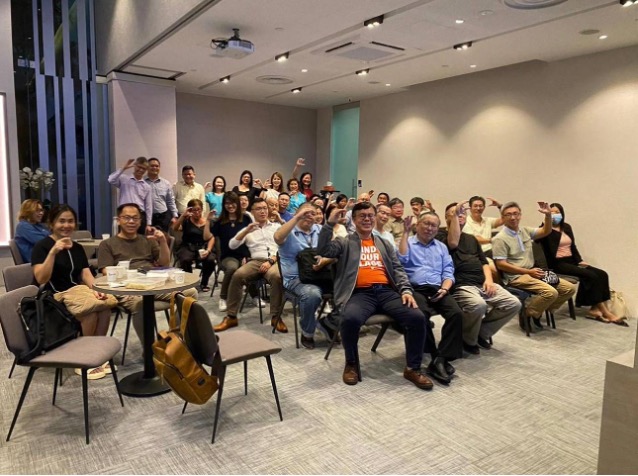
Roy Chang with a workshop audience. In his example, a property calculated at S2millionandboughtatS1.8 million leaves about S$200,000 between calculated value and entry price, a margin of safety rather than a guaranteed profit.
The Calculators Go Beyond Valuation
The number 26 tends to catch people’s attention, but what the calculators measure matters more than how many there are.
Roy’s wider system tests a property against three questions, grouped under what he calls the AIP Framework.
The first is Affordability: before thinking about returns, can the buyer safely afford the property? For Roy that is a different question from how much a bank will lend. A buyer can qualify for a loan and still be left with too little room if income falls, interest costs rise or family circumstances change.
The second is Intrinsic Value: what does his method calculate the property to be worth, and how does that compare with the proposed purchase price?
The third is Profitability: what does the investment look like once you count the costs that a simple comparison of purchase price and sale price leaves out? Stamp duties, financing costs, property tax, maintenance and selling costs can all affect the final result.
A property bought for S2millionandsoldlaterforS2.2 million appears to have made S$200,000, yet that headline gap is not necessarily the investor’s profit. Roy’s real calculation starts once the costs of buying, financing, holding and eventually selling are included.
At that point the method goes further than asking whether a property is likely to appreciate. It asks whether the whole financial structure of the property makes sense for this particular buyer.

Roy Chang with a class of property investors. His calculators sit within the AIP Framework, which asks whether a buyer can afford a property, what it is intrinsically worth and what remains after costs.
The Part No Calculator Can Ignore
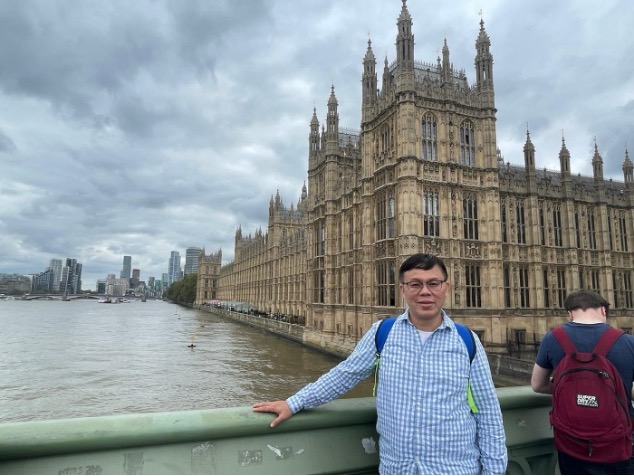
Roy Chang in London. He follows interest rates, housing policy and international developments because they shape the environment in which a property is bought, held and sold.
Roy’s method also looks beyond the property itself. A spreadsheet can analyse numbers, but those numbers sit inside a much larger economy.
Interest rates, financing conditions, housing policies, economic cycles, supply, employment and international developments can all change the conditions under which a property is bought, held and eventually sold.
Roy says that lesson took him years to learn. His academic background gave him a grounding in real estate, and living through major market cycles taught him the rest.
He began his career around the Asian Financial Crisis and later went through the Global Financial Crisis as an investor. During those periods of severe stress he saw how quickly confidence could change, and he sold in a panic himself.
Those years undermined the idea that property can be understood by running through a familiar checklist and assuming the future will behave like the recent past. They also changed what he wanted his analysis to answer.
He moved away from asking “What do I think the market will do next?” and towards “What would happen to this investment if my assumptions are wrong?” The first question demands a prediction and the second demands preparation. His calculators grew out of that search for greater clarity.
From Property Professional to Methodology Builder
Roy is careful about how he wants his work to be understood. His case rests on more than nearly three decades in property, because experience alone does not create a methodology.
What he has tried to do is take what he learned from formal real estate education, decades in the industry, more than 20 years of personal investing and repeated market cycles, and turn it into a process he can apply more consistently. The 26 calculators are the tangible result.
Five of them focus on intrinsic value, and the wider method connects valuation with affordability, costs, profitability and the conditions in which the investment is made.
This matters to Roy because two buyers can look at exactly the same property and face very different decisions. One may have plenty of liquidity, strong holding power and a long investment horizon, while the other is stretching to complete the purchase. The property is the same for both of them. The risk is not.
Entry price changes the picture as well. A development can have attractive fundamentals at S1.8millionandbemuchhardertojustifyatS2.2 million. The location, facilities and surrounding infrastructure stay the same, but the relationship between price and value has moved.
That is why Roy does not want the calculators read as a simple ranking system that labels developments good or bad. The aim is to understand the property, the price and the buyer together.
It is also why he thinks clarity should sometimes end in a decision not to buy. If the affordability numbers are uncomfortable, the gap to intrinsic value is unattractive, or the profit depends on too many things going right, walking away can be as deliberate a decision as buying. A method that always gave the same answer would offer little protection from the biases it was built to challenge.
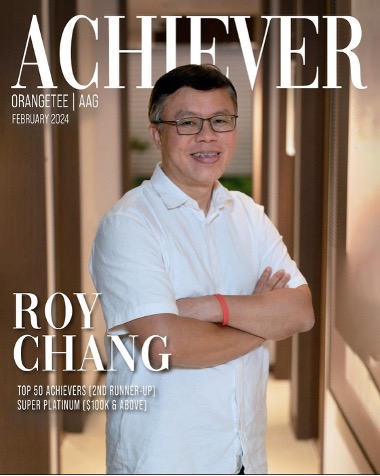
Roy Chang on the February 2024 cover of OrangeTee's Achiever, named 2nd runner up among its Top 50 Achievers. He sees his 26 calculators as the step that turned decades of experience into a repeatable method.
Why More Data Does Not Automatically Mean Better Decisions
Modern property investing has a paradox. Buyers can reach far more data than earlier generations could have imagined, and that same data makes it easier to confirm whatever they already want to believe.
A buyer excited about a development can find a favourable transaction. Someone convinced a neighbourhood will appreciate can find a positive infrastructure announcement, and an investor worried about the market can find a pessimistic forecast.
Finding information is no longer the hard part. Deciding how much weight each piece deserves is.
Roy believes this is where a repeatable method earns its place, because the same core questions get asked whichever property is being promoted. Can the buyer afford it? What is the property intrinsically worth? How does the proposed entry price compare with that value? What will ownership really cost? What has to hold true for the investment to become profitable, and what happens if some of those assumptions prove wrong?
The answers change from property to property and from buyer to buyer, but the questions stay the same. For Roy, asking them consistently is one way investors can limit the pull of emotion, urgency and persuasive market narratives.
The Goal Is Clarity
No calculator can remove uncertainty from property investing. Markets move, economic conditions and interest rates change, policies evolve, and buyers differ in income, responsibilities, time horizons and priorities.
Roy’s method does not remove those variables. It tries to bring more of them into view before a decision is made.
That may be the more interesting story behind the 26 calculators. Roy did not build them to produce a magic number telling investors what will happen next. He built them because decades inside the property market convinced him that a compelling story about a property is not enough, and investors still need to understand the numbers underneath it.
A beautiful showroom says nothing about whether the property is affordable. A transformation story says nothing about whether the entry price is below intrinsic value. A projected selling price says nothing about what the investor may keep after the costs of ownership, and a bank valuation, useful as it is, may not settle the whole question of value.
The calculators are Roy’s way of making those questions harder to ignore. He accepts that property investing will always carry uncertainty. His aim is to leave fewer important questions unanswered when a buyer finally decides to commit.
Among all the numbers he calculates, one question still sits at the centre of the method: what is this property actually worth? Knowing the price and understanding the value can lead to very different decisions, and Roy would rather buyers find that difference before they buy than after the market has made the decision for them.
Roy Chang
Founder & Chief Trainer, SPIN
About Singapore Property Investors Network (SPIN)
Singapore Property Investors Network (SPIN) is a trusted platform empowering property investors to build sustainable generational wealth through data-driven insights, expert consultations, and curated market opportunities. Founded by Roy Chang, the network serves over 550 investors with end-to-end property transactions, high-growth market analysis, and strategic portfolio guidance. For more information, visit spin.sg
Media Contact
Company Name: Singapore Property Investors Network
Contact Person: Roy Chang
Email: Send Email
Phone: +65 9389 1199
Address:430 Lorong 6 Toa Payoh #01-01 OrangeTee Building
City: Singapore 319402
State: Singapore
Country: Singapore
Website: www.spin.sg