Plenty of workers assume a fixed salary means no overtime. But the salary threshold for exempt employees doesn't decide the issue by itself. That's not how federal law works. A paycheck is just one piece of a multipart test, and it's the piece employers botch most often.
Most federal white-collar exemptions demand all of the following at the same time: a qualifying salary basis, pay above the applicable minimum, and executive, administrative, or professional duties that genuinely qualify. Miss even one and the exemption collapses. In 2026, the Department of Labor (DOL) applies a minimum of $684 per week, or $35,568 annually, under its 2019 rule after a federal court vacated the 2024 rule nationwide, as explained on its overtime rulemaking page.
How the salary threshold for exempt employees fits the federal test
Federal wage-and-overtime protections under the FLSA are codified in Title 29, Chapter 8 of the U.S. Code. For most white-collar exemptions, employers run three connected tests. The salary-basis test asks whether the pay is predetermined and generally safe from reductions tied to the quality or quantity of work. Then there's the salary-level test, which is simply the applicable minimum. Finally, the duties test examines your actual primary work, not what an offer letter promises.
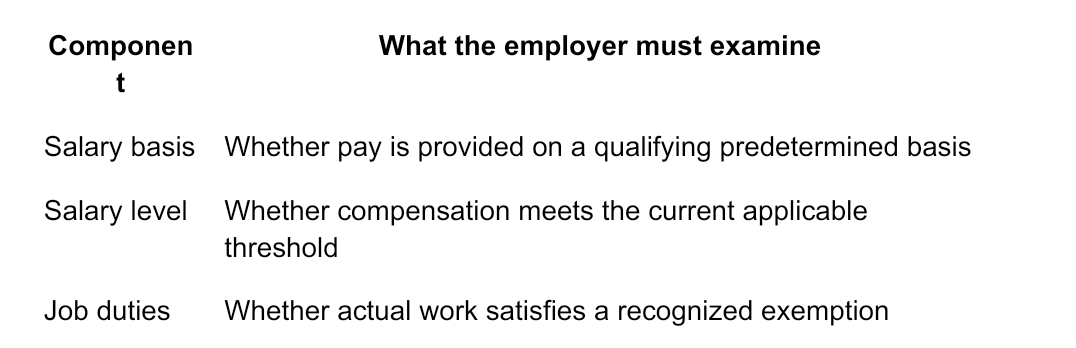
Clearing the federal minimum settles nothing. Salary alone never establishes exempt status. Every threshold change since 2020 has shifted the number employers must verify, and the salary threshold for exempt employees currently in force is the one that governs your classification. Check it. Then check your state's floor too.
Do salary or job duties matter more?
When an exemption requires both, neither can stand in for the other. A high salary won't paper over nonqualifying duties, and genuinely qualifying responsibilities can't rescue a failed pay requirement. Titles don't decide this either. Calling someone a "manager" doesn't make their primary duty management.
Some exemptions play by different rules altogether. Outside sales employees, for instance, skip the standard salary-level test.
What happens if a salaried employee works over 40 hours?
If you're a covered salaried nonexempt employee under the FLSA, overtime generally kicks in after 40 hours in a workweek, at one and one-half times the regular rate. Salary is a payment method. Exemption is what determines federal overtime eligibility.
The workweek is what counts, so averaging across a two-week pay period can't wipe out overtime owed in a particular week. How much you're owed depends on which hours the salary covers and which bonuses or other compensation have to be folded into the regular-rate calculation.
How federal and state overtime exemption rules interact
Employers must consider both systems. The rule providing greater employee protection generally controls. The Colorado Department of Labor and Employment lists a 2026 floor of $57,784 annually, or $1,111.23 weekly, for the principal executive, administrative, and professional exemptions, subject to the current state overtime order's coverage and exceptions.
You can satisfy the federal salary level yet fail Colorado's test. Check the department's current salary guidance for your occupation. That figure doesn't apply to every worker or every state.
Common questions about salaried overtime status
What does exempt mean for a salaried worker?
"Exempt" means you're excluded from specified FLSA overtime protections because you satisfy every requirement of an applicable exemption. A salary is just a pay arrangement.
What is the current federal exempt salary minimum in 2026?
The DOL's rulemaking notice confirms that the 2019-rule minimum remains applicable. The Eastern District of Texas vacated the 2024 rule nationwide on November 15, 2024, undoing its July 2024 increase to $844 weekly and its planned January 2025 increase to $1,128.
What does the highly compensated employee exemption require?
Under the restored federal rule in 2026, employees generally need $107,432 in total annual compensation, including the standard weekly salary or fee minimum, as well as office or nonmanual work and at least one qualifying white-collar duty. DOL Fact Sheet No. 17H says the employee must perform that duty customarily and regularly.
Can pay be reduced when an exempt employee works under 40 hours?
DOL Fact Sheet No. 17G says an exempt salaried employee generally receives the full salary for any week in which work is performed, regardless of hours, subject to permitted deductions. No salary is generally due for a full workweek in which no work is performed.
Verify the rule that applies to your work
Compare your pay structure and actual primary duties with current DOL guidance and your state labor agency's rules. If your classification remains unclear, preserve pay stubs, time records, job descriptions, and evidence of your actual responsibilities before seeking individualized advice about how the applicable exemption tests fit your work.