Have you ever wondered how a random video chat website manages to offer free conversations to thousands of users? Maintaining live video connections requires servers, bandwidth, security systems, and ongoing technical support. Yet many platforms allow visitors to start chatting without paying anything.
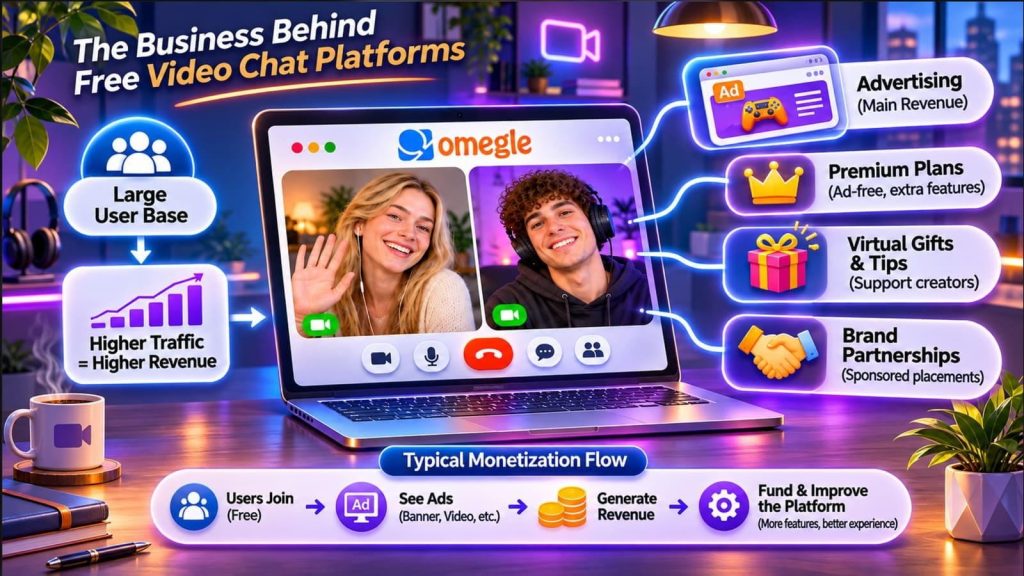
Behind these services is a business model designed to generate revenue while keeping the experience accessible. Advertising, premium memberships, virtual currencies, and other monetization strategies help operators cover expenses and support future development.
Why Free Video Chat Platforms Need Revenue
Running a video chat website involves considerably more than creating a page with camera and microphone buttons. The service needs infrastructure to connect users, manage conversations, process reports, and maintain reliable performance.
Many platforms use WebRTC to establish real-time communication between participants. Direct connections can reduce infrastructure requirements, but certain network conditions require TURN servers to relay audio and video traffic.
Relayed conversations consume bandwidth, creating expenses that increase with usage. Operators must also account for hosting, maintenance, customer support, software development, and moderation.
Advertising: The Foundation of Many Free Chat Services
Advertising is one possible way for websites to earn money without charging every visitor. Businesses pay to display promotional content, allowing publishers to generate income from their audience.
Random video chat websites may display advertisements on homepages, informational articles, or other suitable sections of their platforms. Revenue depends on factors such as visitor location, advertising demand, impressions, and engagement.
For example, a website attracting substantial search traffic might monetize its educational content while keeping the actual chatting interface free from advertisements.
How Premium Subscriptions Create Additional Income
Some video chat companies use a freemium model, providing basic conversations without payment while charging for optional enhancements.
Azar, for instance, offers free basic video matching alongside subscriptions that unlock certain gender and regional preferences. This demonstrates how an operator can maintain an accessible service while earning revenue from users seeking greater control. <Cite ref=”turn488719search13″/>
Subscriptions also offer the potential for recurring income. Unlike advertising revenue, which can fluctuate with traffic and market conditions, membership payments may provide a more predictable financial foundation.
Virtual Coins and Pay-As-You-Go Features
Not every visitor wants to purchase a monthly subscription. Some platforms therefore offer virtual currencies that users can purchase and spend on selected features.
These systems may support premium matching, digital gifts, paid calling time, or other optional interactions. Users can purchase smaller amounts without committing to ongoing payments.
However, pricing should remain transparent. Hidden deductions, confusing currency conversions, or unexpected renewal charges can quickly damage customer confidence.
The Economics of Keeping Conversations Free
A central challenge for video chat businesses is balancing revenue against operating expenses. Attracting more visitors may increase advertising income, but it can also increase infrastructure and moderation costs.
Consider a hypothetical platform generating one million advertisement impressions per month. At an effective revenue rate of $2 per thousand impressions, its gross advertising revenue would be approximately $2,000.
The profitability of any platform depends on its traffic quality, advertising rates, paying customer percentage, bandwidth consumption, and operational efficiency.
How Omegle Influenced the Free Chat Market
The original Omegle demonstrated the widespread appeal of connecting strangers through a simple online interface. Before closing in November 2023, it helped establish spontaneous conversations as a recognizable form of internet entertainment.
Its influence continues across websites offering similar communication experiences. People interested in random chatting may discover services such as OmegleTV while exploring alternatives for meeting unfamiliar people online.
However, not every Omegle-style service uses the same business model. Some rely on advertisements, others introduce optional purchases, and certain platforms combine multiple revenue sources.
Why User Safety Is Also a Business Expense
Moderation is not simply a technical feature; it is an ongoing operational responsibility. Platforms connecting strangers must address harassment, inappropriate content, scams, and other behavior that may discourage participation.
Maintaining reporting systems, reviewing complaints, and enforcing community guidelines requires resources. Some companies combine automated detection tools with human moderation to manage these responsibilities.
Poor moderation can also affect monetization. Google’s advertising policies require publishers to address policy-violating user-generated content appearing alongside advertisements. <Cite refs={[“turn488719search0″,”turn488719search9”]}/>
Why Retaining Users Matters More Than Attracting Clicks
A website that receives thousands of new visitors but fails to retain them may struggle to develop stable revenue.
Returning users generate additional opportunities for advertising impressions, subscription conversions, and community growth. However, retention depends on more than aggressive promotion.
Excessive advertising can have the opposite effect. Interrupting conversations with intrusive promotional content may frustrate visitors and reduce engagement.
Successful monetization therefore requires understanding the difference between maximizing immediate revenue and building lasting user satisfaction.
Building a Sustainable Future for Free Video Chat
The business behind free video chat platforms involves balancing several competing priorities. Operators must generate enough income to maintain infrastructure while keeping conversations convenient, affordable, and enjoyable.
Advertising can support free access, premium subscriptions offer recurring revenue, and optional purchases provide additional flexibility. Each strategy has advantages, but none guarantees commercial success.
Ultimately, the strongest business model is not necessarily the one that charges users the most. It is the one that creates enough value for people to continue using the service while generating sufficient revenue to keep it operating.