Agricultural and farm machinery company Lindsay (NYSE: LNN) reported revenue ahead of Wall Street’s expectations in calendar Q3 2026 (fiscal Q4 2026), with sales up 5.2% year on year to $161.6 million. Its GAAP profit of $1.10 per share was 11.9% above analysts’ consensus estimates.
Is now the time to buy Lindsay? Find out by accessing our full research report, it’s free.
Lindsay (LNN) Q3 CY2026 highlights:
- Revenue: $161.6 million vs analyst estimates of $150.6 million (5.2% year-on-year growth, 7.3% beat)
- EPS (GAAP): $1.10 vs analyst estimates of $0.98 (11.9% beat)
- Operating Margin: 9.8%, up from 7.4% in the same quarter last year
- Free Cash Flow Margin: 24.5%, down from 32.4% in the same quarter last year
- Market Capitalization: $1.08 billion
Mr. Wood continued, "I'm pleased with the dedication and resiliency of our global team as we continue to demonstrate strong execution despite a volatile macro-economic environment. During the quarter, we took additional actions to better align our cost structure with current market demand and support margins. In June, we implemented a global restructuring that reduced our workforce, which we expect to generate approximately $8.0 million of net annualized savings. We remain focused on strengthening our operating performance, while investing in opportunities that support sustainable, long-term shareholder value creation. In fiscal 2026, we returned $96.1 million to shareholders through share repurchases and dividends, while also funding the largest capital investment in our history at our Lindsay, Nebraska facility. During the year, we announced a new share repurchase authorization of $150.0 million, of which $100.0 million remained available at the end of the fiscal year."
Company overview
A pioneer in the field of center pivot and lateral move irrigation, Lindsay (NYSE: LNN) provides a variety of proprietary water management and road infrastructure products and services.
Revenue growth
Examining a company’s long-term performance can provide clues about its quality. Even a bad business can shine for one or two quarters, but a top-tier one grows for years. Over the last five years, Lindsay grew its sales at a sluggish 2.3% compounded annual growth rate. This fell short of our benchmarks and is a tough starting point for our analysis.
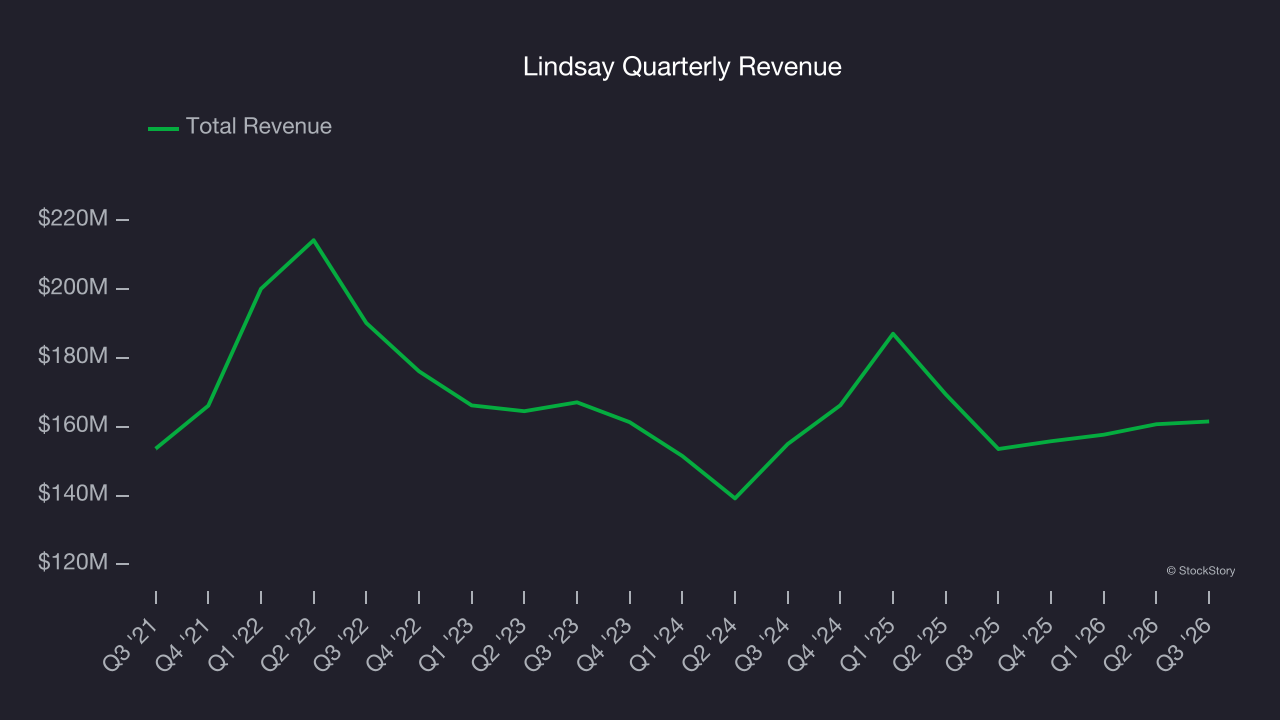
We at StockStory place the most emphasis on long-term growth, but within industrials, a half-decade historical view may miss cycles, industry trends, or a company capitalizing on catalysts such as a new contract win or a successful product line. Lindsay’s annualized revenue growth of 2.3% over the last two years aligns with its five-year trend, suggesting its demand was consistently weak. 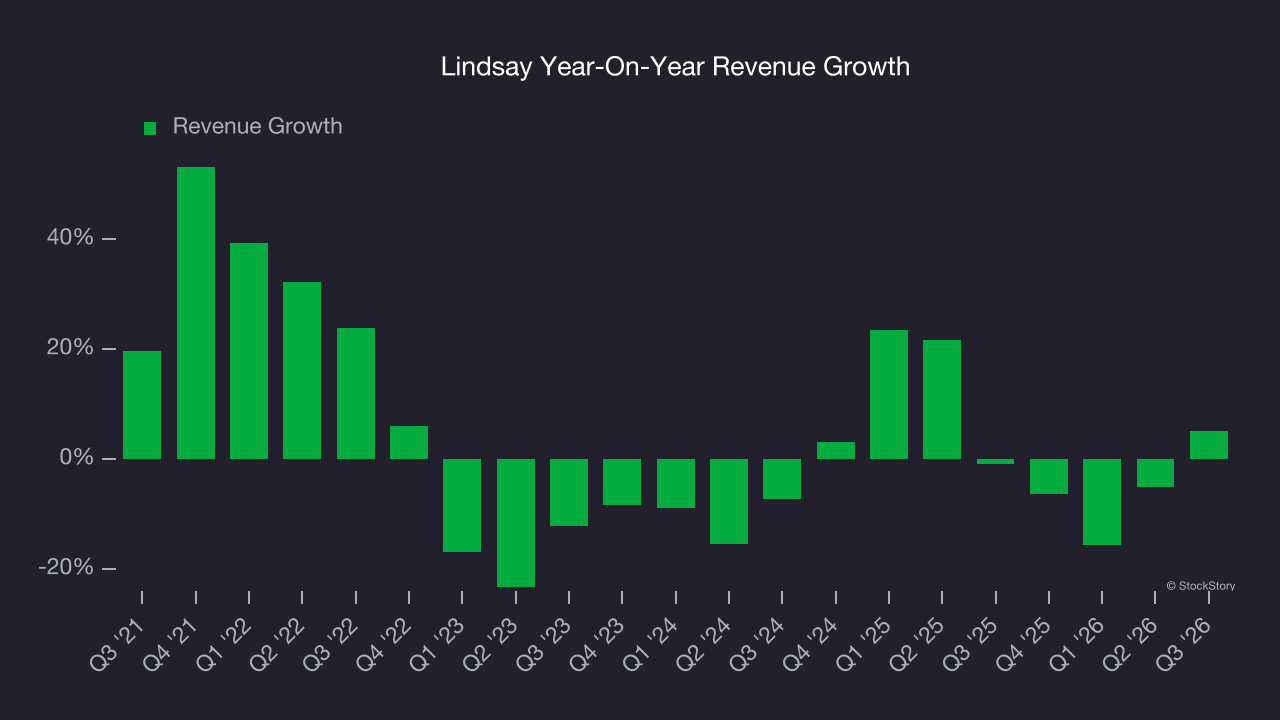
This quarter, Lindsay reported year-on-year revenue growth of 5.2%, and its $161.6 million of revenue exceeded Wall Street’s estimates by 7.3%.
Looking ahead, sell-side analysts expect revenue to remain flat over the next 12 months, a slight deceleration versus the last two years. This projection is underwhelming and suggests its products and services will face some demand challenges.
ALSO WORTH WATCHING: Nvidia’s Quiet Partner. Nvidia’s chips cost a hundred grand. The connectors that make them work cost even more. One company makes them all.
Every AI server needs specialized infrastructure the chip companies don’t make. High-speed cables. Power connectors. Thermal sensors. This 90-year-old company built a monopoly on it. The AI boom just started. This stock is still flying under the radar. Claim The Stock Ticker Here for FREE.
Operating margin
Operating margin is a key measure of profitability. Think of it as net income - the bottom line - excluding the impact of taxes and interest on debt, which are less connected to business fundamentals.
Lindsay has been an efficient company over the last five years. It was one of the more profitable businesses in the industrials sector, boasting an average operating margin of 12.7%. This result was particularly impressive because of its low gross margin, which is mostly a factor of what it sells and takes huge shifts to move meaningfully. Companies have more control over their operating margins, and it’s a show of well-managed operations if they’re high when gross margins are low.
Looking at the trend in its profitability, Lindsay’s operating margin decreased by 1.8 percentage points over the last five years. This raises questions about the company’s expense base because its revenue growth should have given it leverage on its fixed costs, resulting in better economies of scale and profitability.
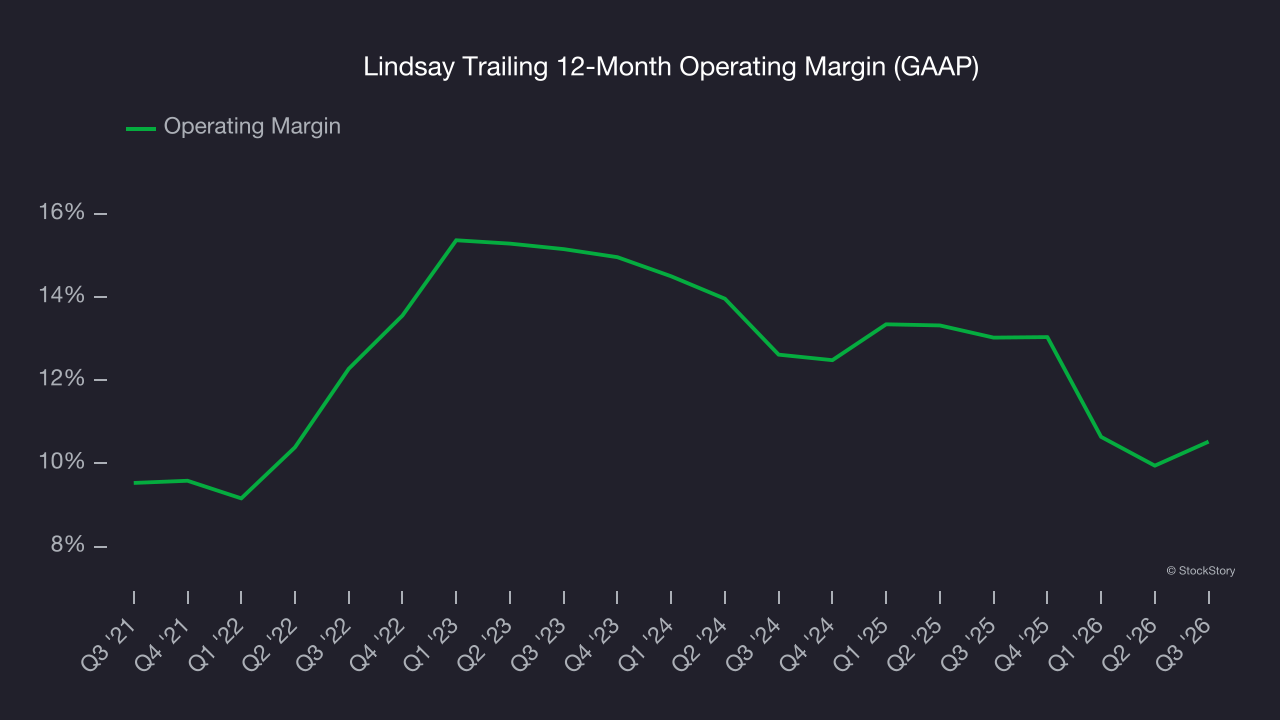
In Q3, Lindsay generated an operating margin profit margin of 9.8%, up 2.4 percentage points year on year. The increase was encouraging, and because its gross margin actually decreased, we can assume it was more efficient because its operating expenses like marketing, R&D, and administrative overhead grew slower than its revenue.
Earnings per share
We track the long-term change in earnings per share (EPS) for the same reason as long-term revenue growth. Compared to revenue, however, EPS highlights whether a company’s growth is profitable.
Lindsay’s EPS grew at 6.6% compounded annual growth rate over the last five years. On the bright side, this performance was better than its 2.3% annualized revenue growth and tells us the company became more profitable on a per-share basis as it expanded.
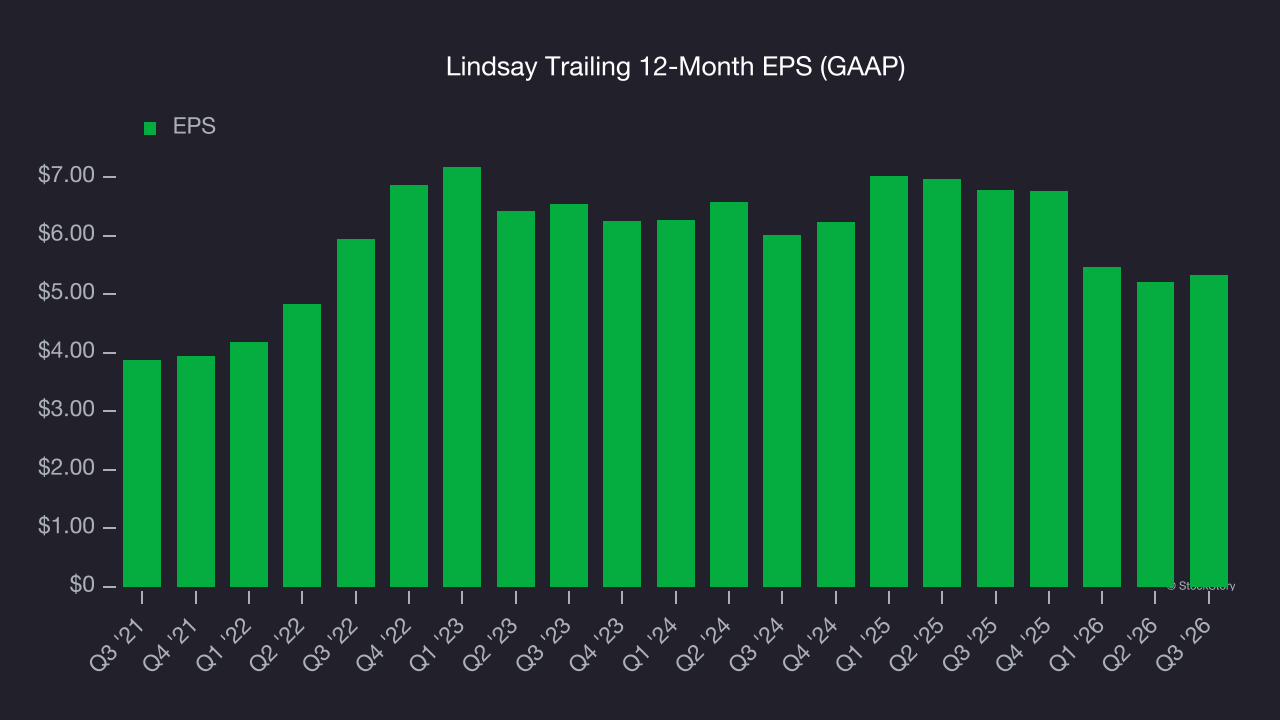
Diving into the nuances of Lindsay’s earnings can give us a better understanding of its performance. A five-year view shows that Lindsay has repurchased its stock, shrinking its share count by 7.4%. This tells us its EPS outperformed its revenue not because of increased operational efficiency but financial engineering, as buybacks boost per share earnings. 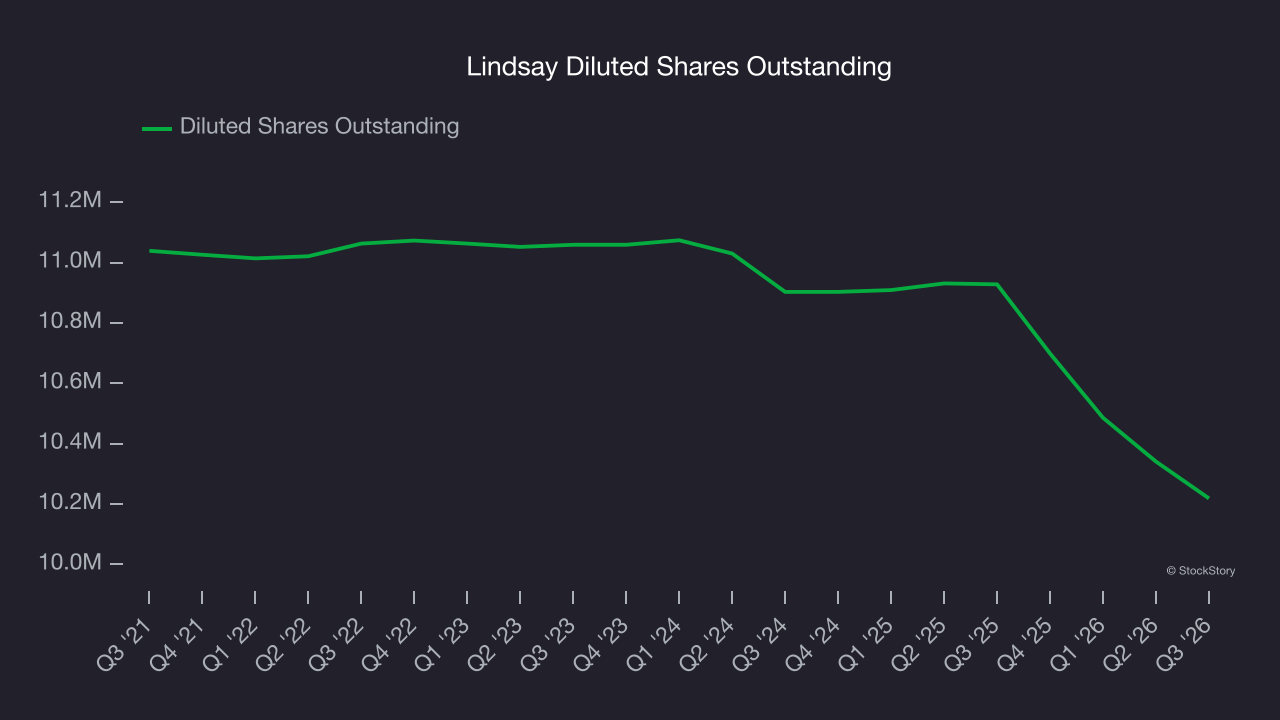
Like with revenue, we analyze EPS over a more recent period because it can provide insight into an emerging theme or development for the business.
For Lindsay, its two-year annual EPS declines of 5.9% show it’s continued to underperform. These results were bad no matter how you slice the data.
In Q3, Lindsay reported EPS of $1.10, up from $0.99 in the same quarter last year. This print easily cleared analysts’ estimates, and shareholders should be content with the results. Over the next 12 months, Wall Street expects Lindsay’s full-year EPS to grow 8.6% from $5.32 to $5.78.
Key takeaways from Lindsay’s Q3 results
We were impressed by how significantly Lindsay blew past analysts’ revenue expectations this quarter. We were also glad its EPS outperformed Wall Street’s estimates. Zooming out, we think this was a solid print. The stock remained flat at $106.50 immediately after reporting.
So should you invest in Lindsay right now? If you’re making that decision, you should consider the bigger picture of valuation, business qualities, as well as the latest earnings. We cover that in our actionable full research report which you can read here (it’s free).