Clinical research company IQVIA (NYSE: IQV) reported Q3 2026 results exceeding the market’s revenue expectations, with revenue up 8% year on year to $4.43 billion. The company expects the full year’s revenue to be around $17.43 billion, close to analysts’ consensus estimates. Its non-GAAP profit of $3.34 per share was 2% above analysts’ consensus estimates.
For more on IQVIA, read our free full research report.
IQVIA (IQV) Q3 2026 highlights:
- Revenue $4.43 billion vs S&P analysts’ consensus estimates of $4.36 billion (8% year-on-year growth, 1.5% beat)
- Adjusted EPS $3.34 vs S&P analysts’ consensus estimates of $3.28 (2% beat)
- Adjusted EBITDA $1.03 billion vs analysts’ consensus estimates of $1.02 billion (23.3% margin, 1.6% beat)
- Revenue guidance The company slightly lifted its revenue guidance for the full year to $17.43 billion at the midpoint from $17.38 billion
- Adjusted EPS guidance Management slightly raised its full-year adjusted EPS guidance to $12.95 at the midpoint
- EBITDA guidance $4.04 billion at the midpoint for the full year, in line with analysts’ consensus estimates
- Operating margin 12.9%, in line with the same quarter last year
- Free cash flow margin 15.1%, down from 18.8% in the same quarter last year
- Constant currency revenue rose 8.6% year on year (3.9% in the same quarter last year)
- Market capitalization $45.03 billion
Third-Quarter 2026 Operating Results "IQVIA delivered another record quarter, with revenue, Adjusted EBITDA and Adjusted Diluted EPS all exceeding the high end of our expectations," said Ari Bousbib, chairman and CEO of IQVIA. "Multiple demand indicators continue to validate the strengthening market environment. EBP funding, RFP flow, clinical trial starts, FDA approvals, outsourcing trends, and pipeline growth across clinical and commercial are all favorable. At the same time, the team's ongoing excellent execution delivered margin expansion, strong free cash flow, higher win rates that resulted in our strongest clinical quarterly bookings since 2022, increased penetration of AI-powered solutions with over 400 AI agents deployed to date, and organic growth acceleration year-over-year to double the rate for commercial and nearly triple the rate for clinical."
Revenue growth
A company’s long-term performance is an indicator of its overall quality. Any business can have short-term success, but a top-tier one grows for years. Over the last five years, IQVIA grew its revenue at a mediocre 5% compounded annual growth rate, falling short of the healthcare sector benchmark.
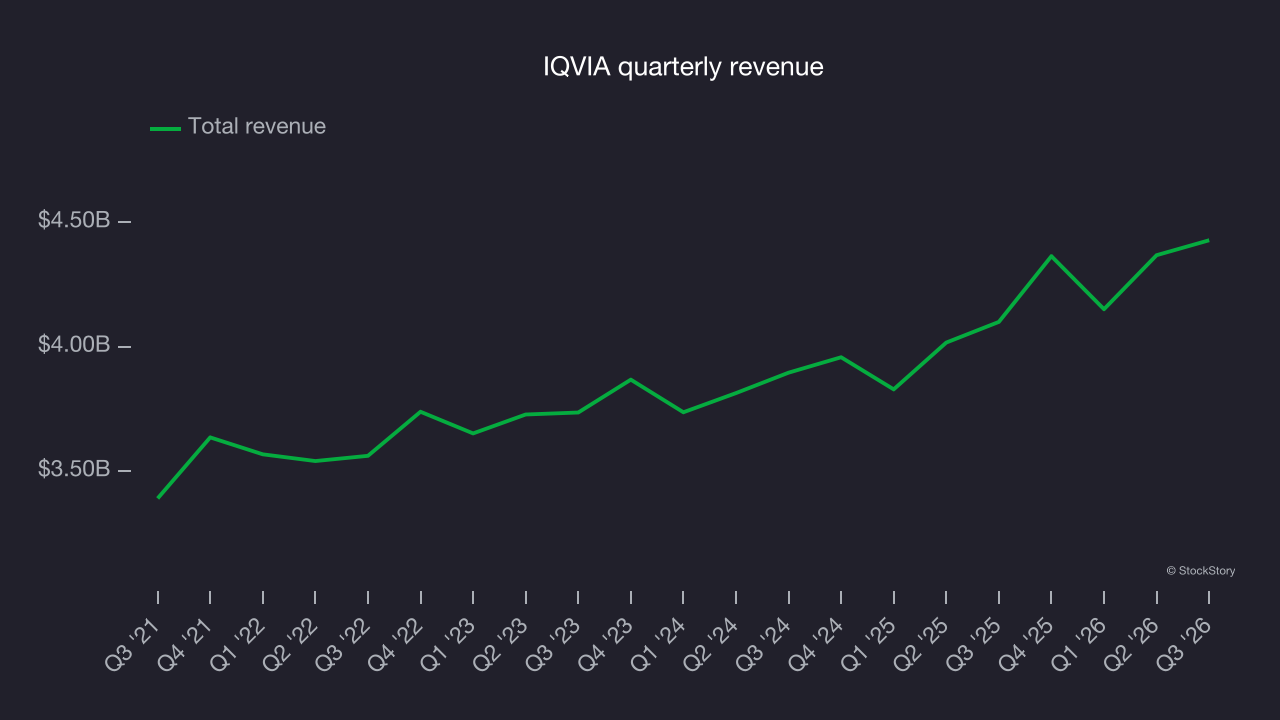
Long-term growth matters most, but within healthcare, a half-decade historical view may miss recent innovations or disruptive industry trends. IQVIA’s annualized revenue growth of 6.3% over the last two years is above its five-year trend, a positive development. 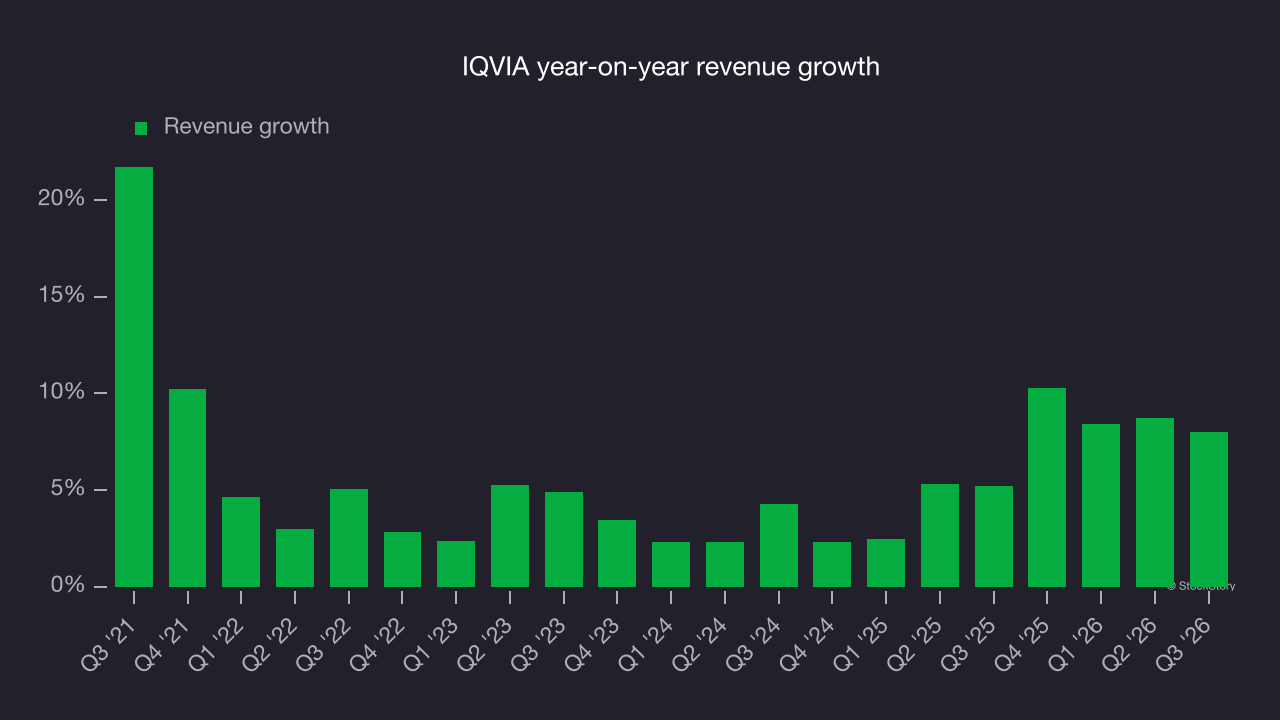
Constant currency revenue offers a closer look at the company’s revenue dynamics by excluding currency movements that are outside its control and not indicative of demand. Over the last two years, its constant currency revenue averaged 5.6% year-on-year growth. This was in line with reported revenue growth, indicating that foreign exchange has not had a meaningful impact on revenue. 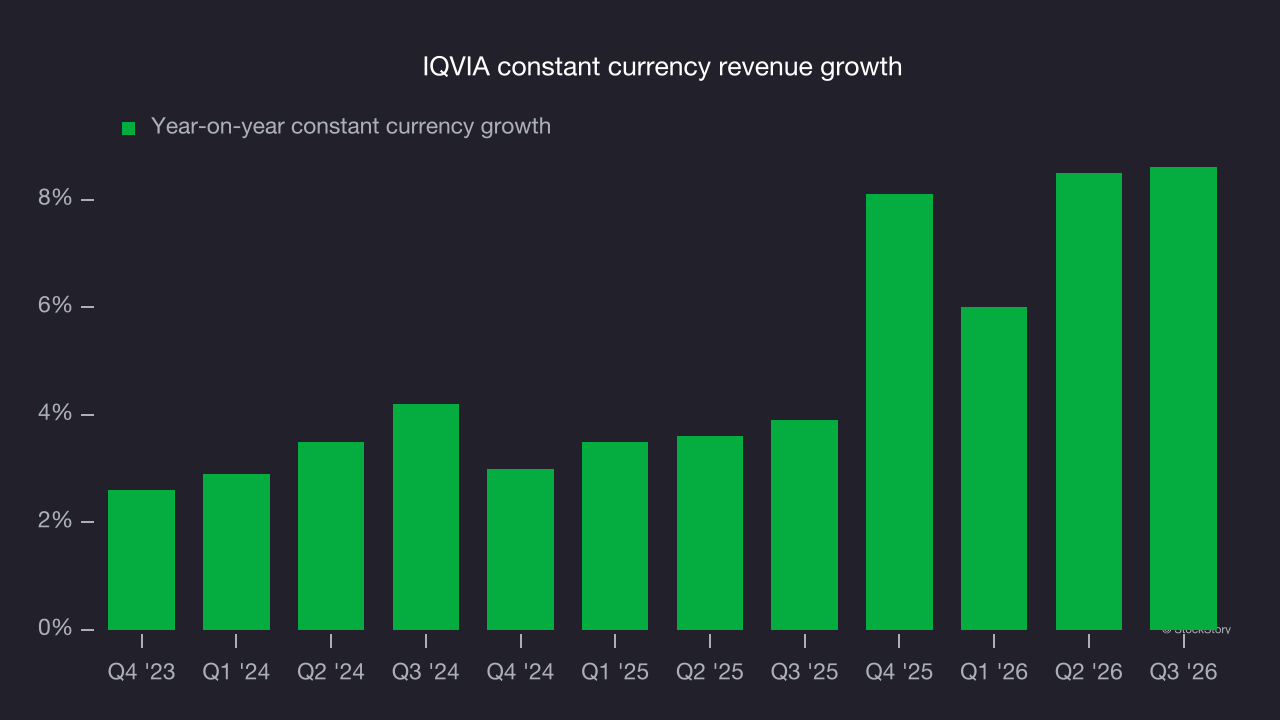
This quarter, IQVIA reported year-on-year revenue growth of 8%, and its $4.43 billion of revenue exceeded Wall Street’s consensus estimates by 1.5%.
Looking ahead, sell-side analysts expect revenue to grow 4.9% over the next 12 months, according to S&P, similar to its two-year rate. This underwhelming projection implies its products and services will face some demand headwinds.
Adjusted operating margin
Adjusted operating margin is a key measure of profitability. Think of it as net income (the bottom line) excluding the impact of non-recurring expenses, taxes and interest on debt – metrics less connected to business fundamentals.
IQVIA has managed its cost base well over the last five years. It demonstrated solid profitability for a healthcare business, producing an average adjusted operating margin of 18.3%.
Looking at the trend in its profitability, IQVIA’s adjusted operating margin rose by 1.2 percentage points over the last five years, as its revenue growth gave it operating leverage. More recently, however, the company’s margin has decreased by 1.8 percentage points on a two-year basis. To meet the standard, IQVIA must show it can expand profitability consistently.
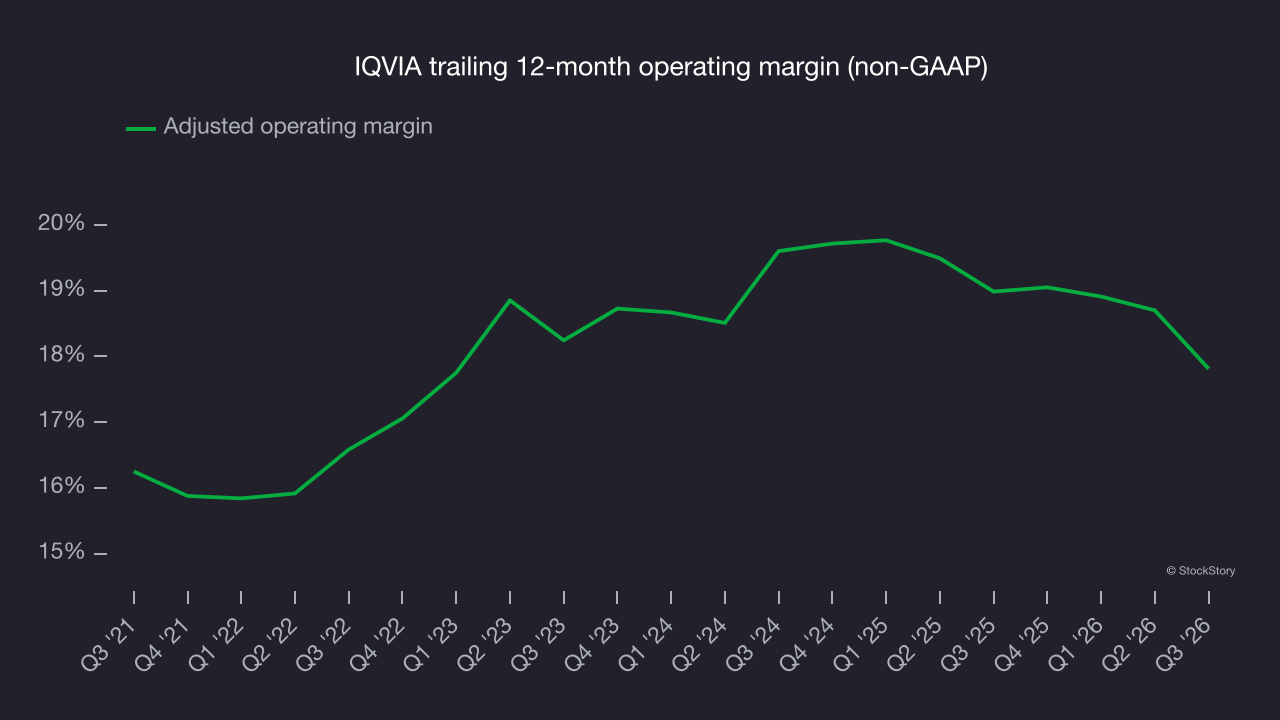
In Q3, IQVIA generated an adjusted operating margin of 14.8%, down 3.4 percentage points year on year. This contraction shows it was less efficient because its expenses grew faster than its revenue.
Earnings per share
Revenue trends explain a company’s historical growth, but the long-term change in earnings per share (EPS) points to the profitability of that growth. For example, a company could inflate its revenue through excessive spending on advertising and promotions.
IQVIA’s EPS grew at an 8.3% compounded annual growth rate over the last five years, higher than its 5% annualized revenue growth. This indicates the company became more profitable on a per-share basis as it expanded.
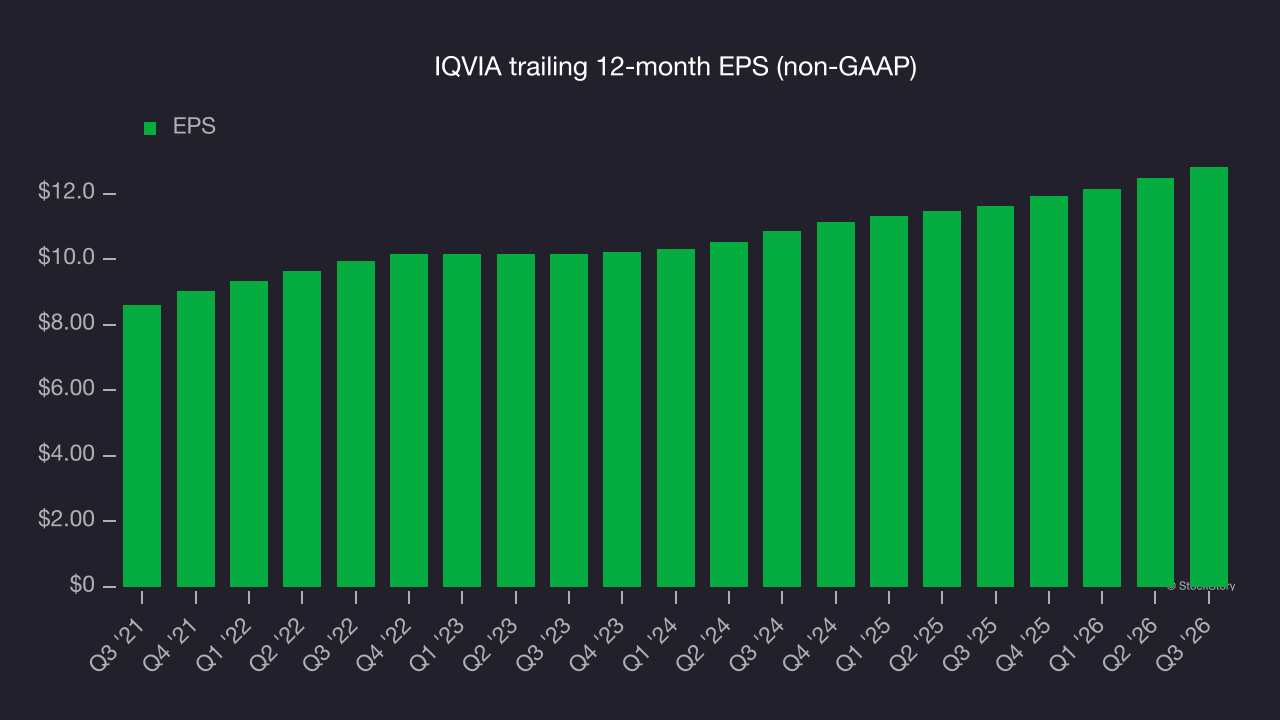
A closer look at IQVIA’s earnings helps explain the drivers of its performance. As mentioned earlier, IQVIA’s adjusted operating margin declined this quarter but expanded by 1.2 percentage points over the last five years. Its share count also shrank by 14.5%, and these factors together are positive signs for shareholders because improving profitability and share buybacks boost EPS growth relative to revenue growth. 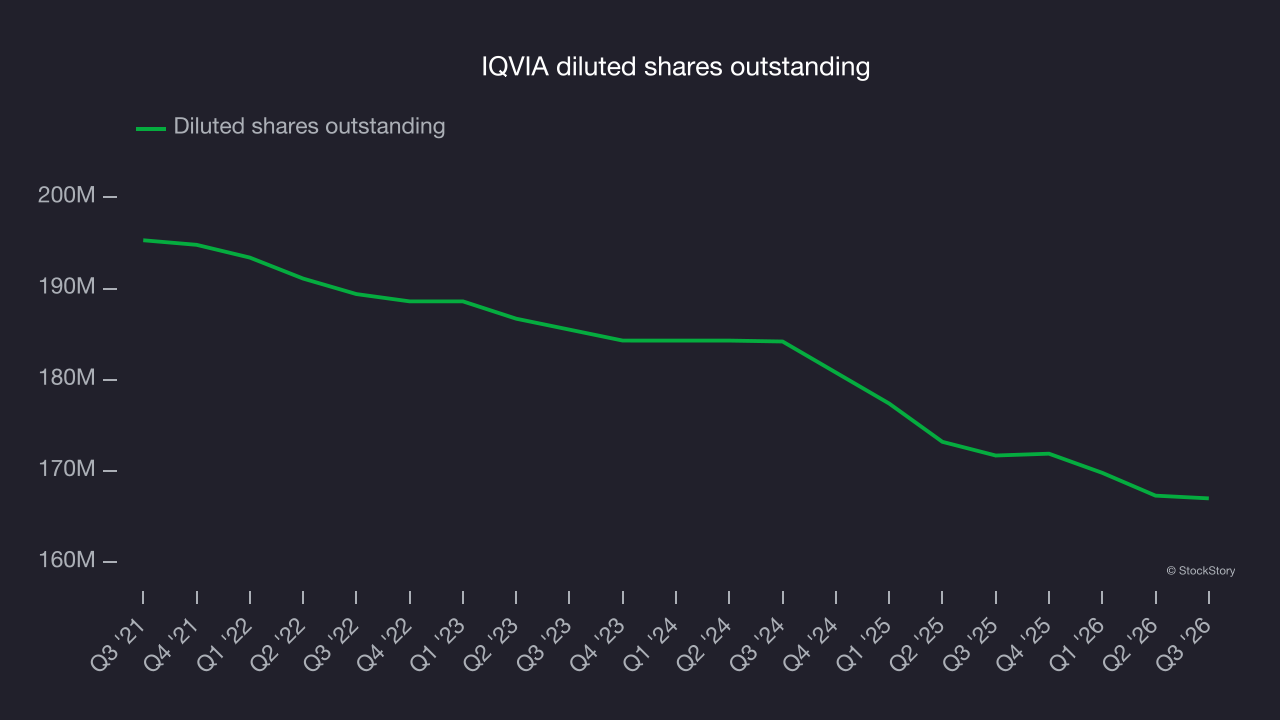
In Q3, IQVIA reported adjusted EPS of $3.34, up from $3 in the same quarter last year. This result beat analysts’ consensus estimates by 2%. Over the next 12 months, Wall Street expects IQVIA’s full-year EPS to grow 9.2% from $12.81 to $13.98, according to S&P.
Key takeaways from IQVIA’s Q3 results
IQVIA’s narrow revenue beat against analysts’ consensus estimates made for a decent quarter. Shares rose 3.1% to $281.96 immediately after the results.
When deciding whether to buy the stock, consider the bigger picture of valuation, business quality and the latest earnings. Read our full research report here (it’s free).