Quarterly earnings results are a good time to check in on a company’s progress, especially compared to its peers in the same sector. Today we are looking at Evercore (NYSE: EVR) and the best and worst performers in the investment banking & brokerage industry.
Investment banks and brokerages facilitate capital raises, mergers and acquisitions, and securities trading. The sector benefits from corporate activity during economic expansion, increased retail trading participation, and advisory opportunities in emerging sectors. Headwinds include economic cycle vulnerability affecting deal flow, compressed trading commissions due to electronic platforms, and regulatory capital requirements constraining certain higher-risk activities.
The 15 investment banking & brokerage stocks we track reported a strong Q2. As a group, revenues beat analysts’ consensus estimates by 4.8% while next quarter’s revenue guidance was 1.1% below.
Amidst this news, share prices of the companies have had a rough stretch. On average, they are down 11.1% since the latest earnings results.
Evercore (NYSE: EVR)
Founded in 1995 as a boutique advisory firm focused on independence and client trust, Evercore (NYSE: EVR) is an independent investment banking firm that provides strategic advisory, capital markets, and wealth management services to corporations, financial sponsors, and high-net-worth individuals.
Evercore reported revenues of $999.5 million, up 19.2% year on year. This print exceeded analysts’ expectations by 1%. Despite the top-line beat, it was still a mixed quarter for the company.
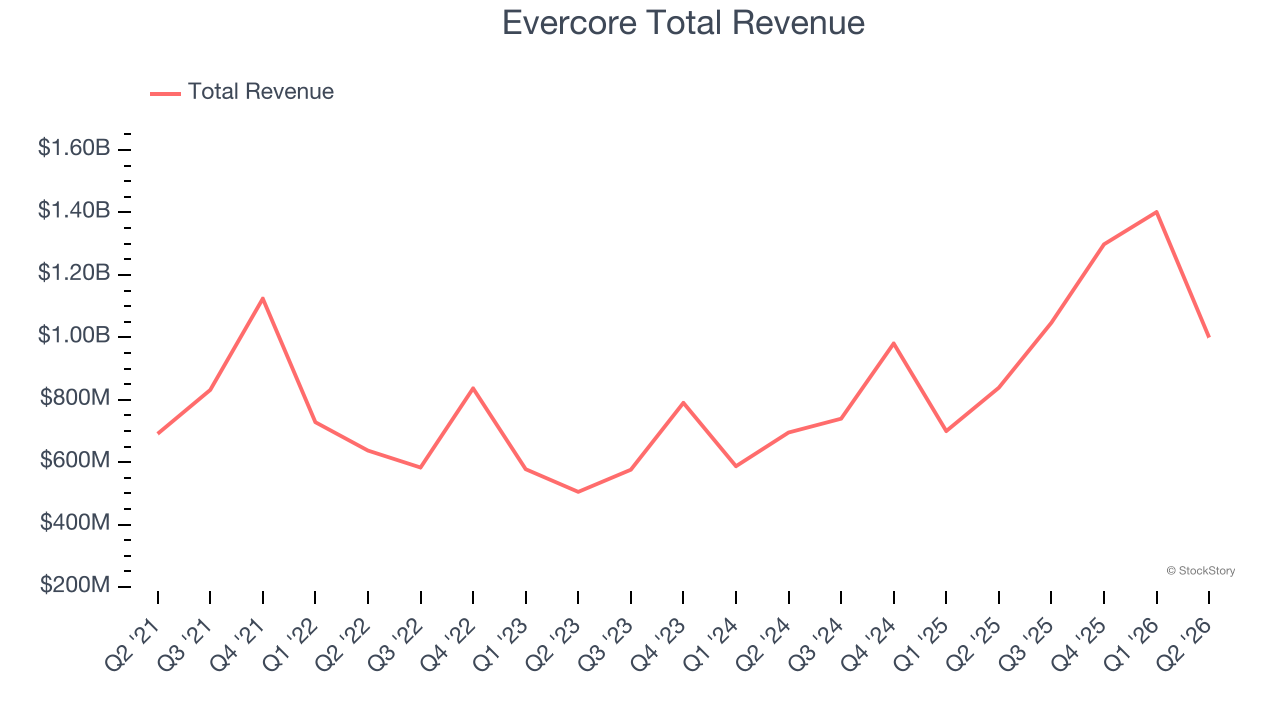
The market seems disappointed with the results as the stock is down 22.7% since reporting and currently trades at $263.05.
Is now the time to buy Evercore? Access our full analysis of the earnings results here, it’s free.
Best Q2: Goldman Sachs (NYSE: GS)
Founded in 1869 as a small commercial paper business in New York City, Goldman Sachs (NYSE: GS) is a global financial institution that provides investment banking, securities, asset management, and consumer banking services to corporations, governments, and individuals.
Goldman Sachs reported revenues of $20.34 billion, up 39.5% year on year, outperforming analysts’ expectations by 23.7%. The business had an incredible quarter with a beat of analysts’ EPS estimates and a solid beat of analysts’ Banking & Markets segment estimates.
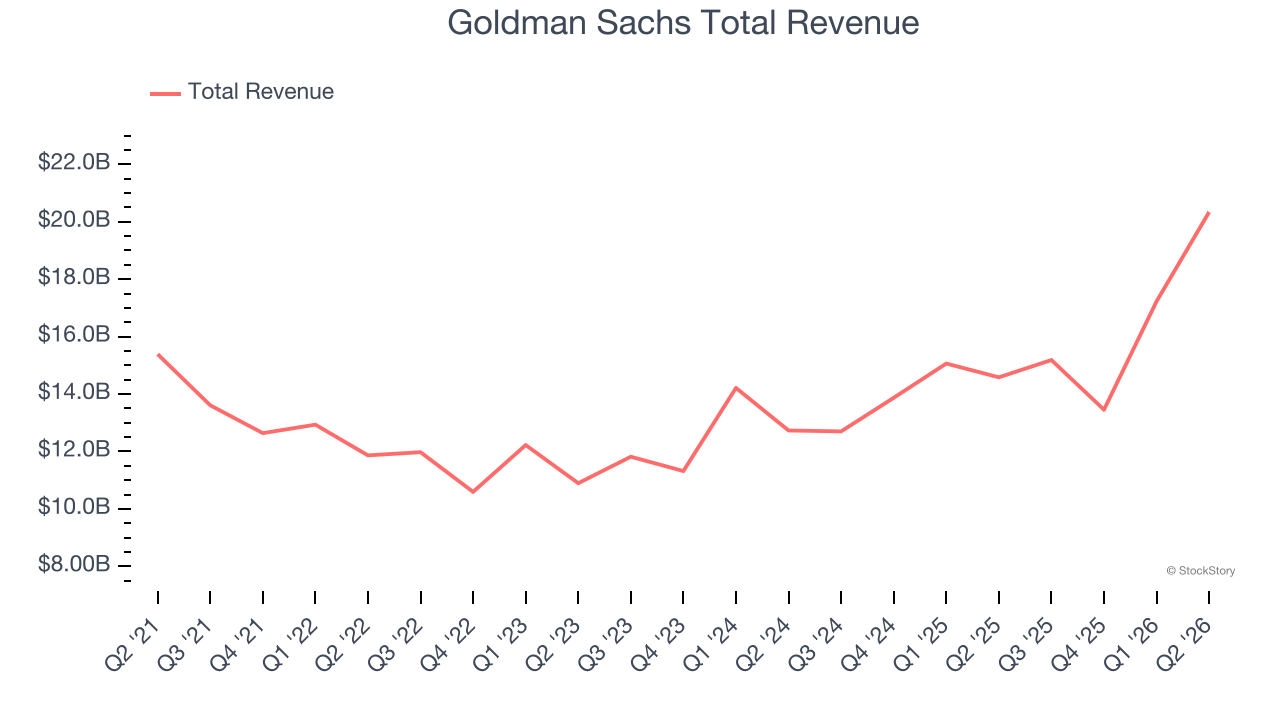
Goldman Sachs achieved the biggest analyst estimate beat and fastest revenue growth among its peers. Although it had a fine quarter compared to its peers, the market seems unhappy with the results as the stock is down 15.1% since reporting. It currently trades at $887.88.
Is now the time to buy Goldman Sachs? Access our full analysis of the earnings results here, it’s free.
Weakest Q2: Houlihan Lokey (NYSE: HLI)
Founded in 1972 and known for its expertise in complex financial situations, Houlihan Lokey (NYSE: HLI) is a global investment bank specializing in mergers and acquisitions, capital markets, financial restructurings, and valuation advisory services.
Houlihan Lokey reported revenues of $511 million, down 15.6% year on year, falling short of analysts’ expectations by 16.3%. It was a disappointing quarter as it posted a significant miss of analysts’ EBITDA estimates and a significant miss of analysts’ EPS estimates.
Houlihan Lokey delivered the weakest performance against analyst estimates and slowest revenue growth in the group. As expected, the stock is down 11.5% since the results and currently trades at $123.04.
Read our full analysis of Houlihan Lokey’s results here.
Raymond James (NYSE: RJF)
Founded in 1962 and headquartered in St. Petersburg, Florida, Raymond James Financial (NYSE: RJF) is a diversified financial services company that provides wealth management, investment banking, asset management, and banking services to individuals and institutions.
Raymond James reported revenues of $3.93 billion, up 15.6% year on year. This result surpassed analysts’ expectations by 1.4%. It was a strong quarter as it also logged an impressive beat of analysts’ AUM estimates and a beat of analysts’ EPS estimates.
The stock is down 6.4% since reporting and currently trades at $157.23.
Read our full, actionable report on Raymond James here, it’s free.
PJT (NYSE: PJT)
Spun off from Blackstone in 2015 and founded by former Morgan Stanley executive Paul J. Taubman, PJT Partners (NYSE: PJT) is an advisory-focused investment bank that provides strategic advice, restructuring services, and fundraising solutions to corporations, boards, and investment firms.
PJT reported revenues of $486.3 million, up 19.5% year on year. This print beat analysts’ expectations by 14.3%. Overall, it was an incredible quarter as it also put up a beat of analysts’ EPS estimates and a solid beat of analysts’ EBITDA estimates.
The stock is down 19.7% since reporting and currently trades at $135.54.
Read our full, actionable report on PJT here, it’s free.
Market Update
Over the past year, investors have been forced to repeatedly answer the same question: what is the market’s biggest risk? The answer has changed several times, and each shift has reshaped market leadership.
Late in 2025 and early 2026, artificial intelligence became the market’s primary uncertainty. Investors questioned whether AI would erode software pricing power and weaken competitive moats as AI made it easier to replicate once-differentiated products.
By the spring, technology took a back seat to geopolitics. The U.S. conflict with Iran briefly became the market’s dominant narrative, raising concerns about oil prices, inflation, and global growth. But as energy markets remained orderly and fears of a prolonged supply disruption faded, investors quickly turned their focus back to fundamentals.
Want to invest in winners with rock-solid fundamentals? Check out our Strong Momentum Stocks and add them to your watchlist. These companies are poised for growth regardless of the political or macroeconomic climate.