Online study and academic help platform Chegg (NYSE: CHGG) reported Q3 2026 results topping the market’s revenue expectations, but revenue fell by 40.2% year on year to $46.47 million. On the other hand, next quarter’s revenue guidance of $39 million was less impressive, coming in 0.9% below analysts’ consensus estimates. Its non-GAAP loss of $0.05 per share was 44.4% above analysts’ consensus estimates.
For more on Chegg, read our free full research report.
Chegg (CHGG) Q3 2026 highlights:
- Revenue $46.47 million vs S&P analysts’ consensus estimates of $43.52 million (40.2% year-on-year decline, 6.8% beat)
- Adjusted EPS -$0.05 vs S&P analysts’ consensus estimates of -$0.09 (44.4% beat)
- Adjusted EBITDA $5.44 million vs analysts’ consensus estimates of $1.50 million (11.7% margin, significant beat)
- Revenue guidance $39 million at the midpoint for Q4 2026, below analysts’ consensus estimates of $39.34 million
- EBITDA guidance $1 million at the midpoint for Q4 2026, below analysts’ consensus estimates of $3.84 million
- Operating margin -11%, in line with the same quarter last year
- Free cash flow margin 0%, similar to the previous quarter
- Market capitalization $74.43 million
“Over the last year our focus was rearchitecting our cost structure, accumulating cash, eliminating our debt, and positioning Chegg to return to growth,” said Dan Rosensweig, Executive Chairman and CEO of Chegg. “We are evolving Chegg from a homework help company into an employability company, focused on helping people find internships, assess and develop relevant job skills, and secure full-time employment. Our mission is simple; to help people get the jobs they want and build the careers they deserve.”
Revenue growth
A company’s long-term revenue performance can indicate its overall quality. Any business can have a good quarter or two, but the best consistently grow over time. Chegg struggled to consistently generate demand over the last three years as its revenue dropped at a 31.6% annual rate. This was below our standards and suggests it’s a low-quality business.
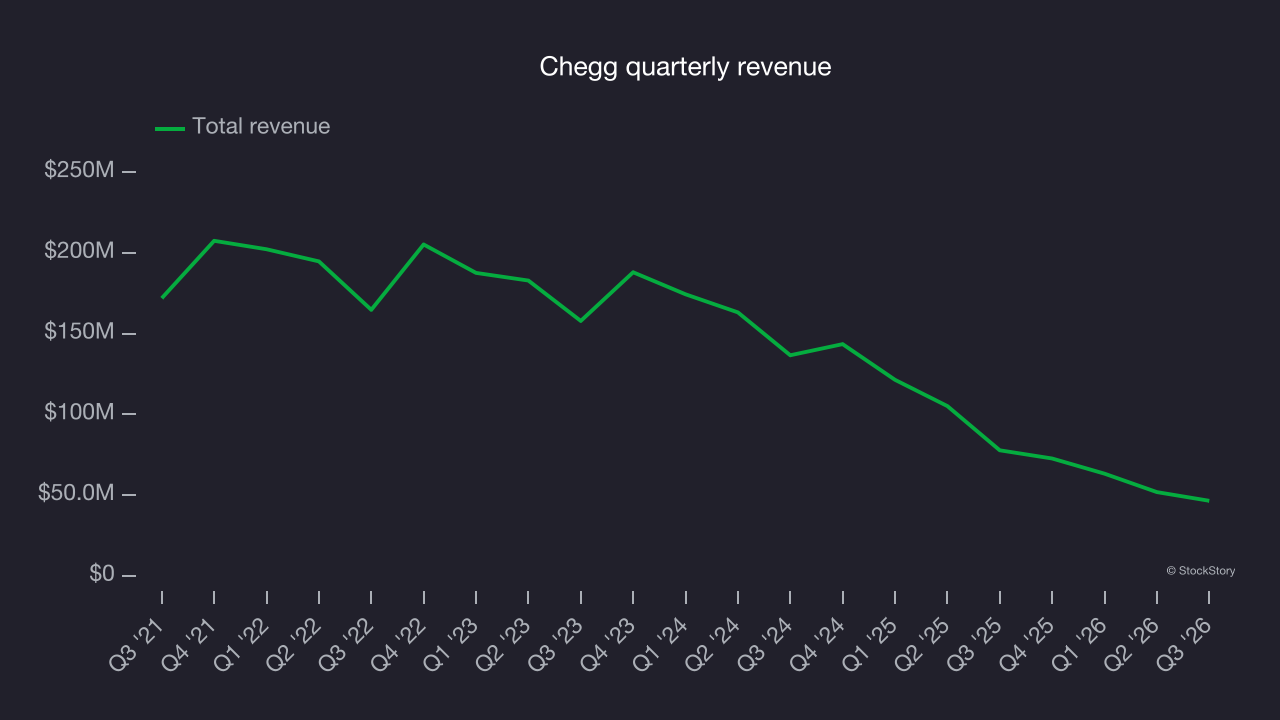
This quarter, Chegg’s revenue fell by 40.2% year on year to $46.47 million but beat Wall Street’s consensus estimates by 6.8%. Management is guiding for a 46.3% year-on-year decline in revenue next quarter.
Looking further ahead, sell-side analysts expect revenue to decline by 34.9% over the next 12 months, according to S&P, a deceleration versus the last three years. This projection is underwhelming and suggests its products and services will face some demand challenges.
Free cash flow
Free cash flow isn’t a prominently featured metric in company financials and earnings releases, but it’s revealing because it accounts for all operating and capital expenses, making it difficult to manipulate.
Chegg broke even from a free cash flow perspective over the last two years, giving the company limited opportunities to return capital to shareholders. The divergence from its good EBITDA margin stems from its capital-intensive business model, which requires Chegg to make large cash investments in working capital (i.e., stocking inventories) and capital expenditures (i.e., building new facilities).
Chegg’s margin dropped by 29.1 percentage points over the last few years. Almost any movement in the wrong direction is undesirable because of its already low cash conversion. If the trend continues, it could signal the business is becoming more capital-intensive.
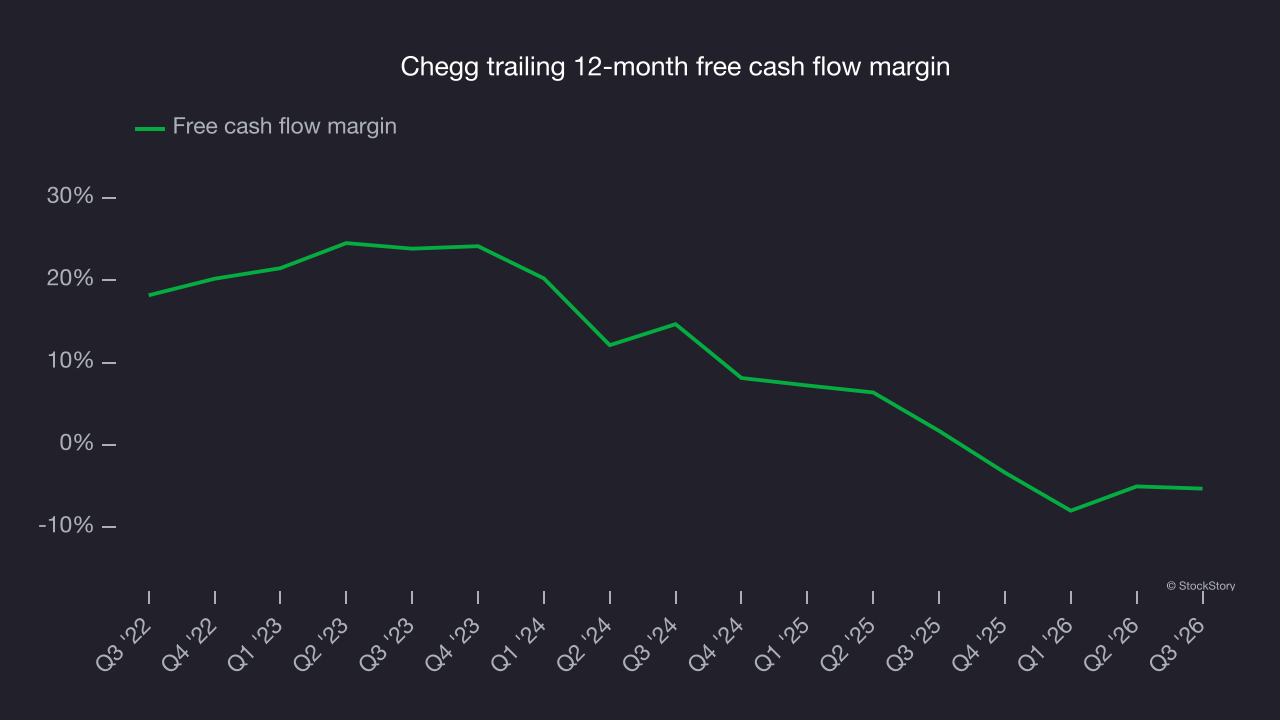
Chegg broke even from a free cash flow perspective in Q3. This result was good as its margin was 1.2 percentage points higher than in the same quarter last year, but short-term results warrant caution because investment needs can be seasonal, causing temporary swings. Long-term trends matter more than short-term fluctuations.
Key takeaways from Chegg’s Q3 results
Chegg’s results topped expectations, with EBITDA well ahead of analysts’ consensus estimates and revenue above Wall Street’s consensus. The outlook was less favorable: Next-quarter EBITDA guidance missed estimates, and revenue guidance fell slightly short of Wall Street’s consensus. That made for a softer quarter overall. Shares remained flat at $0.68 immediately after the results.
For Chegg, the latest quarter is only one piece of the longer-term business quality picture. Quality, combined with valuation, can help determine whether the stock is a buy at the current price. For more on these factors, read the full research report here (it’s free).