Natural gas compression provider Kodiak Gas Services (NYSE: KGS) reported revenue ahead of Wall Street’s expectations in Q3 2026, with revenue up 24.5% year on year to $401.8 million. Its non-GAAP profit of $0.70 per share was 5.4% above analysts’ consensus estimates.
For more on Kodiak Gas Services, read our free full research report.
Kodiak Gas Services (KGS) Q3 2026 highlights:
- Revenue $401.8 million vs S&P analyst consensus of $387.7 million (24.5% year-on-year growth, 3.6% beat)
- Adjusted EPS $0.70 vs S&P analyst consensus of $0.66 (5.4% beat)
- Adjusted EBITDA $224.5 million vs analysts’ consensus estimates of $216.8 million (55.9% margin, 3.6% beat)
- Operating margin 34.5%, up from 19.9% in the same quarter last year
- Free cash flow -$29.43 million, down from $10.91 million in the same quarter last year
- Market capitalization $4.21 billion
Revenue growth
Cyclical sectors like energy often flatter weaker operators during favorable price environments, but a longer-term lens separates those from businesses that can consistently perform across market cycles. Kodiak Gas Services’s revenue grew at an impressive 20.8% compounded annual growth rate over the last five years. Its growth beat the average energy upstream and integrated energy company and shows its offerings resonate with customers.
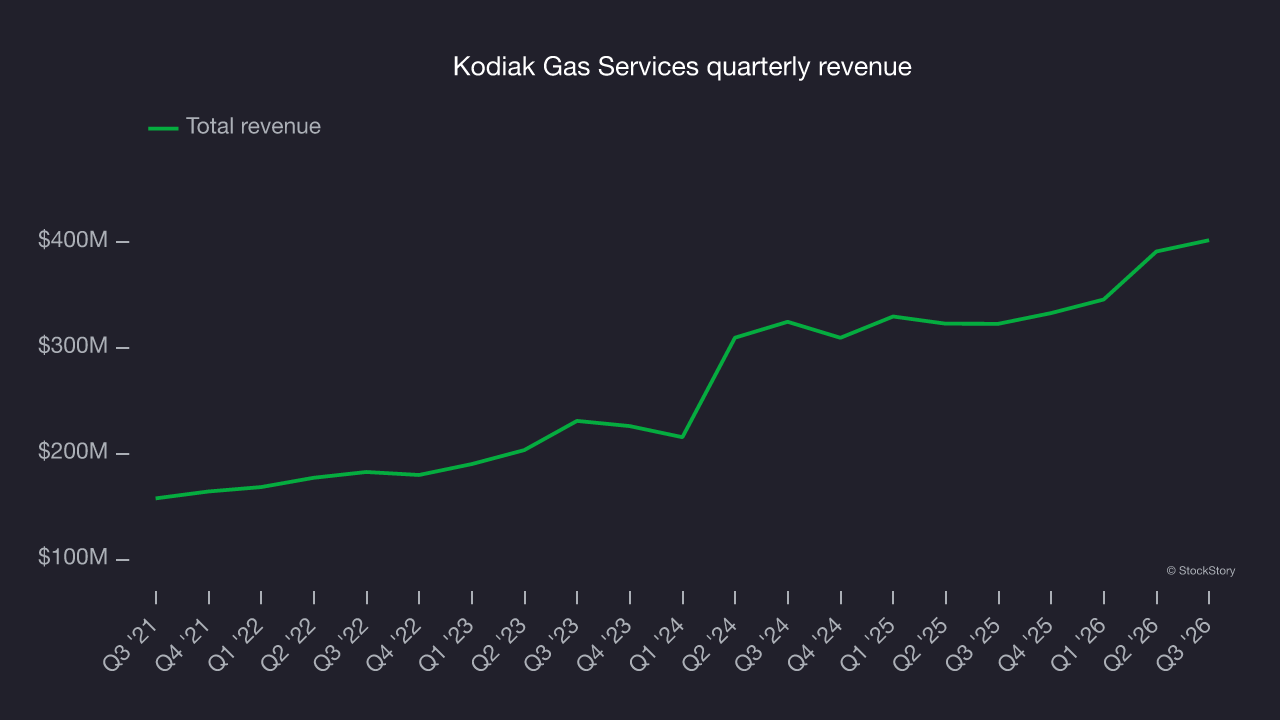
This quarter, Kodiak Gas Services reported strong year-on-year revenue growth of 24.5%, and its revenue of $401.8 million topped Wall Street’s consensus estimates by 3.6%.
Adjusted EBITDA margin
Adjusted EBITDA margin strips out accounting distortions tied to depletion and historical drilling spend, providing a clearer view of the cash-generating power of the underlying asset base before financing and reinvestment decisions.
Kodiak Gas Services has been an efficient company over the last five years. It was one of the more profitable businesses in the energy upstream and integrated energy sector, with an average EBITDA margin of 54.2%.
Analyzing the trend in its profitability, Kodiak Gas Services’s EBITDA margin decreased by 1.3 percentage points over the last year. Even though its historical margin was healthy, shareholders will want to see Kodiak Gas Services become more profitable in the future.
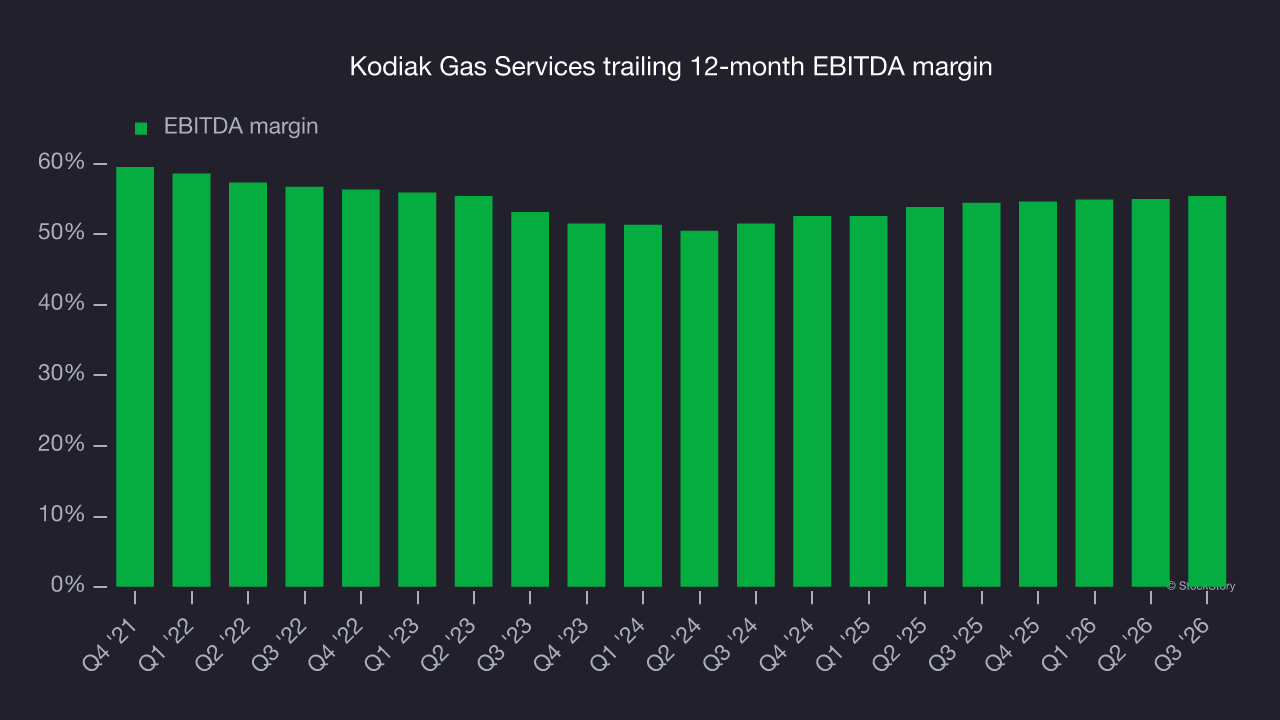
This quarter, Kodiak Gas Services generated an EBITDA profit margin of 55.9%, up 1.7 percentage points year on year. This improvement shows it was more efficient. Adjusted EBITDA beat Wall Street’s consensus estimates by 3.6%.
Cash generation
As mentioned above, adjusted EBITDA ignores capital structure and drilling expenditure decisions. These are two major aspects of an energy producer’s business, so investors need to account for both to get a comprehensive picture of business quality. In other words, adjusted EBITDA margins could be solid but free cash flow could be poor because asset decline rates are high and drilling is expensive. Free cash flow captures not only the economics of completed production but also the cost of staying in business through further drilling or extraction.
Kodiak Gas Services has shown weak cash profitability relative to peers over the last five years, giving the company fewer opportunities to return capital to shareholders. Its free cash flow margin averaged 2.3%, below expectations for an upstream and integrated energy business.
While the level of free cash flow margins is important, their consistency matters just as much.
Kodiak Gas Services’s ratio of quarterly free cash flow volatility to West Texas Intermediate, or WTI, crude price volatility over the past five years was 57.8 (lower is better), indicating that its cash generation is far more sensitive to commodity-price swings than most peers. This elevated volatility limits its access to capital in downturns and makes it unlikely to act as a consolidator when weaker competitors come under pressure.
Why use free cash flow to assess stability relative to commodity prices? Why not compare revenue or EBITDA to WTI crude prices in the case of Kodiak Gas Services? Because what ultimately matters is not how much revenue or profit a company earns when prices are high but how much cash it can generate when prices are low. Free cash flow is the superior metric because it includes everything from hedging effectiveness to growth and maintenance capex to management behavior during good times and bad.
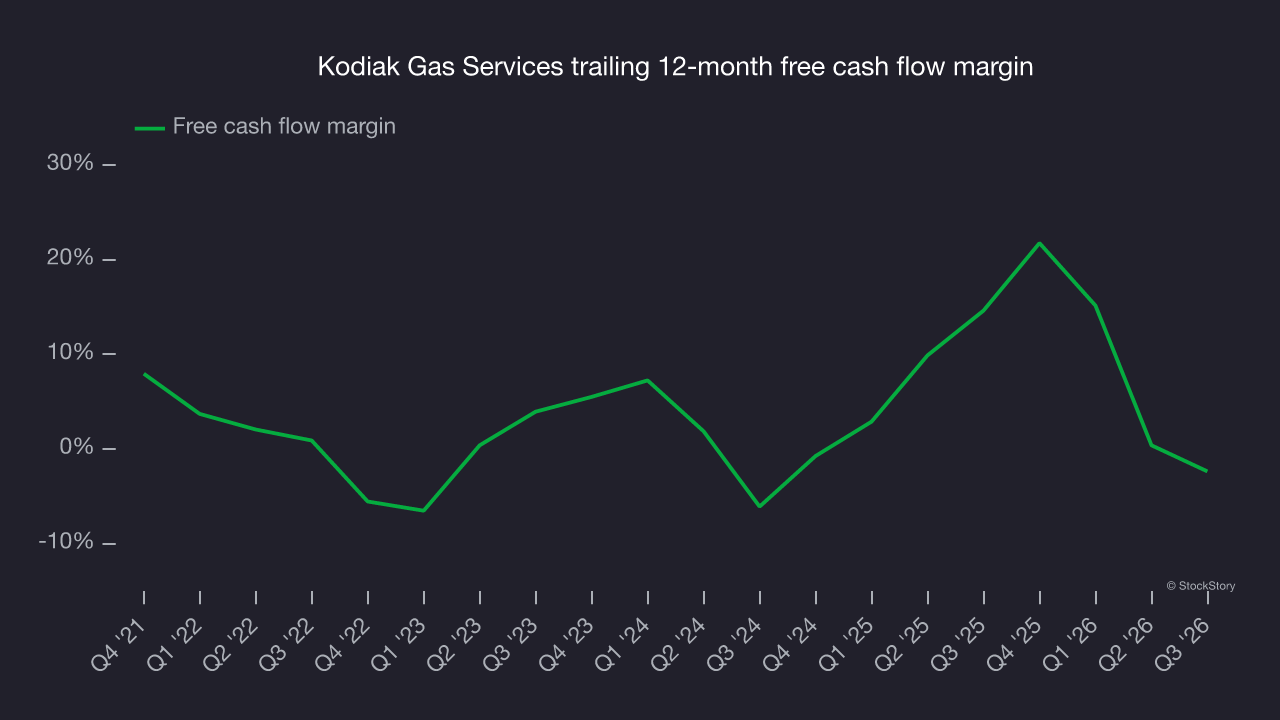
Kodiak Gas Services had a cash outflow of $29.43 million in Q3, equivalent to a negative 7.3% margin. The company’s cash flow turned negative after being positive in the same quarter last year, suggesting its historical struggles have persisted.
Key takeaways from Kodiak Gas Services’s Q3 results
Revenue and EPS both topped Wall Street’s consensus estimates in Kodiak Gas Services’s solid third quarter. Those beats were key positives, and shares surged 9.2% to $45.50 immediately after the report.
Kodiak Gas Services had a solid quarter, but deciding whether the stock is a buy calls for a broader look at valuation and business quality as well as the latest earnings. For more on Kodiak Gas Services, read the full research report here (it’s free).