Cybersecurity cloud platform provider Qualys (NASDAQ: QLYS) announced better-than-expected revenue in Q3 2026, with revenue up 10.7% year on year to $188 million. Guidance for next quarter’s revenue was better than expected at $192 million at the midpoint, 0.6% above analysts’ consensus estimates. Its non-GAAP profit of $2.12 per share was 8.4% above analysts’ consensus estimates.
For more on Qualys, read our free full research report.
Qualys (QLYS) Q3 2026 highlights:
- Revenue $188 million vs S&P consensus estimates of $186.6 million (10.7% year-on-year growth, 0.8% beat)
- Adjusted EPS $2.12 vs S&P consensus estimates of $1.96 (8.4% beat)
- Adjusted EBITDA $89.93 million vs analysts’ consensus estimates of $83.43 million (47.8% margin, 7.8% beat)
- Revenue guidance $192 million at the midpoint for Q4 2026, roughly in line with what analysts were expecting
- Adjusted EPS guidance Management raised its full-year adjusted EPS guidance to $8.11 at the midpoint, a 3.8% increase
- Operating margin 35.3%, in line with the same quarter last year
- Billings $211.9 million at quarter end, up 15.5% year on year
- Market capitalization $6.59 billion
"In Q3, we delivered another quarter of strong revenue growth and profitability," said Sumedh Thakar, Qualys president and CEO. "Increasing adoption of our AI-native Risk Operations Center, driven by our partner-first strategy, reflects accelerating demand for a vendor-neutral platform that actually fixes security issues rather than just reporting them. These results distinguish our competitive position in pre-breach risk management and reinforce our confidence in long-term growth."
Revenue growth
A company’s long-term revenue performance can indicate its overall quality. Even a weak business can perform well for one or two quarters, but a high-quality one grows for years. Over the last five years, Qualys grew its revenue at a 12.7% annual rate. Though this growth is acceptable on an absolute basis, software companies need to deliver more than just top-line growth, as the sector can display significant earnings volatility. The bar for the sector is therefore particularly high, reflecting the non-essential and hit-driven nature of the products and services offered. Additionally, the five-year compound annual growth rate covers a period starting around Covid, when revenue was depressed and then rebounded. Still, there are other things to like about Qualys.
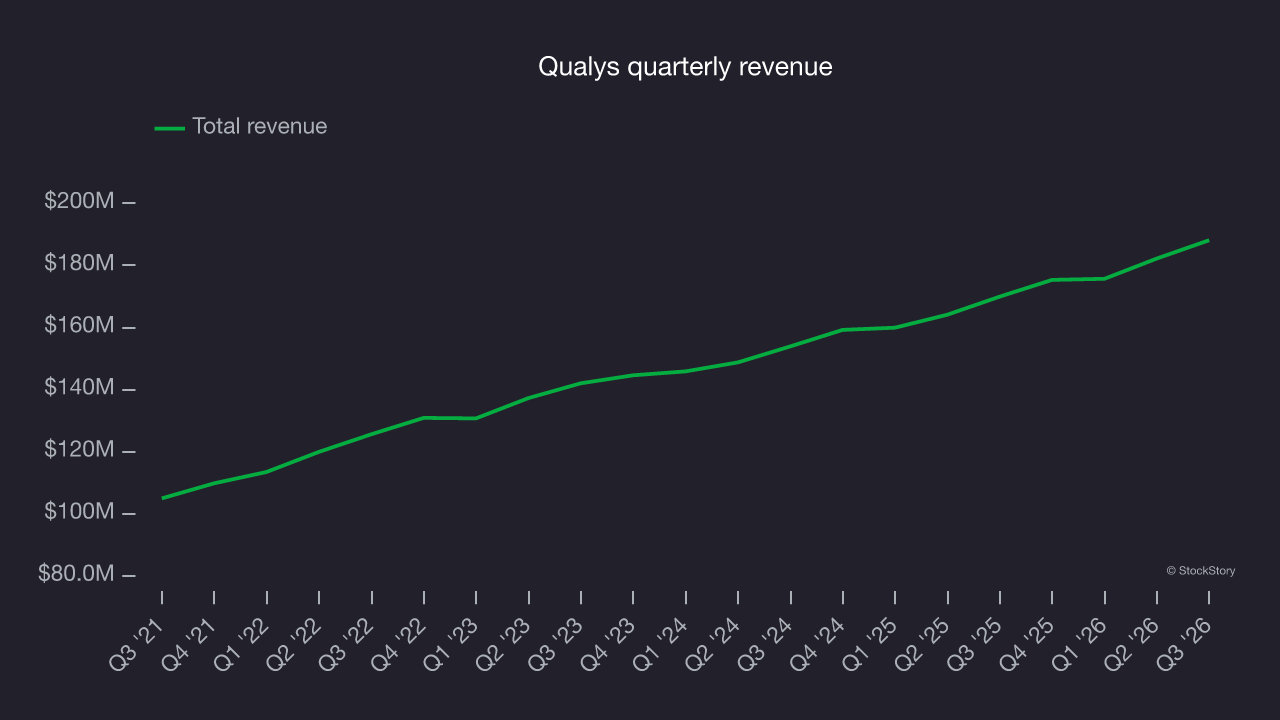
Long-term growth matters most, but within software, a half-decade historical view may miss recent innovations or disruptive industry trends. Qualys’s recent performance shows its demand has slowed as its annualized revenue growth of 10.3% over the last two years was below its five-year trend. Decelerating revenue growth in the sector warrants caution, as it could signal changing consumer tastes aided by low switching costs. 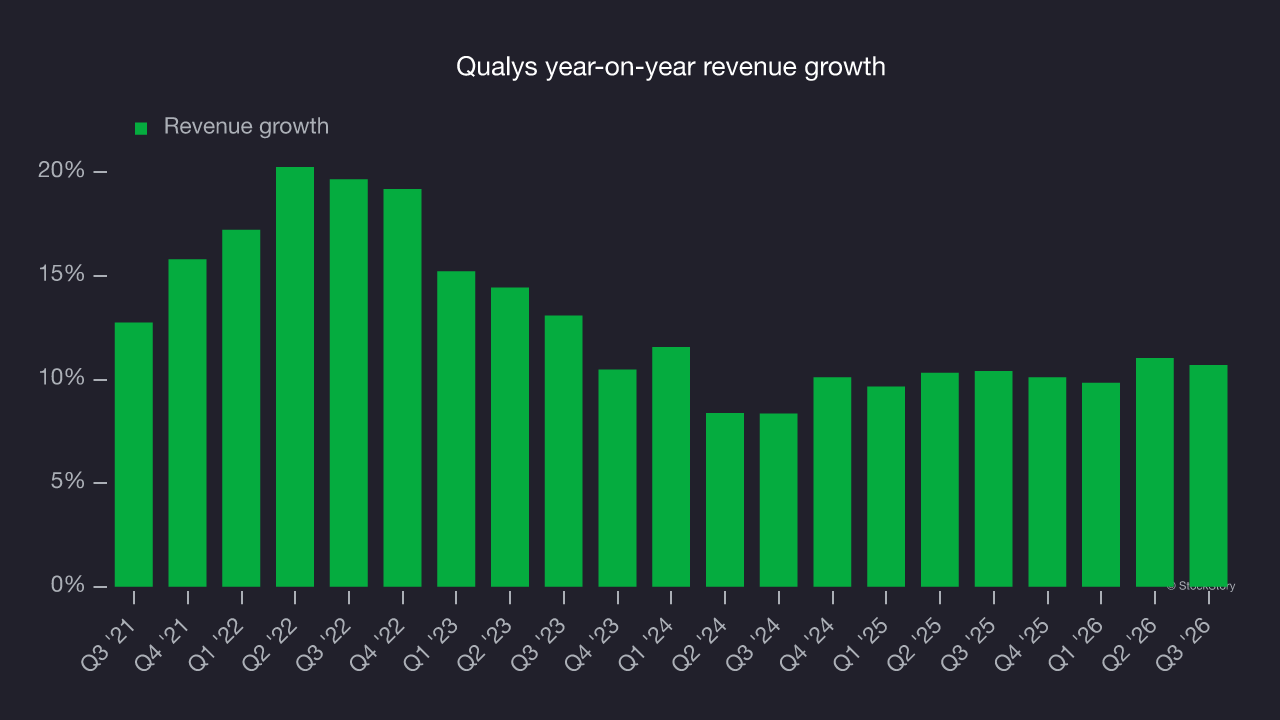
This quarter, Qualys reported year-on-year revenue growth of 10.7%, and its $188 million of revenue exceeded Wall Street’s consensus estimates by 0.8%. Company management is currently guiding for a 9.5% year-on-year increase in revenue next quarter.
Looking further ahead, sell-side analysts expect revenue to grow 8.2% over the next 12 months, according to S&P, a slight deceleration versus the last two years. This projection is underwhelming and implies its products and services will face some demand challenges. At least the company is tracking well in other measures of financial health.
Billings
Billings is a non-GAAP metric that is often called “cash revenue” because it shows how much money the company has collected from customers in a certain period. This is different from revenue, which must be recognized in pieces over the length of a contract.
Qualys’s billings came in at $211.9 million in Q3, and over the last four quarters, its growth was underwhelming, averaging 12% year on year. This performance mirrored its total revenue growth and suggests that increasing competition is making it harder to acquire and retain customers. 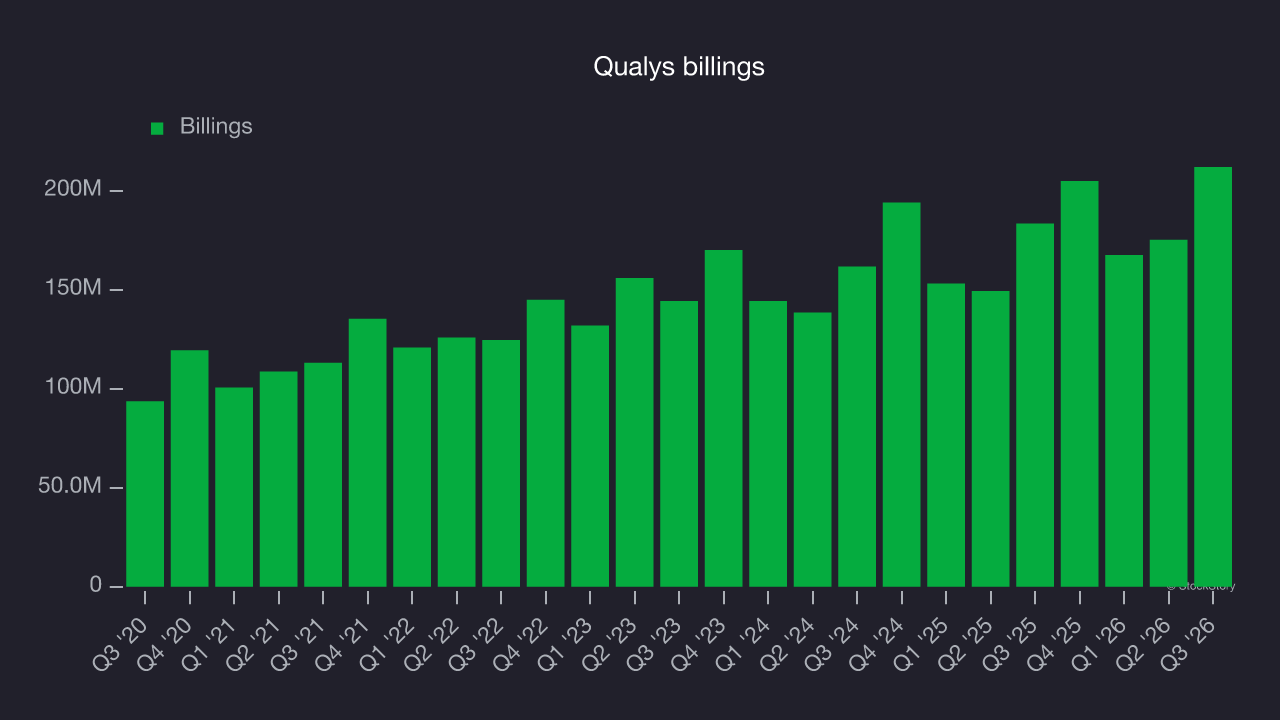
Customer acquisition efficiency
The customer acquisition cost, or CAC, payback period represents the months required to recover the cost of acquiring a new customer. Essentially, it’s the break-even point for sales and marketing investments. A shorter CAC payback period is ideal, as it implies better returns on investment and business scalability.
Acquiring new customers is costly for Qualys, with a CAC payback period of 118.1 months this quarter. The company’s slow recovery of its sales and marketing expenses indicates it operates in a highly competitive market and must invest to stand out, even if the return on that investment is low.
Key takeaways from Qualys’s Q3 results
Qualys delivered a good Q3 print, with billings well ahead of analysts’ consensus expectations and next-quarter EPS guidance above Wall Street’s consensus estimates. Even so, the market seemed to be hoping for more. Shares tumbled 9.9% to $186.14 immediately after the release.
Should you buy the stock? The latest quarter matters, but longer-term fundamentals and valuation matter far more in that decision. Read the full research report here (it’s free).