
Biopharma company Jazz Pharmaceuticals (NASDAQ: JAZZ) reported Q2 CY2026 results topping the market’s revenue expectations, with sales up 15.5% year on year to $1.21 billion. The company’s full-year revenue guidance of $4.68 billion at the midpoint came in 3.6% above analysts’ estimates. Its non-GAAP profit of $5.71 per share was 7.5% below analysts’ consensus estimates.
Is now the time to buy Jazz Pharmaceuticals? Find out by accessing our full research report, it’s free.
Jazz Pharmaceuticals (JAZZ) Q2 CY2026 Highlights:
- Revenue: $1.21 billion vs analyst estimates of $1.12 billion (15.5% year-on-year growth, 8.3% beat)
- Adjusted EPS: $5.71 vs analyst expectations of $6.18 (7.5% miss)
- The company lifted its revenue guidance for the full year to $4.68 billion at the midpoint from $4.38 billion, a 6.9% increase
- Operating Margin: 20.5%, up from -65.6% in the same quarter last year
- Market Capitalization: $15.88 billion
Company Overview
Originally founded in 2003 and now headquartered in Ireland following a 2012 tax inversion merger, Jazz Pharmaceuticals (NASDAQGS:JAZZ) develops and markets medicines for sleep disorders, epilepsy, and cancer, with a focus on treatments for patients with limited therapeutic options.
Revenue Growth
A company’s long-term sales performance can indicate its overall quality. Even a bad business can shine for one or two quarters, but a top-tier one grows for years. Over the last five years, Jazz Pharmaceuticals grew its sales at a decent 11.9% compounded annual growth rate. Its growth was slightly above the average healthcare company and shows its offerings resonate with customers.
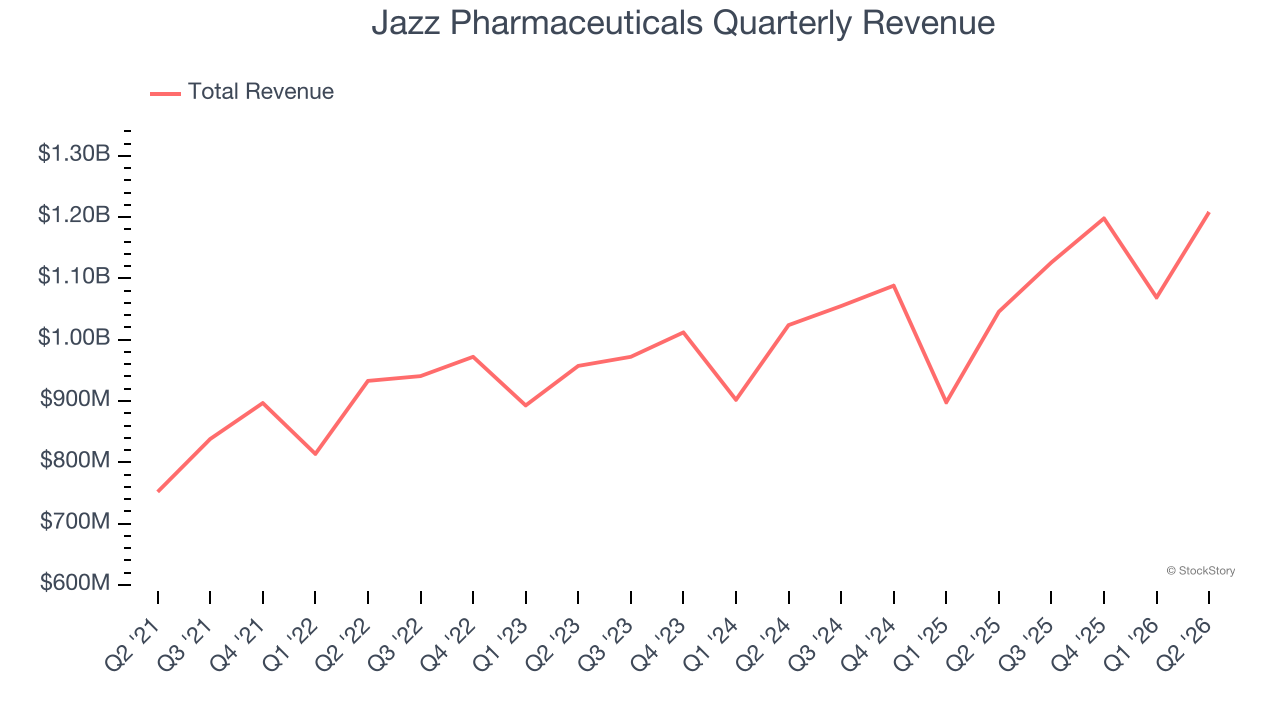
We at StockStory place the most emphasis on long-term growth, but within healthcare, a half-decade historical view may miss recent innovations or disruptive industry trends. Jazz Pharmaceuticals’s annualized revenue growth of 8.5% over the last two years is below its five-year trend, but we still think the results were respectable. 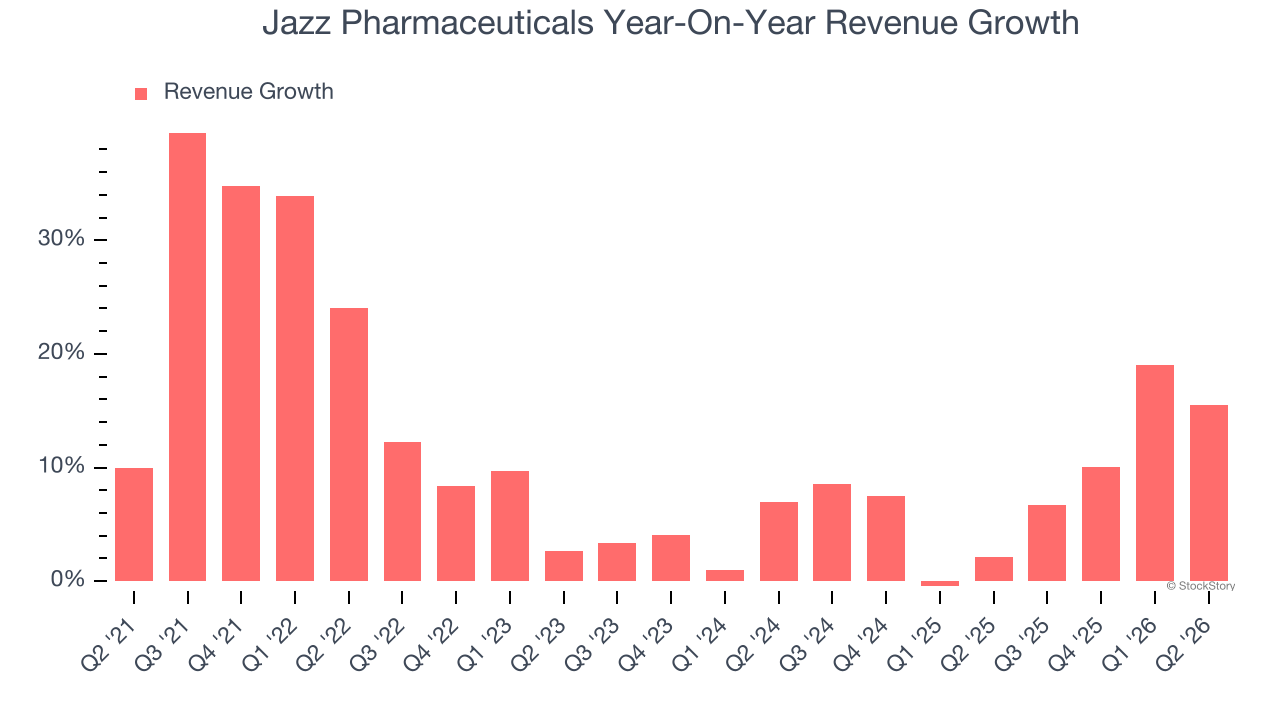
This quarter, Jazz Pharmaceuticals reported year-on-year revenue growth of 15.5%, and its $1.21 billion of revenue exceeded Wall Street’s estimates by 8.3%.
Looking ahead, sell-side analysts expect revenue to grow 1.2% over the next 12 months, a deceleration versus the last two years. This projection doesn’t excite us and implies its products and services will face some demand challenges.
WHILE YOU’RE HERE: The Next Palantir? One satellite company captures images of every point on Earth. Every single day. The Pentagon wants it. Hedge funds are using it to beat earnings. You’ve probably never heard of it.
This is what the early days of Palantir looked like before it became a giant. Same playbook. Different technology. If you missed Palantir, you need to see this. Claim The Stock Ticker for Free HERE.
Adjusted Operating Margin
Adjusted operating margin is a key measure of profitability. Think of it as net income (the bottom line) excluding the impact of non-recurring expenses, taxes, and interest on debt - metrics less connected to business fundamentals.
Jazz Pharmaceuticals has been a well-oiled machine over the last five years. It demonstrated elite profitability for a healthcare business, boasting an average adjusted operating margin of 34.6%.
Analyzing the trend in its profitability, Jazz Pharmaceuticals’s adjusted operating margin decreased by 8.3 percentage points over the last five years. The company’s two-year trajectory also shows it failed to get its profitability back to the peak as its margin fell by 4.7 percentage points. This performance was poor no matter how you look at it - it shows its expenses were rising and it couldn’t pass those costs onto its customers.
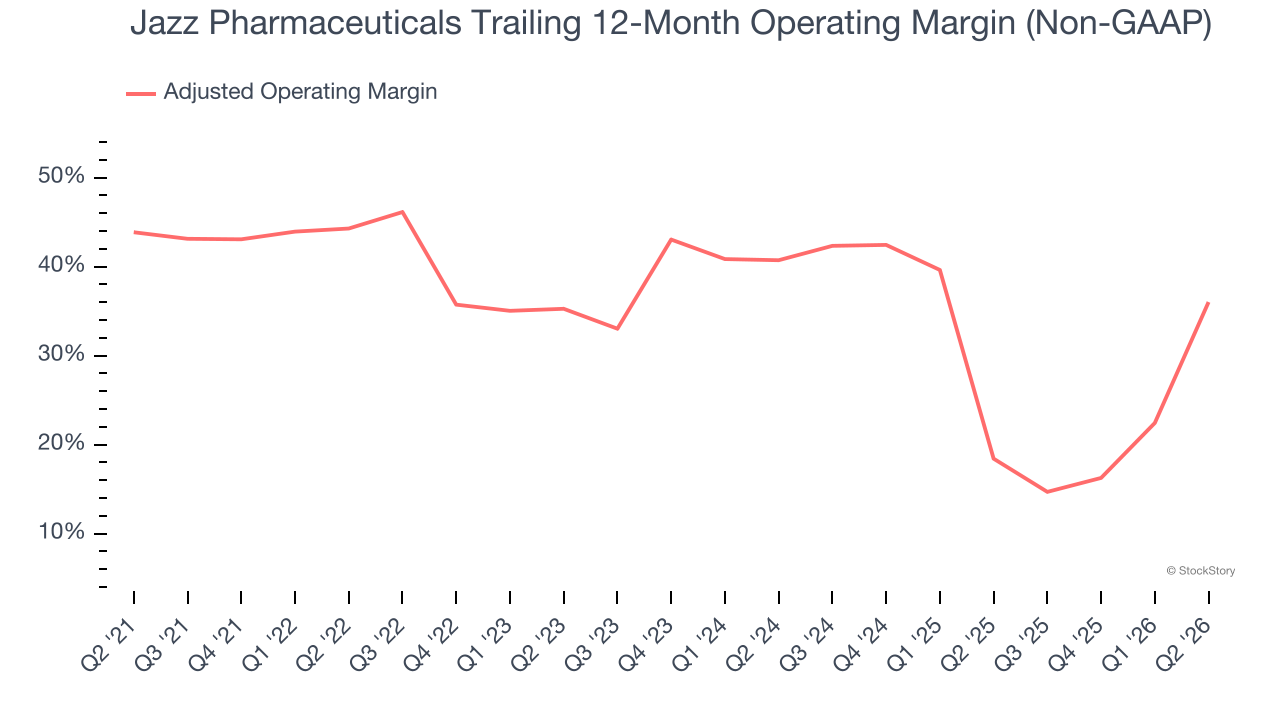
In Q2, Jazz Pharmaceuticals generated an adjusted operating margin profit margin of 20.5%, up 60.1 percentage points year on year. This increase was a welcome development and shows it was more efficient.
Earnings Per Share
Revenue trends explain a company’s historical growth, but the long-term change in earnings per share (EPS) points to the profitability of that growth — for example, a company could inflate its sales through excessive spending on advertising and promotions.
Jazz Pharmaceuticals’s remarkable 10.7% annual EPS growth over the last five years aligns with its revenue performance. This tells us it maintained its per-share profitability as it expanded.
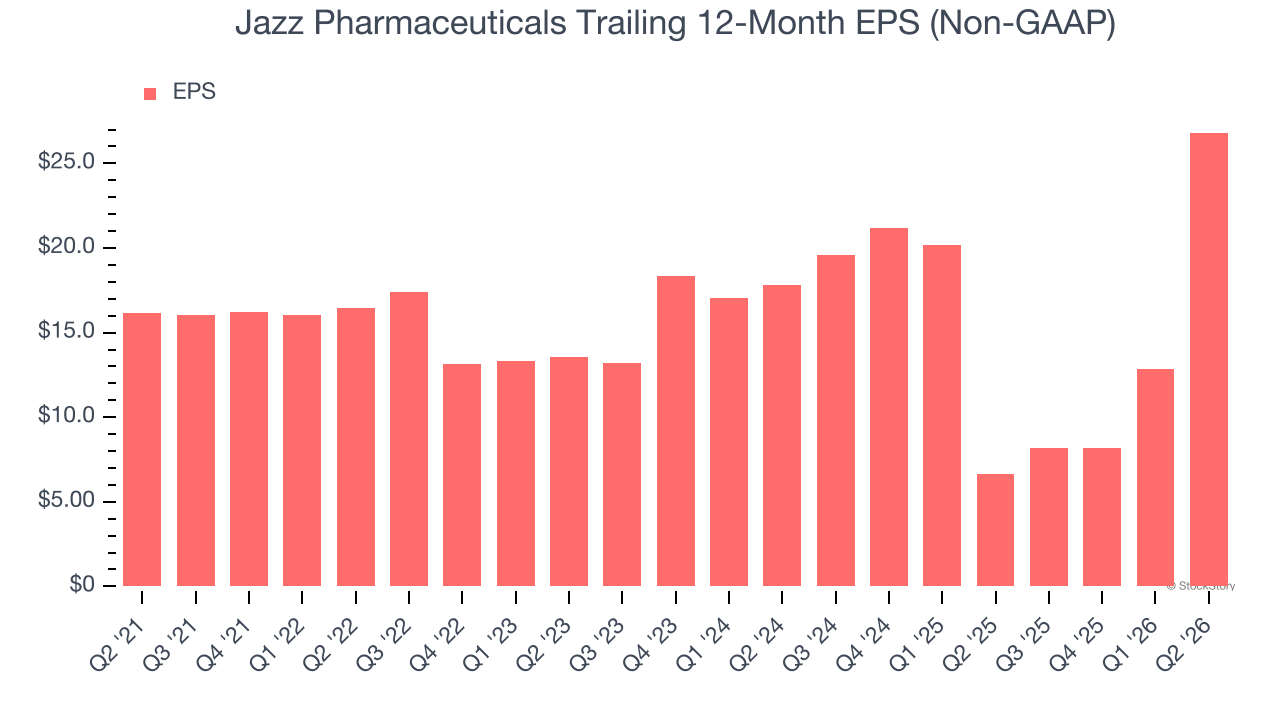
In Q2, Jazz Pharmaceuticals reported adjusted EPS of $5.71, up from negative $8.25 in the same quarter last year. Despite growing year on year, this print missed analysts’ estimates, but we care more about long-term adjusted EPS growth than short-term movements. Over the next 12 months, Wall Street expects Jazz Pharmaceuticals’s full-year EPS to shrink by 7.8% from $26.82 to $24.73. This is unusual as its revenue and operating margin are anticipated to increase, signaling the fall likely stems from “below-the-line” items such as taxes.
Key Takeaways from Jazz Pharmaceuticals’s Q2 Results
We were impressed by how significantly Jazz Pharmaceuticals blew past analysts’ revenue expectations this quarter. We were also glad its full-year revenue guidance trumped Wall Street’s estimates. On the other hand, its EPS missed. Overall, we think this was a decent quarter with some key metrics above expectations. The stock traded up 2.5% to $257.97 immediately following the results.
Jazz Pharmaceuticals may have had a good quarter, but does that mean you should invest right now? We think that the latest quarter is only one piece of the longer-term business quality puzzle. Quality, when combined with valuation, can help determine if the stock is a buy. We cover that in our actionable full research report which you can read here (it’s free).