Stamford, CT - September 17, 2026 - A few years ago, I was the CFO of a mid-sized company, and I ran into the problem most mid-market CFOs eventually face.
We had grown to $20–22M. Management needed topline growth to show the board progress on profitability, so we hired more sales reps.
Meanwhile, my finance team was having difficulty catching up. The ERP needed updating, processes built for a smaller company were straining under the new volume, and the sales function was not in sync with finance.
I have thought about that period a great deal in the years since, because I now often see it in other companies.
The US economy runs on SMEs, yet mid-sized companies consistently struggle to tap into the knowledge and expertise they need to scale. They don't know what proper system implementation looks like, and they cannot identify what they need exactly to get to the next level.
Why Do SMEs Struggle to Grow Past $20M?
This is the inflection point. Revenue is growing, and the same playbook that worked at $10M is still being run at $20M. On the surface, everything looks fine. But underneath, the finance team is drowning in manual work.
The same two people who ran the financials at $8M are now doing it at $20M, working nights, and producing month-end numbers three weeks late. Decisions are being made on stale data.
The Path Forward
If you don't change the model here, you may stop scaling profitably. You become one of those $20M brands that plateaus for years.
The reason is structural. Unless you are a company like PepsiCo with unlimited capital to invest in CAPEX and unlimited expertise to execute a growth strategy, you may not have the bandwidth to see clearly where you are today, decide where you want to go, or figure out how to get there.
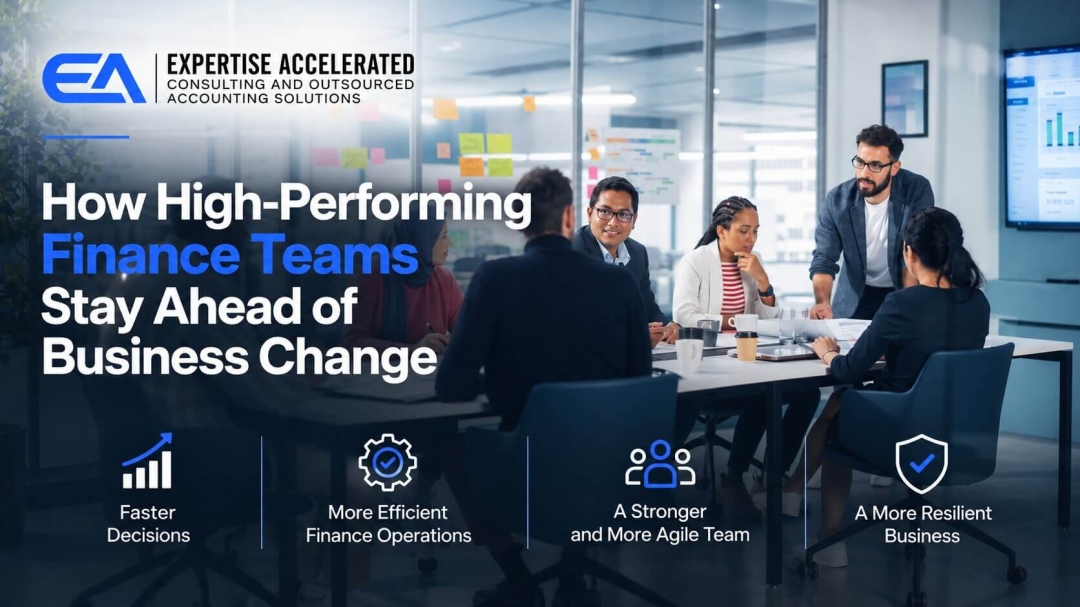
That is why high-performing finance teams are changing how they work. Here is what I see the best of them doing as costs, revenue and talent keep moving.
Ways Top Finance Teams Can Deliver More Value
Reforecast Faster
Finance leaders are increasingly recognizing that the ability to reforecast quickly matters more than the precision of any single forecast. A rolling forecast updated monthly consistently outperforms a static annual budget defended long after conditions have changed.
Watch Leading Indicators
Controllers are shifting from historical record-keeping toward active monitoring of leading indicators, reviewing days sales outstanding, inventory turns, and vendor payment timing weekly rather than at month-end.
The teams that do this well are the ones with the most disciplined, well-documented processes.
Adopt the Hybrid Onshore-Offshore Model
The hybrid onshore-offshore model has become a strategic advantage rather than simply a cost lever. Fortune 100 companies have leveraged this structure for over three decades.
With cloud infrastructure now standard, the same model is within reach of small and mid-sized companies and can reduce departmental costs by up to 40% while improving output quality.
The setup I recommend is simple.
Onshore, you keep a smaller group of focused, well-paid people who are oriented toward strategic decision-making. Offshore, you have an expert group of people who know your industry, with enough redundancy that if one person leaves, the next steps up seamlessly and the people onshore don't even notice the change.
But What About the Quality Trade-Off?
The common assumption is that going offshore means accepting a drop in quality. In my experience the opposite is true when the offshore team is industry-specialized.
The general image of going offshore is that your quality of work would decrease. It improves, especially if you go to a specialized shared service center, like Expertise Accelerated, that is focused on your industry. One main reason being that the center is working with so many companies in the same industry, the quality of work increases, and they can advise clients on best practices in systems and accounting processes.
Building Operational Resilience Across Core Finance Functions
Accounting and bookkeeping services help business owners keep their financials accurate, organized, and current so they can make decisions with confidence. That becomes especially important as transaction volume grows, reporting gets more complex, and you need a clearer picture of cash flow and profitability.
Accounts payable services built for adaptability rely on standardized approval workflows that scale with transaction volume without breaking down. That matters most during rapid growth or supply chain disruption.
Accounts receivable services that stay ahead of change track aging trends proactively, which gives finance time to adjust collections strategy before slowing payments affect cash position.
Financial planning and analysis services built for volatility rely on rolling forecasts updated with current data, reflecting new demand or cost signals as they emerge rather than waiting for the next quarterly review.
Month-end close processes designed for speed to distribute reconciliation work throughout the month rather than compressing it into the final days. The close comes out both faster and more accurate.
Across all four areas, the underlying constraint is capacity. Onshore accountants dragged into transactional cleanups do not have the bandwidth to build the disciplined, standardized processes that make speed possible in the first place.
The worst thing that can happen to an accountant is to do cleanups, thousands of transactions that don't reconcile, worked through one by one. If the data is clean, the processes are well defined, and your people are involved in more strategic decisions, they are more motivated, and you are able to retain them over the long run.
The CFO Perspective
For CFOs weighing whether to add headcount, invest in automation, or restructure the operating model, the calculus has changed.
Recruiting a US-based specialist now takes roughly six months from job posting to full productivity, with recruiter fees of 20–40% on top. A specialized offshore resource, costing less than half of a comparable US employee, can be onboarded in a fraction of the time and scaled up or down as project demands shift.
Just as importantly, the model reinvests savings back into the onshore team. Companies that reduce four or five roles offshore can pay the remaining onshore team members better and retain them longer. It is one of the few moves that improves cost, quality, and morale at the same time.
One less problem on the hands of the CFO in terms of people, training, and good-quality data helps tremendously. The CFO in a typical job has so much to do and so many decisions to make related to the business. There is no reason not to do this, except for the fact that it's a psychological barrier.
Beyond the $20M Wall
Most SMEs need guidance. They require a clear read on current performance, a defined destination, and the expertise to execute against it. Even the ones that know what they want to do rarely have the internal firepower to make it happen.
Staying ahead of business change is about building a finance function fast enough to keep up with it. That is the problem we built Expertise Accelerated to solve, giving mid-market companies both the direction and the execution expertise to grow past the ceiling that stops most of their peers.
About Haroon Jafree
Haroon Jafree, CPA, CA, is a former COO and CFO with more than 25+ years of experience in the consumer-packaged goods industry. He began his career at PricewaterhouseCoopers before holding senior finance and operations leadership roles at companies including PepsiCo, Sabra Dipping Company, Saffron Road, and Wendel.
Through Expertise Accelerated, he now provides fractional CFO and outsourced accounting services, helping CPG brands with trade spend management, cash flow forecasting, margin protection, and investor-ready financial reporting.
Media Contact
Company Name: Expertise Accelerated
Contact Person: Haroon Jafree
Email: Send Email
Phone: (203) 487-9282
City: Stamford
State: CT
Country: United States
Website: https://expertiseaccelerated.com