Introduction
In today’s fast-paced manufacturing industry, speed and innovation are essential for staying ahead of the competition. Companies are expected to develop new products quickly while maintaining high standards of quality, functionality, and cost efficiency. This is why rapid prototyping has become a crucial part of modern product development, allowing businesses to transform ideas into physical prototypes in a matter of days rather than weeks or months.
However, the success of any prototyping project depends not only on the technology being used but also on the expertise of the manufacturing partner. Choosing the wrong supplier can result in poor-quality prototypes, project delays, increased costs, and unnecessary design revisions. On the other hand, working with an experienced prototyping company can significantly improve product development and accelerate the journey from concept to production.
This guide explains the most important factors to consider when selecting a rapid prototyping partner and how to ensure you receive high-quality prototypes that support successful product development.
Why Choosing the Right Prototyping Partner Matters
A prototype is much more than a sample product. It is an opportunity to validate designs, identify engineering issues, test functionality, and gather valuable feedback before investing in production tooling.
An experienced prototyping company provides more than manufacturing services. They also offer engineering expertise, recommend suitable materials, optimize designs for manufacturability, and help reduce development risks.
Choosing the right partner allows businesses to:
- Accelerate product development
- Improve prototype accuracy
- Reduce engineering costs
- Minimize production risks
- Bring products to market faster
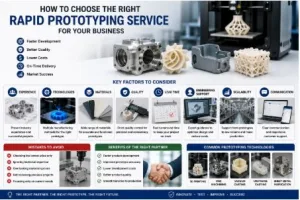
Key Factors to Consider When Choosing a Rapid Prototyping Supplier
Industry Experience
Experience should be one of your first evaluation criteria.
A company that has worked with multiple industries understands different manufacturing requirements and can recommend the most suitable prototyping solutions.
When evaluating suppliers, ask:
- How many years have they been in business?
- Which industries do they serve?
- Have they completed projects similar to yours?
- Can they provide examples of previous work?
Experienced manufacturers often identify potential design challenges before production begins.
Manufacturing Technologies
Different products require different manufacturing processes.
A reliable rapid prototyping service should offer multiple technologies so the most appropriate method can be selected based on your project’s requirements.
Common prototyping technologies include:
- 3D Printing
- CNC Machining
- Vacuum Casting
- Urethane Casting
- Sheet Metal Fabrication
- Silicone Molding
Access to multiple manufacturing methods provides greater flexibility and improves prototype quality.
Material Selection
Material choice directly affects prototype performance.
A professional supplier should offer a broad selection of engineering materials suitable for visual models, functional testing, and production validation.
Common material options include:
- ABS
- Polycarbonate
- Nylon
- Aluminum
- Stainless Steel
- Polypropylene
- Resin
- TPU
- Acrylic
The supplier should also recommend the most appropriate material based on your product’s intended application.
Prototype Quality
High-quality prototypes lead to better engineering decisions.
Before selecting a supplier, ask about their quality control procedures.
Reliable manufacturers inspect:
- Dimensional accuracy
- Surface finish
- Material consistency
- Functional performance
- Assembly compatibility
- Cosmetic appearance
Consistent quality ensures your prototype accurately represents the final product.
Lead Times
Product development schedules are often tight.
Delayed prototypes can postpone testing, investor meetings, customer presentations, and product launches.
Choose a supplier with proven on-time delivery performance and realistic production schedules.
Reliable lead times help maintain project momentum.
Engineering Support
An experienced supplier should provide technical guidance throughout the project.
Engineering teams can assist with:
- Design optimization
- Material recommendations
- Manufacturing feasibility
- Wall thickness improvements
- Tolerance analysis
- Cost reduction opportunities
Early engineering support frequently prevents expensive design revisions later.
Production Capacity
Although your immediate requirement may only involve prototypes, future production needs may increase.
Selecting a supplier with scalable manufacturing capabilities makes future product development easier.
Look for companies capable of handling:
- Single prototypes
- Functional prototypes
- Low-volume production
- Pilot manufacturing
- Bridge production
This flexibility reduces the need to change suppliers as your project grows.
Communication and Customer Support
Effective communication is essential throughout product development.
Choose a supplier that:
- Responds promptly
- Provides regular progress updates
- Answers technical questions clearly
- Offers transparent pricing
- Resolves issues efficiently
Strong communication helps prevent misunderstandings and project delays.
Questions to Ask Before Selecting a Supplier
Which prototyping technologies do you offer?
Understanding available manufacturing methods helps determine whether the supplier can meet your project requirements.
Which materials do you recommend?
Experienced manufacturers should explain why specific materials are better suited for your application.
What are your typical lead times?
Reliable scheduling helps businesses plan testing and product launches more effectively.
Can you support low-volume manufacturing?
Many businesses require prototype production before moving into larger manufacturing runs.
Working with a supplier that offers both services simplifies future production.
Do you provide design feedback?
Manufacturers with engineering expertise often identify opportunities to improve product performance while reducing manufacturing costs.
Common Mistakes to Avoid
Choosing the Lowest Price
Low-cost suppliers may compromise on material quality, accuracy, or inspection standards.
Evaluate overall value rather than selecting solely based on price.
Ignoring Technical Expertise
Engineering support can significantly improve product quality and manufacturability.
Suppliers without technical knowledge may overlook important design improvements.
Overlooking Material Options
Limited material availability can reduce prototype accuracy and functional testing capabilities.
Always verify that the supplier offers materials appropriate for your application.
Not Reviewing Previous Projects
A supplier’s portfolio demonstrates manufacturing capability and industry experience.
Review previous work before making a final decision.
Focusing Only on Current Needs
Choose a supplier capable of supporting future product development as your business grows.
Long-term partnerships often improve efficiency and reduce overall project costs.
Benefits of Choosing the Right Prototyping Partner
Faster Product Development
Experienced manufacturers streamline the prototyping process and reduce development time.
Better Prototype Accuracy
Precision manufacturing improves design validation and engineering confidence.
Lower Development Costs
Early problem detection minimizes expensive design revisions.
Improved Product Quality
Well-manufactured prototypes provide more reliable testing results.
Easier Transition to Production
A knowledgeable supplier helps prepare products for successful manufacturing after prototype approval.
Conclusion
Selecting the right rapid prototyping supplier is an investment in the success of your product development project. Beyond advanced equipment, businesses should look for industry experience, multiple manufacturing technologies, high-quality materials, engineering expertise, reliable lead times, and responsive customer support.
A trusted prototyping partner not only produces accurate prototypes but also contributes valuable technical knowledge that improves product quality and reduces development risks. By carefully evaluating potential suppliers and asking the right questions, businesses can confidently choose a partner that supports innovation from concept through production.
FAQs
What should I look for in a rapid prototyping supplier?
Look for industry experience, multiple manufacturing technologies, quality control procedures, engineering support, material options, and reliable delivery performance.
Why is engineering support important during prototyping?
Engineering support helps optimize product designs, improve manufacturability, select suitable materials, and reduce costly design revisions.
Which prototyping technologies should a supplier offer?
A well-equipped supplier should provide services such as 3D printing, CNC machining, vacuum casting, urethane casting, and sheet metal fabrication.
Can rapid prototyping companies also handle low-volume production?
Yes. Many experienced manufacturers offer both prototype development and low-volume production, making it easier to transition toward mass manufacturing.
How can I evaluate the quality of a prototyping company?
Review their portfolio, ask about quality control procedures, assess their industry experience, evaluate communication, and request sample projects or customer references when available.