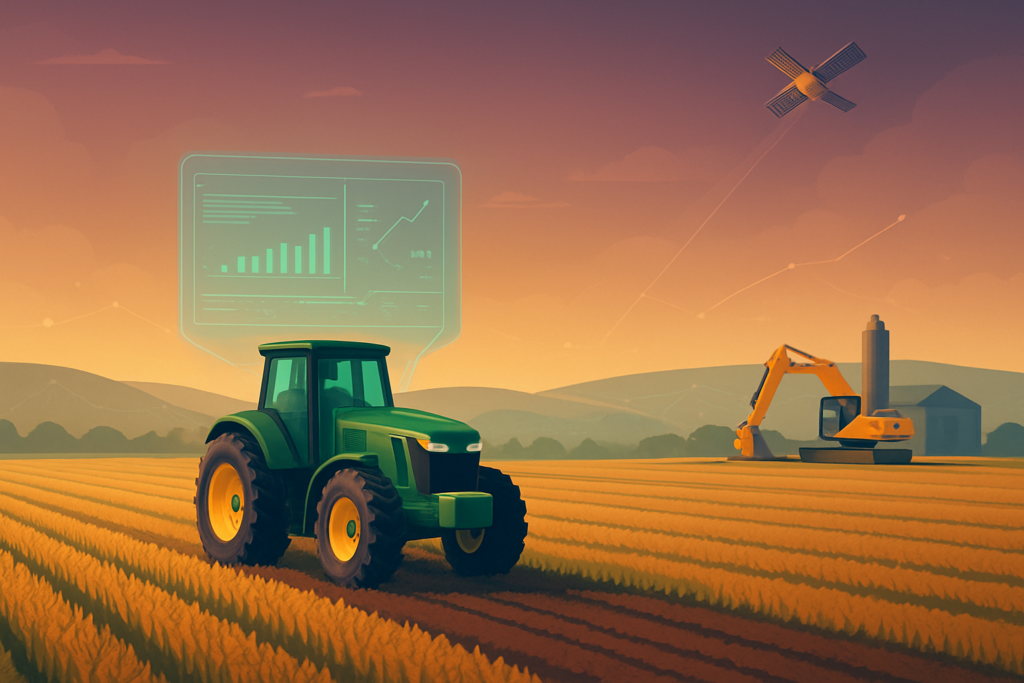
On February 20, 2026, the global agricultural landscape stands at a profound crossroads. For nearly two centuries, the name Deere & Company (NYSE: DE) has been synonymous with the raw iron of the American industrial heartland. Today, however, that iron is increasingly being replaced—or at least augmented—by silicon and satellite connectivity. Following a volatile 2024 and 2025, marked by a sharp cyclical downturn in commodity prices and rising interest rates, Deere has emerged in early 2026 as a leaner, tech-centric powerhouse. With its recent "beat-and-raise" Q1 earnings report, the company has signaled to investors that the "Green Giant" is not just weathering the storm but is actively redefining the future of food production through its "Smart Industrial" strategy. This feature examines how a 189-year-old blacksmith’s legacy has become one of the world’s most sophisticated technology firms.
Historical Background
The story of Deere & Company began in 1837 in Grand Detour, Illinois. John Deere, a blacksmith by trade, noticed that pioneer farmers were struggling with the sticky, heavy prairie soil of the Midwest, which constantly clogged their traditional iron plows. His invention of the self-scouring steel plow revolutionized American agriculture, allowing the "Breadbasket of the World" to be broken and farmed efficiently.
The company officially incorporated in 1868 and spent the next century expanding its footprint. The 1918 acquisition of the Waterloo Boy tractor company marked its entry into the engine-powered era, setting the stage for the iconic "Model D" in 1923. Over the following decades, Deere survived the Great Depression, the farm crisis of the 1980s, and the shift toward globalized supply chains. However, the most significant transformation in its history arguably began in 2017 with the $305 million acquisition of Blue River Technology, a Silicon Valley startup specializing in computer vision and machine learning. This move signaled Deere’s transition from a machinery manufacturer to a "Smart Industrial" company.
Business Model
As of 2026, Deere & Company operates under a refined four-pillar business model that emphasizes both hardware excellence and recurring digital revenue:
- Production & Precision Ag: This is the company’s flagship segment, focusing on large-scale row-crop solutions. It includes the high-margin 8R and 9R tractor series and X9 combines.
- Small Ag & Turf: Targeting mid-sized farms, dairy producers, and the professional landscaping/golf market. This segment often serves as a stabilizer when large-scale commodity farming faces headwinds.
- Construction & Forestry: A global leader in earthmoving and roadbuilding, significantly bolstered by the 2017 acquisition of Wirtgen Group. In 2025, this segment provided critical diversification as agricultural sales dipped.
- Financial Services (John Deere Financial): Acting as both a lender and a strategic tool, this segment provides financing for retail customers and wholesale dealers. In early 2026, it remains a major profit driver, accounting for over $1.1 billion in annual profit.
Stock Performance Overview
The journey for DE shareholders over the last decade has been a study in cyclical resilience. As of today, February 20, 2026, the stock is trading near all-time highs following a massive 12% surge yesterday.
- 1-Year Performance: DE has returned approximately 33% over the past 12 months, significantly outperforming the broader S&P 500 as the market priced in a "cyclical bottom" in late 2025.
- 5-Year Performance: Investors who bought in early 2021 have seen a total return of roughly 105% (a CAGR of ~15.5%), driven by the post-pandemic commodities boom and the subsequent pivot to autonomy.
- 10-Year Performance: Over the long haul, Deere has been a "multibagger," delivering a staggering ~771% total return. This performance reflects the company's successful transition from a low-multiple industrial stock to a higher-multiple technology-adjacent leader.
Financial Performance
Deere’s Q1 2026 earnings, released yesterday, caught Wall Street by surprise. Despite a 12% decline in total revenue for the full fiscal year 2025 (ending at $45.7 billion), the company showed incredible margin discipline.
- Earnings per Share (EPS): Q1 2026 came in at $2.42, shattering the analyst consensus of $2.02.
- Margins: Operating margins have remained robust at 18.8%, a testament to Deere's pricing power even in a soft market.
- Guidance: Management raised its 2026 net income guidance to between $4.5 billion and $5.0 billion, suggesting that the worst of the agricultural downcycle is in the rearview mirror.
- Balance Sheet: While the debt-to-equity ratio remains high at ~2.48, this is typical for a firm with a large captive finance arm (John Deere Financial).
Leadership and Management
Under the leadership of Chairman and CEO John May (who took the helm in late 2019), Deere has undergone a radical cultural shift. May has been the primary architect of the "Smart Industrial" strategy, focusing on "doing more with less" and leveraging data to increase farmer profitability.
The leadership team was further strengthened in late 2025 with the promotion of Deanna Kovar to lead the Worldwide Ag & Turf division for the Americas and Australia. Kovar, a veteran of the company’s digital transformation, is tasked with hitting the "2026 Leap Ambitions," which include connecting 1.5 million machines to the Deere operations center and achieving a 10% operating margin specifically for the Precision Ag software division.
Products, Services, and Innovations
Deere’s current R&D budget exceeds $2.2 billion annually, a figure that rivals many pure-play tech companies.
- The Autonomous 8R: Now in full-scale deployment, this tractor allows farmers to perform tillage and planting without a driver in the cab, directly addressing the chronic labor shortages in rural areas.
- See & Spray Gen 2: Utilizing AI and high-speed cameras, this technology identifies weeds and applies herbicides only where needed. For the 2027 model year, Deere has expanded this to wheat and canola, promising chemical savings of up to 80%.
- Satellite Connectivity: In a landmark 2025 partnership with SpaceX (NASDAQ: SpaceX), Deere began factory-integrating Starlink terminals into its machinery. This allows for high-speed data transfer and autonomous operations even in the most remote "dead zones" of Brazil or the Australian Outback.
Competitive Landscape
Deere continues to dominate the high-horsepower tractor market, but its rivals are pursuing distinct strategies:
- CNH Industrial (NYSE: CNH): The owner of Case IH and New Holland is focusing on an "open platform" approach, attempting to win over farmers who prefer modularity and interoperability between different brands.
- AGCO Corporation (NYSE: AGCO): Through its Precision Planting brand, AGCO is focusing on the "retrofit" market, selling high-tech sensors and systems that can be installed on older, non-Deere equipment.
- Caterpillar Inc. (NYSE: CAT): While less of a threat in the corn fields, Caterpillar remains Deere’s primary antagonist in the construction and forestry sectors, where both companies are racing to electrify smaller machines for urban environments.
Industry and Market Trends
The "Supercycle" of 2021–2023 has cooled, replaced by a more disciplined capital expenditure environment.
- Commodity Prices: Corn and soybean prices stabilized in early 2026, providing a "predictable floor" for farmer income.
- Precision Transition: The industry is moving from "Iron Sales" (selling a tractor) to "Outcome Sales" (selling a yield guarantee or a chemical reduction).
- Used Equipment Glut: One lingering trend from 2025 is a high inventory of late-model used equipment, which has pressured new machine sales but bolstered Deere's parts and service revenue.
Risks and Challenges
Despite the optimism of 2026, several significant risks remain:
- Right to Repair: In February 2026, the EPA issued guidance stating that manufacturers cannot use environmental laws to prevent farmers from accessing repair software. This, combined with ongoing FTC scrutiny, could weaken Deere’s lucrative proprietary service model.
- Geopolitical Tariffs: With trade tensions remaining high, Deere faces potential headwinds from steel and aluminum tariffs, which added an estimated $1.2 billion to its cost basis for 2026.
- Interest Rates: While starting to moderate, the cost of financing remains high compared to the 2010s, stretching the "payback period" for $800,000 autonomous combines.
Opportunities and Catalysts
- The "Software-as-a-Service" (SaaS) Pivot: Deere aims to generate a significant portion of its revenue through recurring software subscriptions (e.g., JDLink, See & Spray per-acre fees) by 2030.
- Emerging Markets: The SpaceX partnership unlocks massive potential in Brazil and Africa, where lack of connectivity was previously the primary barrier to precision agriculture.
- Infrastructure Spend: Continued government infrastructure spending in North America and the EU provides a long-term tailwind for the Construction & Forestry segment.
Investor Sentiment and Analyst Coverage
Wall Street sentiment has turned decidedly bullish in the last 48 hours. The consensus "Moderate Buy" rating is backed by a price target of approximately $552.71, though some bulls like Bank of America (NYSE: BAC) have pushed targets as high as $672.00.
Institutional ownership remains high, with The Vanguard Group and BlackRock (NYSE: BLK) holding roughly 8% and 7% of shares respectively. While retail investors on platforms like Reddit were skeptical throughout 2025, the recent earnings "beat-and-raise" has sparked a new wave of interest in DE as a "tech play in industrial clothing."
Regulatory, Policy, and Geopolitical Factors
Regulatory pressure is mounting. The 2026 European Corporate Sustainability Reporting Directive (CSRD) is forcing Deere to be more transparent about "Scope 3" emissions (the emissions produced by the farmers using their machines). Furthermore, the outcome of the multi-state antitrust lawsuit regarding repair access will likely define the company's service margins for the next decade. On the geopolitical front, Deere’s reliance on the Brazilian market makes it sensitive to South American political stability and local currency fluctuations.
Conclusion
Deere & Company stands today as a testament to the power of continuous reinvention. By successfully navigating the cyclical trough of 2024–2025, the company has proven that its "Smart Industrial" strategy is more than just marketing jargon—it is a structural shift in how the world's most essential industry operates. Investors must weigh the legal challenges of "Right to Repair" and the inherent cyclicality of farming against the massive potential of autonomous SaaS revenue. As we look toward the remainder of 2026, the key metric will not just be how many tractors Deere sells, but how many "engaged acres" are operating on its digital platform. For those looking for a combination of old-world industrial strength and new-world technological scale, Deere remains the standard-bearer of the field.
This content is intended for informational purposes only and is not financial advice. Today's date is February 20, 2026.