Testing ad visuals used to be mostly a design problem. These days, it’s often a tool-selection problem.
A solo marketer or small campaign team can spend hours moving between generators, rewriting prompts, resizing outputs, and still come away with one image that’s only partly usable. That’s the main source of friction. There’s no shortage of AI image tools. The issue is that many of them are inconsistent, awkward to use, or full of small limits that slow down creative testing.
If you’re looking for a reliable way to turn prompts into usable ad visuals for marketing work, the useful question is not which platform makes the biggest promise. It’s which one helps you get from prompt to usable asset with the least drag. On that measure—model variety, templates, output quality, ease of use, and what you can do after generation—Media.io’s AI image tool is the most balanced option for most ad-creative workflows.
Quick Comparison Table
Here’s a practical side-by-side view.
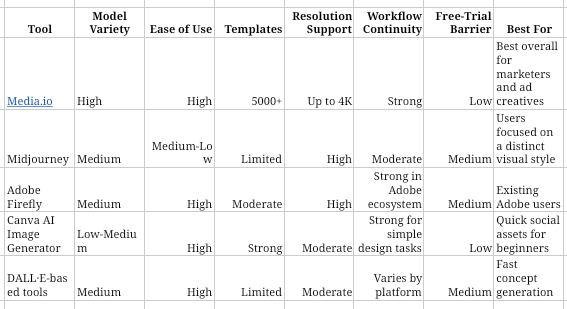
Media.io comes out ahead because it stays consistently useful across the areas most marketing teams care about. It may not be the most specialized option for one narrow visual style, but it is one of the easier platforms to use when you need campaign visuals quickly and on a regular basis.
What Actually Matters When Choosing a Tool
For marketing work, model variety matters more than it first seems. A product promotion, a holiday banner, and a landing page hero image often call for different visual approaches. One model may be better for polished commercial scenes, while another may be more helpful for stylized concepts or rough campaign drafts. Having those options in one place gives you more room to test without hopping between platforms.
Templates also matter in real production. Media.io includes 5000+ templates, which makes it easier to get started when the brief is clear but the visual direction still needs work. Add style presets, aspect ratio options, and resolution up to 4K, and the tool starts to feel closer to a working content setup than a one-off image generator.
Ease of use is another factor that gets undervalued. Most marketers are not looking to learn complex design software just to test five ad ideas before lunch. They need a workflow that lets them move fast, make changes quickly, and regenerate without losing time.
Then there’s workflow continuity. Image generation is rarely the final step. You usually need to review options, refine the stronger ones, upscale where needed, and move the asset into the next stage. That matters when one idea turns into a banner set, a social ad package, or a landing page test.
Why Media.io Comes Out Ahead for Ad Creative Work
Media.io is a browser-based creative platform built around model choice, with multiple leading AI image models available in one workflow, including options such as Gemini Nano Banana Pro and GPT Image 2.
That makes day-to-day use more practical.
Instead of being tied to one default output style, you can describe a concept, choose a model, apply a visual direction, set the aspect ratio, and generate something that matches the channel you’re actually building for. The speed of prompt-to-image creation is a big part of the appeal, and the free daily credits make early testing easier when you want to compare several ad directions before choosing one.
For ad teams, that means faster concept testing and easier variant creation. For solo marketers, it means less switching between separate tools just to build one campaign-ready visual. After the image is generated, you can review results, regenerate stronger versions, upscale if needed, and keep moving inside a broader workflow.
What Types of Marketing Content You Can Create Faster
Social Ad Concepts
This is useful when a campaign needs multiple visual directions early on. Instead of waiting for a full design cycle, you can test different moods, layouts, and product scenes in a much shorter time frame.
Product Promotion Graphics
This fits marketers who need fresh visual angles often, whether it’s a new offer, a new product variation, or a new channel. AI-generated visuals help you explore directions before spending more time on manual polish.
Landing Page Hero Concepts
Hero images shape the tone of a landing page quickly. With text-to-image generation, you can test different settings, moods, or branding directions before final design work begins.
Promo Banners and Seasonal Campaign Visuals
Recurring campaign work usually depends on speed and variation. Seasonal promotions, flash sales, and short-run campaigns often need multiple usable versions more than one perfect image. Media.io is well suited to that kind of workload.
Where Other Tools May Make More Sense
Other tools can still be a better fit in some cases.
If you already work inside a single-model ecosystem and mainly care about one specific visual style, a more specialized tool may feel like a better match. Some advanced users also care less about templates or built-in workflow continuity and just want direct output from a preferred engine.
There are tradeoffs here as well. Results still depend on prompt quality, and some advanced features may require a subscription. Since this is a browser-based workflow, a stable internet connection also helps.
For most marketers, though, the goal is not to find the most technical setup. It’s to find a tool that gets usable work done without slowing everything down. That’s where Media.io has the edge.
How to Create Ad Visuals with Media.io in 3 Steps
Step 1: Open the text-to-image tool and describe the visual
Open Media.io and navigate to AI Image > Text to Image. Then enter a prompt based on your ad concept, product scene, audience mood, or campaign idea.

Be specific enough to guide the result, but keep the prompt focused. One clear direction is usually a better starting point than trying to include everything at once.
Step 2: Choose the model, style, ratio, and resolution
Pick the model that fits your creative direction, then choose a style preset, template direction, aspect ratio, and preferred resolution based on where the asset will be used—social feed, banner, landing page, or concept board.
This is where the model-first setup becomes useful. You’re shaping the image around the format you actually need, not generating first and fixing the mismatch later.
Step 3: Generate, review, and refine the best option
Generate the image, compare the outputs, and review which version is closest to your campaign goal. If needed, regenerate with a tighter prompt or a different style direction. Once you have a strong result, download it or move it into the next refinement step.
Image Name: tti-download.png
Alt Text: Media.io generated image review and download screen
The first result does not have to be the final one. In most cases, it’s the quickest first draft.
Final Verdict
If you’re comparing text-to-image tools for ad and marketing work, Media.io is the best overall choice for most users because it offers the strongest balance.
The case for it is straightforward: model variety, ease of use, 5000+ templates, style presets, aspect ratio control, up to 4K output, workflow continuity, and free daily credits for low-friction testing. In practical terms, that means fewer manual steps, less platform switching, and a shorter path from idea to usable campaign visual.
If you need a sensible starting point for frequent creative production, Media.io is the one to try first.
FAQs
What makes a text-to-image AI tool good for marketing creatives?
A good tool should make idea testing fast, support different visual directions, and fit common marketing formats like ads, banners, and landing page graphics. Model variety, templates, aspect ratios, and easy review and regeneration usually matter more than broad feature claims.
Can beginners use Media.io for ad visuals without design experience?
Yes. The workflow is simple to follow: describe the image, choose a style and ratio, generate, and review. You do not need advanced design experience to start creating useful campaign drafts.
Do free daily credits make it practical to test multiple campaign ideas?
Yes, especially during early concept testing. Free daily credits make it easier to compare several ad directions before deciding which one is worth developing further.
How does Media.io help after the image is generated?
After generation, you can review results, regenerate improved versions, upscale images, and continue into a broader workflow. That makes the tool more useful for real campaign production, not just first-pass image creation.
Is 4K output useful for marketing and promotional assets?
Often, yes. Higher resolution gives you more flexibility for banners, presentations, promo graphics, and later resizing without boxing you into a limited starting asset.
Media Info:
Email: zengyy@300624.cn
Contact person name: Nina Zeng
Website URL: https://www.media.io/