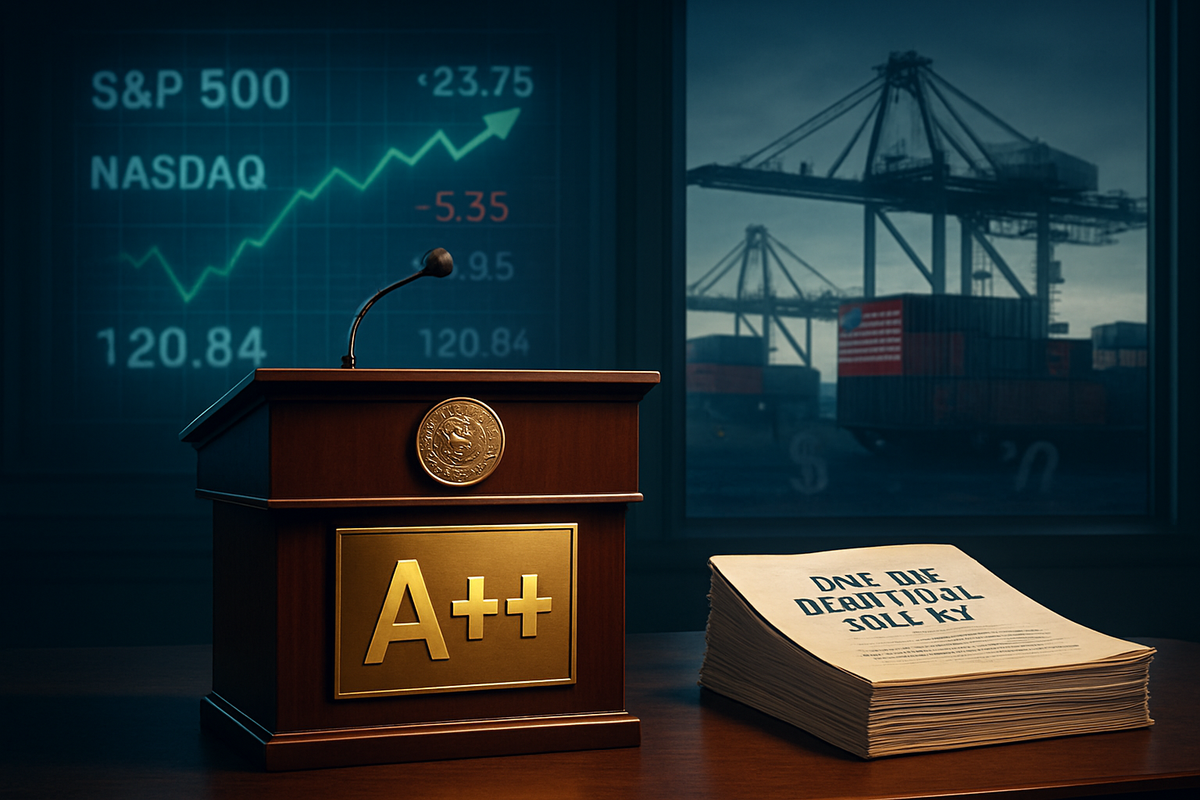
As the sun rises on January 1, 2026, the United States finds itself at a historical crossroads, caught between the triumphant rhetoric of an "Economic Revolution" and the sobering data of a cooling labor market. Former President Donald Trump, entering the second year of his second term, has spent the final weeks of 2025 grading the nation’s economy an "A++," citing a resilient stock market and the passage of his signature legislative achievement, the One Big Beautiful Bill Act (OBBBA). However, institutional analysts and market data suggest a more complex reality: a "see-saw" recovery marked by high tariffs, sticky inflation, and a labor market that is beginning to show cracks.
The immediate implications of this divide are profound for American investors. While the S&P 500 managed to close 2025 with a respectable 17% gain, much of that growth was fueled by a late-year recovery following a massive market correction in April—dubbed the "April Crash"—triggered by the administration’s aggressive new tariff regimes. As the 2026 fiscal year begins, the market is bracing for a potential showdown between the White House and the Federal Reserve, as Trump continues to lobby for drastic rate cuts to sustain the momentum of his trade policies.
The Year of the 'See-Saw': Tariffs, Shutdowns, and the OBBBA
The narrative of 2025 was defined by the July 4th signing of the One Big Beautiful Bill Act (OBBBA), a sweeping piece of legislation that made the 2017 tax cuts permanent, slashed corporate rates for domestic manufacturers to 15%, and eliminated federal taxes on tips and overtime. Trump has heralded the OBBBA as the catalyst for a manufacturing renaissance. However, the path to this legislation was fraught with volatility. A record-breaking 43-day government shutdown in late 2025 weighed heavily on fourth-quarter GDP, which struggled to reach 2.1%. Analysts at Goldman Sachs (NYSE: GS) note that while the OBBBA provided a significant fiscal stimulus, the "Liberation Day" tariffs—which brought the average effective U.S. tariff rate to 16.8%—have created a "low-hire, low-fire" environment.
The timeline of the past year reveals a series of high-stakes gambles. In April 2025, the administration implemented a 60% tariff on Chinese imports, sending the Nasdaq into a tailspin as tech giants scrambled to adjust supply chains. Trump responded to the market dip by coining the term "PANICANs" to describe those who doubted his trade strategy, insisting that the revenue—which reached $250 billion by year-end—would eventually replace the federal income tax. By December, the rhetoric shifted toward a promised $2,000 "Tariff Dividend" check for every American in 2026, a move that JPMorgan (NYSE: JPM) warns could further entrench inflation, which currently sits at a "sticky" 2.7%.
Corporate Winners and Losers in the New Trade Order
The impact of "Trumpnomics 2.0" has created a bifurcated corporate landscape. Among the primary winners is Pfizer (NYSE: PFE), which secured a landmark three-year tariff exemption by agreeing to lower domestic drug prices and participate in the "TrumpRX" direct-to-consumer platform. This strategic pivot has allowed Pfizer to avoid the 100% tariff threats facing other pharmaceutical firms that have not reshored production. Similarly, Nvidia (NASDAQ: NVDA) has maintained its market dominance, benefiting from OBBBA’s AI-focused deregulation and strategic exemptions for critical semiconductor hardware, keeping its market cap near the $4 trillion mark despite broader trade tensions.
Conversely, the "losers" of this era are those with deep ties to global supply chains. Apple (NASDAQ: AAPL) has faced significant headwinds, with the 60% China tariff adding an estimated $900 million in costs per quarter. While CEO Tim Cook has announced a massive multi-year investment in U.S. facilities, the transition has been slow, leaving the stock vulnerable to price hikes on its flagship products. Caterpillar (NYSE: CAT) has also struggled, reporting an aggregate $1.5 billion hit from tariff-related costs on imported steel and components. Meanwhile, John Deere (NYSE: DE) presents a mixed picture; while it faced a 200% tariff threat for moving production to Mexico, the OBBBA’s restoration of bonus depreciation for farm equipment has begun to stabilize its domestic margins as it reshores manufacturing.
Redefining the Global Trade Paradigm and Regulatory Landscape
The current economic climate represents a fundamental shift in how the U.S. interacts with the global market. The administration’s move toward "Reciprocal Trade" has pushed the U.S. toward a level of protectionism not seen since the 1930s. This shift has significant ripple effects on competitors and partners alike. For instance, the threat of 200% tariffs on automotive imports has forced companies like BMW (OTC:BMWYY) to reconsider their North American footprints, potentially leading to a glut of domestic manufacturing capacity that could take years to fully utilize.
This event fits into a broader trend of "economic nationalism" that is challenging the independence of the Federal Reserve. Trump has publicly criticized Fed Chair Jerome Powell—whom he has nicknamed "Too Late"—and signaled a desire to replace him with a more "consultative" leader when Powell’s term expires in May 2026. This potential loss of central bank autonomy has led Morgan Stanley (NYSE: MS) to assign a 35% probability of a recession in 2026, as investors fear that political pressure for 1% interest rates could reignite inflationary pressures that the OBBBA's tax cuts were intended to mitigate.
The 2026 Outlook: Strategic Pivots and Market Scenarios
As we look toward the remainder of 2026, several short-term possibilities emerge. The implementation of the $2,000 "Tariff Dividend" in the first quarter is expected to provide a temporary boost to consumer spending, potentially benefiting domestic retailers like Best Buy (NYSE: BBY) and Target (NYSE: TGT). However, the long-term sustainability of this model remains a point of contention. Companies will likely need to engage in "strategic reshoring" to take full advantage of the 15% domestic manufacturing tax rate, a pivot that requires significant capital expenditure and a stable regulatory environment.
The primary market opportunity lies in the energy sector. Companies like Freeport-McMoRan (NYSE: FCX) are poised to benefit from the OBBBA’s deregulation of the fossil fuel and nuclear industries. If the administration succeeds in lowering energy costs for AI data centers and manufacturing plants, it could offset the inflationary impact of tariffs. However, the "Trump chip tariff twist" and ongoing trade friction with China remain the ultimate wildcards. A successful negotiation or a "Phase 2" trade deal could send the S&P 500 toward Goldman Sachs' target of 7,600, while a breakdown could trigger a return to the volatility seen during the April Crash.
Conclusion: A High-Stakes Balancing Act for Investors
The start of 2026 is defined by a paradox: a booming stock market and aggressive fiscal policy set against a backdrop of rising unemployment (4.6%) and trade-induced uncertainty. The key takeaway for investors is that political rhetoric is now a primary driver of market sentiment, often outweighing traditional fundamental analysis. Trump’s "A++" economy is built on the hope that tariff revenue and domestic manufacturing can replace global trade dependencies without triggering a stagflationary spiral.
Moving forward, the market will be hyper-focused on two key events: the transition of the Federal Reserve leadership in May and the actual impact of the Tariff Dividends on consumer behavior. While the OBBBA provides a strong foundation for domestic growth, the "Reciprocal Trade" environment demands a more active and selective investment strategy. In the coming months, investors should watch for signs of labor market stabilization and any shifts in the administration's tariff stance, as these will be the true indicators of whether the "Economic Revolution" is a lasting reality or a temporary market high.
This content is intended for informational purposes only and is not financial advice