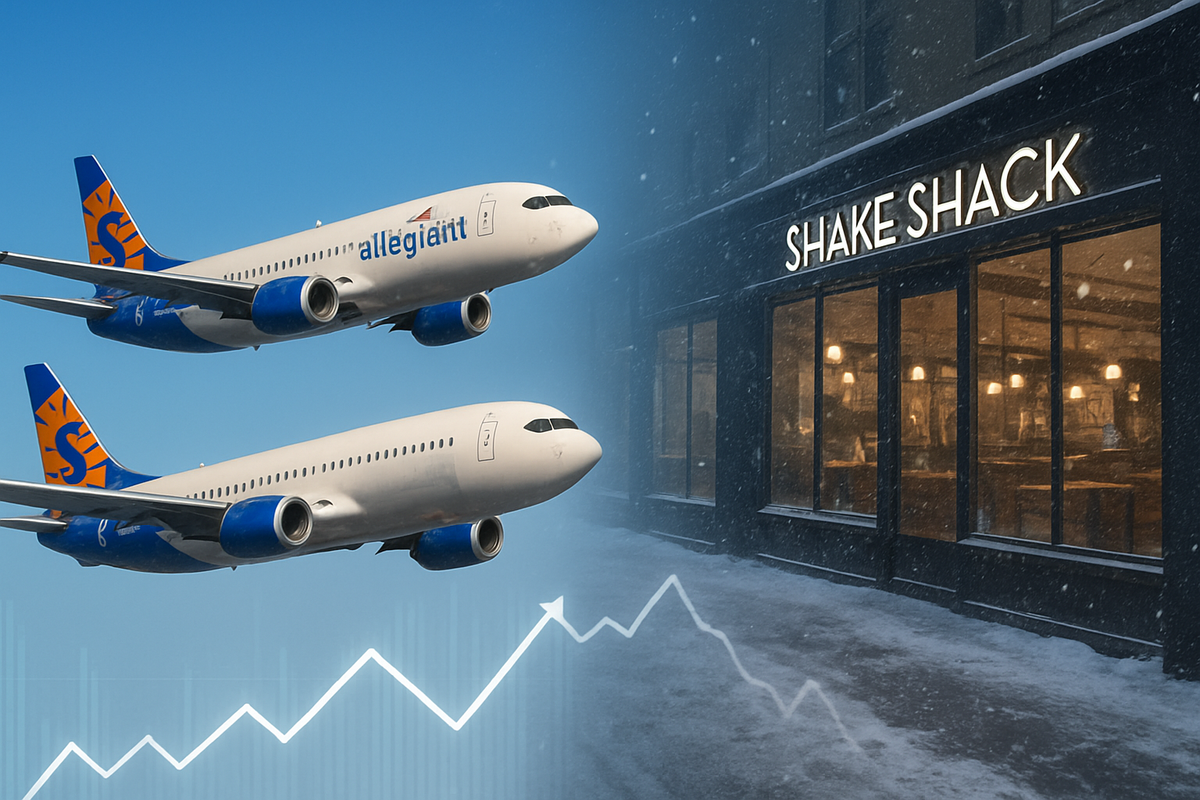
The consumer discretionary sector witnessed a dramatic start to the week as two industry stalwarts, Sun Country Airlines and Shake Shack, moved in sharply opposite directions. On January 12, 2026, the market was jolted by a definitive merger agreement in the airline space, while the fast-casual dining sector grappled with the cold reality of seasonal volatility. These moves highlight a widening gap in the "experience economy," where strategic consolidation is creating winners in travel, while regional sensitivities continue to plague premium dining brands.
The immediate implications are clear: the low-cost carrier landscape is undergoing its most significant transformation since the mid-2020s, potentially signaling a new era of "complementary" airline networks. Meanwhile, for the restaurant industry, the latest figures from the burger segment serve as a stark reminder that even the strongest brands remain at the mercy of the elements and a bifurcated consumer base that is increasingly selective about where it spends its discretionary dollars.
A $1.5 Billion Bet on the Skies
The headline event of the day was the announcement that Allegiant Travel Company (NASDAQ: ALGT) has entered into a definitive agreement to acquire Sun Country Airlines (NASDAQ: SNCY) in a deal valued at approximately $1.5 billion. The transaction, which includes the assumption of $400 million in net debt, offers Sun Country shareholders $18.89 per share—a mix of $4.10 in cash and 0.1557 shares of Allegiant stock. Investors reacted with immediate fervor, sending Sun Country’s shares soaring by more than 12% in premarket trading on Monday.
The deal marks the culmination of a strategic pivot for Sun Country, which has successfully operated a unique "three-pillar" business model consisting of scheduled leisure flights, charter services, and a robust cargo partnership with Amazon.com Inc (NASDAQ: AMZN). Allegiant CEO Gregory Anderson noted that the acquisition would create a "diversified leisure powerhouse" capable of competing more effectively against the "Big Four" carriers. The timeline for the merger aims for a close in the second half of 2026, pending a regulatory review that many analysts believe will be smoother than previous industry attempts at consolidation.
Key stakeholders, including Sun Country CEO Jude Bricker, have championed the move as a way to achieve scale in an environment plagued by rising pilot wages and maintenance costs. Bricker, who is expected to transition to a strategic advisory role and join the Allegiant Board of Directors upon closing, emphasized that the two airlines have almost no route overlap, a factor that could be the "silver bullet" for gaining Department of Justice (DOJ) approval.
Winners, Losers, and the Battle for the "Experience Dollar"
The primary winner in this scenario appears to be Sun Country (NASDAQ: SNCY), whose shareholders are receiving a 20% premium over the previous closing price. However, the broader low-cost carrier (LCC) segment is also watching closely. Competitors like Frontier Group Holdings (NASDAQ: ULCC) and Spirit Airlines (NYSE: SAVE) may find themselves at a disadvantage as Allegiant gains the scale and cargo revenue streams necessary to weather economic downturns. For Allegiant (NASDAQ: ALGT), the acquisition provides a crucial foothold in the Minneapolis-St. Paul hub and a diversified revenue stream that is less dependent on pure leisure ticket sales.
On the losing side of Monday’s market moves was Shake Shack (NYSE: SHAK). The company’s stock fell 3.3% after management issued a Q4 2025 guidance update that fell short of Wall Street expectations. Despite reporting its 2026 revenue targets of $1.6 billion to $1.7 billion, the short-term outlook was dampened by a significant miss in the final six weeks of 2025. CEO Rob Lynch attributed the performance to "inclement winter weather" in the Northeast—a region where the brand remains heavily concentrated.
The "weather miss" highlights a persistent vulnerability for Shake Shack compared to more geographically diverse competitors like Chipotle Mexican Grill (NYSE: CMG) or McDonald's Corp (NYSE: MCD). While Shake Shack has expanded into suburban markets and added drive-thrus, its high-volume urban locations in New York, Boston, and D.C. still rely heavily on foot traffic, which evaporates during harsh winters. Analysts at JPMorgan and Wells Fargo remain cautious, noting that the company’s "nosebleed" valuation—trading at nearly 80 times forward earnings—leaves little room for seasonal errors.
Industry Trends and the Regulatory Shadow
The Allegiant-Sun Country merger is a direct response to the "strategic specialization" trend currently sweeping the travel industry. After the DOJ successfully blocked the JetBlue (NASDAQ: JBLU) and Spirit Airlines merger in 2024, carriers have learned that "cannibalistic" mergers—those that eliminate direct competition on many routes—are non-starters. In contrast, the ALGT/SNCY deal follows the blueprint of the Alaska Air Group (NYSE: ALK) and Hawaiian Holdings merger, which was cleared because of its complementary network.
Beyond the airline gates, the consumer discretionary sector is facing a "bifurcation" of the American shopper. High-income consumers continue to splurge on premium fast-casual dining and leisure travel, but they are becoming more sensitive to service disruptions and weather. Meanwhile, lower-income demographics are pulling back significantly, squeezed by persistent beef inflation—currently in the mid-teens—and the looming threat of new tariffs on imported goods.
Historical precedents suggest that weather-related misses for brands like Shake Shack are often "transitory," but the frequency of these events in 2025 and early 2026 has raised questions about the brand's resilience in a changing climate. Furthermore, the restaurant industry is bracing for potential labor shortages and immigration enforcement policies from the current administration, which could further strain the margins of urban-centric brands that rely on a diverse service workforce.
The Road Ahead: Integration and Innovation
Looking forward, the success of the Allegiant-Sun Country tie-up will depend on a seamless integration of two very different operational cultures. Allegiant’s focus on ultra-low-cost, point-to-point service must be reconciled with Sun Country’s complex charter and cargo operations. In the short term, investors will be watching for any signs of "merger indigestion," such as labor disputes or IT integration hurdles that have historically plagued airline consolidations.
For Shake Shack, the mandate for 2026 is clear: geographic diversification and digital resilience. To mitigate its "Northeast problem," the company must accelerate its expansion into the Sun Belt and West Coast, while continuing to refine its "Shack Track" digital ordering system. The departure of CFO Katie Fogertey in March 2026 adds a layer of leadership transition risk that the company must navigate as it tries to prove to investors that it can maintain its premium status while scaling into a global powerhouse.
Market opportunities may emerge in the cargo space, as the combined Allegiant-Sun Country entity could look to expand its relationship with major e-commerce players. Conversely, the biggest challenge for both companies will be the macro-economic environment. If the "tariff ceasefire" seen in early January fails to hold, the cost of kitchen equipment for Shake Shack and aircraft parts for Allegiant could spike, putting further pressure on bottom-line growth.
Final Thoughts for the Savvy Investor
The events of January 12, 2026, underscore a fundamental shift in the consumer discretionary landscape. Consolidation is no longer just about size; it is about "defensive diversification." Allegiant’s acquisition of Sun Country is a bold move to protect against the volatility of leisure travel by leaning into cargo and charter stability. For Shake Shack, the recent dip is a reminder that brand prestige cannot always overcome regional concentration and seasonal headwinds.
The key takeaways for investors are twofold. First, the regulatory environment for mergers has become more predictable, favoring "complementary" deals over "competitive" ones. Second, the "experience economy" is becoming increasingly fragmented; companies that cannot adapt to the bifurcated spending habits of consumers will likely struggle.
In the coming months, watch for the DOJ's initial response to the Allegiant filing and keep a close eye on Shake Shack’s Q1 2026 traffic numbers. If the brand can show a strong rebound from the winter slump, it may justify its high valuation. However, in an era of climate volatility and shifting trade policies, the only certainty is that the "discretionary" in consumer discretionary will be more hard-earned than ever before.
This content is intended for informational purposes only and is not financial advice.