As the fourth-quarter earnings season for 2025 kicks off this week, the traditional celebration of corporate profitability has been replaced by a sense of profound unease across Wall Street. While the nation’s largest financial institutions—led by JPMorgan Chase (NYSE: JPM) and Bank of America (NYSE: BAC)—were expected to post stellar results following a banner year for investment banking, a "perfect storm" of political and regulatory shocks has shifted the narrative. Investors are no longer looking at the balance sheets of the past; they are staring into a future defined by a constitutional crisis at the Federal Reserve and an aggressive new populist agenda targeting the industry’s most lucrative revenue streams.
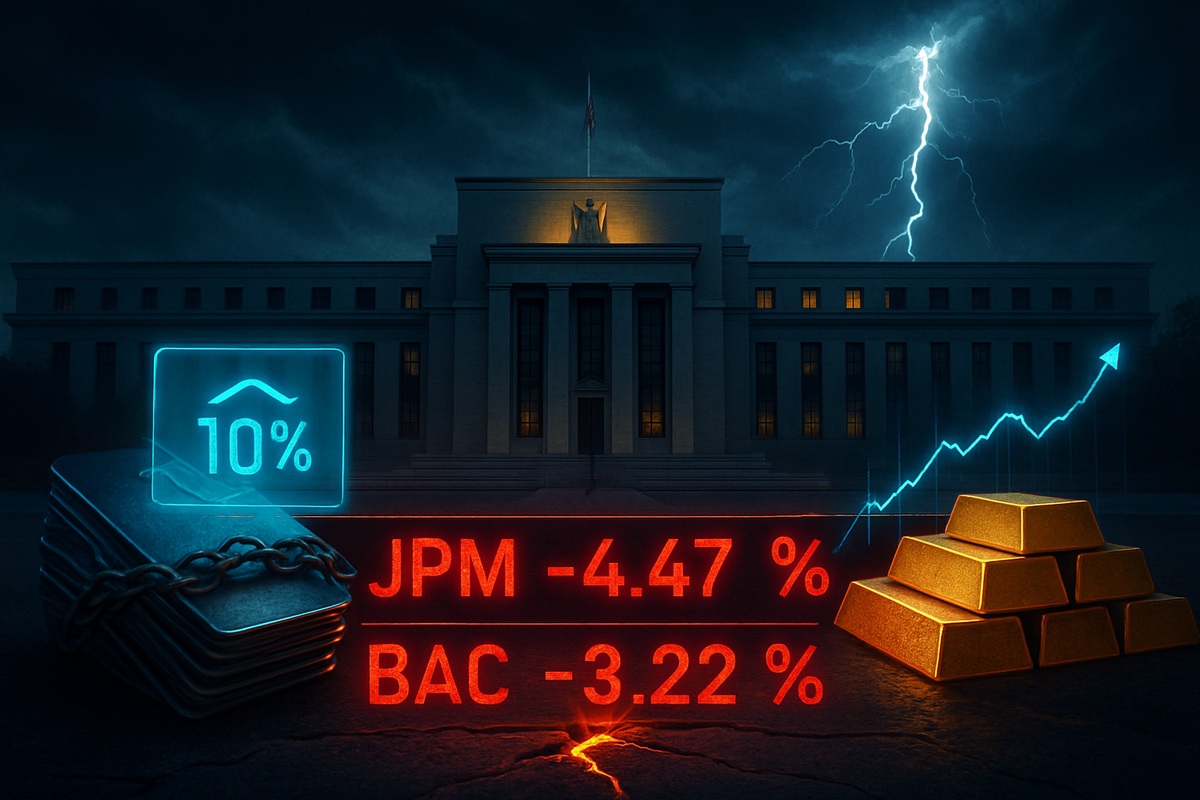
The immediate catalyst for this market turbulence is a dual-pronged assault on the status quo: a historic confrontation between the executive branch and Fed Chair Jerome Powell, and a surprise proposal to cap credit card interest rates at 10%. On Monday, January 12, 2026, the markets reacted with visible distress as the U.S. Dollar Index plummeted to 99.03 and gold prices shattered records, hitting $4,612 per ounce. What was meant to be a victory lap for a resilient banking sector has instead become a defensive struggle against unprecedented political volatility.
A Central Bank Under Siege: The Powell Subpoena
The stability of the U.S. financial system was rocked on the evening of Sunday, January 11, 2026, when Federal Reserve Chair Jerome Powell released a somber video statement confirming that the Department of Justice (DOJ) had served the central bank with grand jury subpoenas. The investigation ostensibly centers on a $2.5 billion renovation of the Fed’s Washington D.C. headquarters, but Powell was quick to characterize the move as a "political pretext." According to Powell, the investigation is a direct retaliation for the Fed’s refusal to implement the deep 2% interest rate cuts demanded by the Trump administration in late 2025, with the central bank instead opting for a more conservative 75-basis-point reduction to keep inflation at bay.
This confrontation marks the most significant threat to central bank independence in modern American history. The Senate Banking Committee has already signaled a legislative stalemate, vowing to block any new Fed nominees until the "legal intimidation" of the central bank ceases. The timeline of this crisis moved with lightning speed, evolving from a series of social media critiques of the Fed’s "high-rate policy" in December to a full-blown criminal investigation by the second week of January.
The market's initial reaction has been one of flight. On Monday, shares of major banks slid, with Citigroup (NYSE: C) dropping 4% and JPMorgan Chase falling 3% in early trading. The uncertainty surrounding the leadership of the world's most powerful central bank has triggered a massive rotation into safe-haven assets, as the prospect of a leaderless or politically compromised Fed threatens the very foundations of global monetary policy.
Winners, Losers, and the 10% Threshold
The earnings outlook for the "Big Four" is now being viewed through the lens of a new regulatory threat: the proposed 10% cap on credit card interest rates. Announced late last week, the proposal aims to implement a temporary one-year ceiling on card rates effective January 20, 2026. This populist move, which mirrors the "10 Percent Credit Card Interest Rate Cap Act" previously championed by a bipartisan group of senators, has sent shockwaves through consumer-facing lenders.
Bank of America (NYSE: BAC) and Citigroup (NYSE: C) appear most vulnerable to this shift. Both institutions have significant consumer credit portfolios that rely on high-yield interest income to offset lower margins in other divisions. Analysts estimate that a 10% cap could save consumers $100 billion annually, but that liquidity would come directly out of the banks' Net Interest Income (NII). For Bank of America, which was projected to show 13% net income growth this quarter, the cap could turn a year of momentum into a year of retrenchment.
In contrast, Wells Fargo (NYSE: WFC) and JPMorgan Chase (NYSE: JPM) may be better positioned to weather the storm due to their diversified revenue streams and ongoing efficiency drives. Wells Fargo, in particular, has spent years cleaning up its balance sheet and may have more room to absorb regulatory shocks than its peers. However, the American Bankers Association (ABA) has warned that such a cap will force all major players to "cancel millions of cards" for subprime borrowers, as the 10% limit makes it impossible to price for the risk of default in a cooling labor market.
The Populist Pivot and Historical Precedents
The current environment represents a radical departure from the traditional regulatory landscape. For decades, the Federal Reserve operated with a high degree of autonomy, and interest rate caps were largely relegated to the fringes of economic debate. The convergence of a "Fed Leadership Crisis" and a populist rate-cap proposal suggests a fundamental shift in how the U.S. government interacts with the financial sector. This event fits into a broader global trend of "regulatory populism," where elected officials bypass traditional administrative processes to provide direct, visible relief to voters.
Historically, the closest comparison to the current Fed crisis might be the pressure faced by Paul Volcker in the early 1980s, though even then, the threat of criminal investigation was never utilized as a tool of policy persuasion. The ripple effects of this confrontation are likely to be felt by every competitor in the financial space, from regional banks to fintech disruptors. If the Fed's independence is perceived to be compromised, the "inflation premium" on long-term bonds could rise significantly, complicating the very rate cuts the administration seeks.
Furthermore, the 10% rate cap proposal effectively negates the recent "win" banks secured regarding the removal of the $8 late fee cap. While the administration supported allowing banks to return to higher fee structures, the interest rate ceiling is a far more devastating blow to the industry's bottom line.
The Road Ahead: Earnings in the Shadow of Jan 20
As JPMorgan Chase and Wells Fargo prepare to report their Q4 2025 results on Tuesday, January 13, the numbers themselves may take a backseat to the forward-looking guidance. Analysts will be listening intently for any mention of "strategic pivots" or plans to scale back consumer lending in anticipation of the January 20 effective date for the rate cap. The short-term possibility of a legal challenge to the executive order is high, but the damage to investor sentiment may already be done.
In the long term, the banking sector may be forced to adapt by moving away from interest-dependent revenue toward fee-based services or more conservative commercial lending. However, such a transition takes years, not weeks. The immediate challenge will be navigating a market where "political risk" has become the primary metric for valuation. If the Fed leadership crisis is not resolved quickly, the market could see a sustained period of volatility that undermines the broader economic recovery.
Conclusion: A Season of Uncertainty
The Q4 2025 earnings season will be remembered not for the record dealmaking or the robust consumer spending of the previous year, but for the moment the "rules of the game" were rewritten. The key takeaways for investors are clear: operational excellence is no longer a shield against political volatility. The major banks are entering 2026 with strong balance sheets but facing an existential threat to their traditional business models.
As we move forward, the market will be watching two dates with intense focus: January 13, for the first glimpse of how bank CEOs plan to navigate this crisis, and January 20, the proposed implementation of the rate cap. For now, the "valuation overhang" caused by the Fed crisis and populist regulation remains the dominant force on Wall Street. Investors should remain defensive, keeping a close eye on gold and other safe havens as the battle for the future of American finance unfolds.
This content is intended for informational purposes only and is not financial advice.