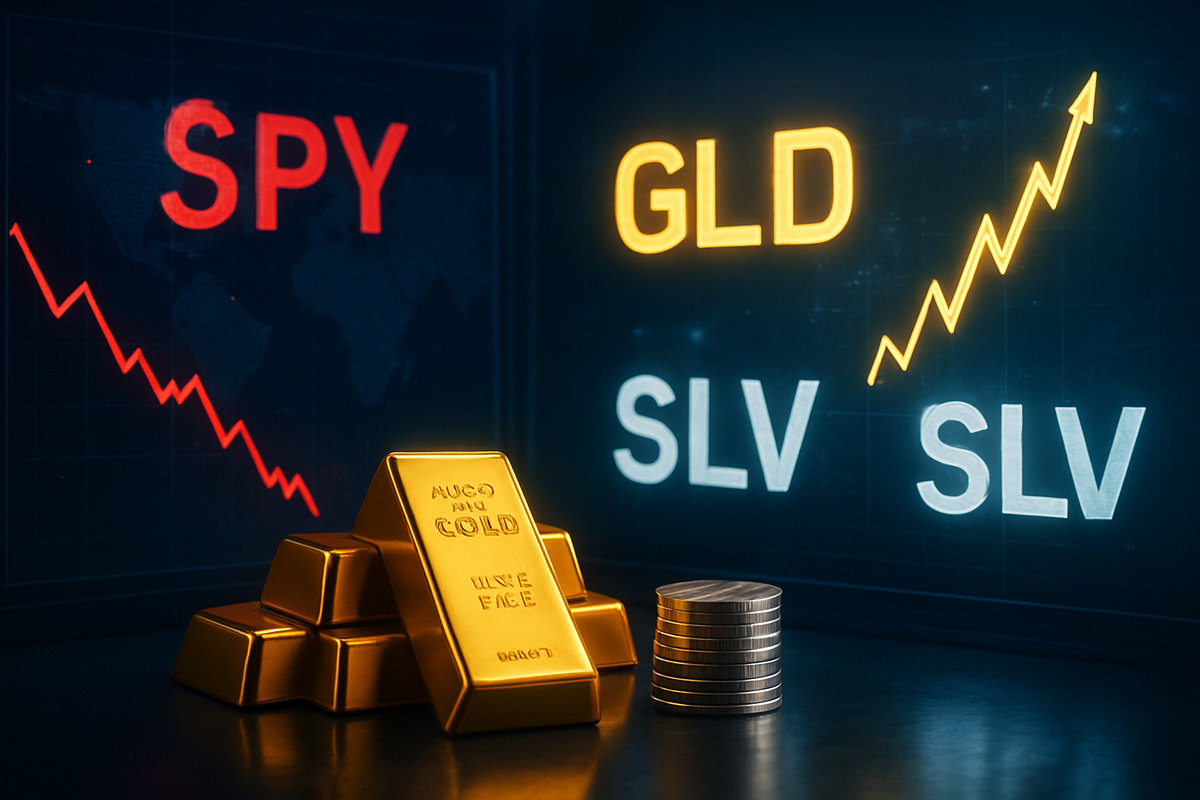
In the first six trading days of 2026, the global financial landscape has undergone a seismic structural shift, as investors moved a staggering $46 billion into Exchange-Traded Funds (ETFs). This massive wave of capital represents nearly four times the typical historical volume for the start of a year, signaling a "violent recalibration" of risk. While the broader market remains on edge, the data reveals a clear and urgent narrative: a mass exodus from traditional equities in favor of the timeless security of precious metals.
The primary casualty of this rotation has been the SPDR S&P 500 ETF Trust (NYSEARCA:SPY), which saw approximately $8 billion in outflows during this period. While early January often sees seasonal selling for tax-loss harvesting, the scale of the departure from the S&P 500 has been overwhelmed by record-breaking inflows into safe-haven vehicles. The SPDR Gold Shares (NYSEARCA:GLD) and the iShares Silver Trust (NYSEARCA:SLV) have emerged as the primary beneficiaries, as gold prices shattered records to trade above $4,600 per ounce and silver spiked to a multi-decade high of over $84 per ounce.
A Perfect Storm: Subpoenas, Geopolitics, and Economic Cracks
The catalyst for this unprecedented movement of capital was a "perfect storm" of institutional and geopolitical shocks that converged during the second week of January. The most jarring headline arrived on Sunday, January 11, 2026, when news broke that the U.S. Justice Department had served grand jury subpoenas to the Federal Reserve and Chair Jerome Powell personally. While the investigation ostensibly concerns administrative costs related to headquarters renovations, Powell has publicly characterized the move as a "pretext" for political intimidation by the executive branch. The perceived threat to the Federal Reserve’s independence has sparked a "sell-America" trade, with investors fleeing dollar-denominated paper assets in fear of a looming constitutional and monetary crisis.
Compounding this domestic instability is a rapidly deteriorating geopolitical situation. In Iran, intensifying anti-government protests have reportedly led to hundreds of casualties, prompting the U.S. administration to warn of "very strong options" targeting Iranian military assets. Simultaneously, the fallout from the recent capture of former President Nicolás Maduro in Venezuela by U.S. special forces has left the energy markets in a state of high anxiety. When combined with a December jobs report that showed a measly 50,000 new payrolls—well below the 60,000 forecast—the narrative of a "soft landing" for the U.S. economy has effectively evaporated, replaced by a desperate search for hard-asset protection.
Winners and Losers in the New Metal Super-Cycle
As the S&P 500 faces structural headwinds, the precious metals mining sector has entered a historic "super-cycle." Newmont Corporation (NYSE: NEM), the world’s largest gold producer, has seen its stock price surge to all-time highs near $106.38, a 178% increase over the past year. Newmont’s operational success at its Ahafo North project has allowed it to capture the full upside of $4,600 gold, making it a cornerstone for institutional portfolios. Similarly, Barrick Gold Corporation (NYSE: GOLD) has leveraged its Tier-One assets to project a 48% growth in earnings per share for 2026, with its stock trading near $39.14.
The silver market has been even more volatile, driven by a supply squeeze after China reclassified silver as a "strategic dual-use material" and restricted exports on January 1. Pan American Silver Corp. (NASDAQ: PAAS) has emerged as a top-tier performer, rising 163% over the last 12 months to $54.27, following its strategic acquisition of MAG Silver. Pure-play miners like First Majestic Silver Corp. (NYSE: AG) and Hecla Mining Company (NYSE: HL) are also seeing massive gains, with First Majestic trading near $19 as it benefits from its high beta to the silver price. Conversely, the "losers" in this environment are the broad-market index funds and consumer-discretionary stocks that rely on a stable dollar and low inflation—both of which are currently under siege.
Institutional Trust and the "Sell America" Trade
The wider significance of this $46 billion shift cannot be overstated. It marks a fundamental breakdown in the "60/40" portfolio logic that has dominated the last decade. Historically, the U.S. Treasury market and the S&P 500 were the twin pillars of global stability. However, the DOJ’s move against the Federal Reserve has introduced a "sovereign risk" premium into U.S. assets that was previously unthinkable. Analysts are now comparing this moment to the 1970s stagflation era, but with the added complication of modern algorithmic trading and the rapid-fire liquidity of the ETF market.
Furthermore, the "silver squeeze" initiated by China’s export controls suggests that precious metals are no longer just inflation hedges; they are becoming strategic industrial battlegrounds. As silver is essential for high-tech manufacturing and green energy, the $84 price tag reflects a structural deficit that cannot be easily solved by increasing mining output. This ripple effect is forcing competitors in the tech and automotive sectors to reconsider their supply chains, potentially leading to a new wave of resource nationalism that could further fragment global trade.
The Road Ahead: Potential Scenarios and Strategic Pivots
Looking forward, the market is bracing for the next Federal Open Market Committee (FOMC) meeting, where Jerome Powell’s demeanor and the Fed’s policy stance will be scrutinized for any signs of capitulation to political pressure. If the Fed maintains its independence and signals aggressive rate cuts to combat the weakening jobs market, gold could see even further gains as real yields plunge. However, any sign of a "politicized" Fed could lead to a catastrophic loss of confidence in the U.S. Dollar, potentially pushing gold toward the $5,000 mark.
Investors should also watch for a potential "short squeeze" in the silver market. With SLV seeing record inflows and physical inventories at multi-year lows, the conditions are ripe for a parabolic move that could dwarf the gains seen in early January. Companies like Agnico Eagle Mines Limited (NYSE: AEM) are already pivoting their exploration budgets toward silver-heavy deposits in anticipation of sustained high prices. The short-term challenge for the market will be navigating the extreme volatility, while the long-term opportunity lies in identifying which miners can maintain low All-In Sustaining Costs (AISC) in an inflationary environment.
Summary of a Market in Transition
The events of the first two weeks of 2026 have rewritten the playbook for global investors. The $46 billion shift into ETFs—and specifically the flight from (NYSEARCA:SPY) into (NYSEARCA:GLD) and (NYSEARCA:SLV)—is not merely a temporary trend; it is a structural response to the erosion of institutional trust and the escalation of global conflict. Gold at $4,600 and silver at $84 are the new benchmarks of a world where hard assets are the only perceived certainty.
Moving forward, the market will remain hyper-sensitive to the DOJ's investigation into the Federal Reserve and the unfolding crises in the Middle East and South America. Investors should keep a close eye on the performance of major miners like (NYSE: NEM) and (NASDAQ: PAAS) as bellwethers for the sector's health. In this "Great Recalibration," the ability to distinguish between paper promises and physical reality will be the defining factor for portfolio survival.
This content is intended for informational purposes only and is not financial advice.