As the sun rises on the final days of January 2026, the financial world has its eyes fixed on a single entity: Meta Platforms (NASDAQ: META). Following a turbulent 2025 that saw the social media giant grapple with a "death cross" and fluctuating investor sentiment, the company is set to release its fourth-quarter 2025 earnings report. The stakes have never been higher, as Meta is expected to reveal its most aggressive capital expenditure (CapEx) forecast in corporate history, potentially crossing the $100 billion annual threshold for the first time.
The immediate implications are profound. Meta is no longer just a social networking company; it has transitioned into a global infrastructure powerhouse, challenging the traditional "Cloud Three" dominance of Microsoft, Alphabet, and Amazon. With its stock successfully reclaiming its 50-day and 200-day moving averages in recent sessions, technical traders are signaling a renewed confidence, even as the company prepares to justify a spending spree that could fundamentally redefine the "Magnificent Seven" hierarchy.
The AI Arms Race: $109 Billion and the Quest for Autonomy
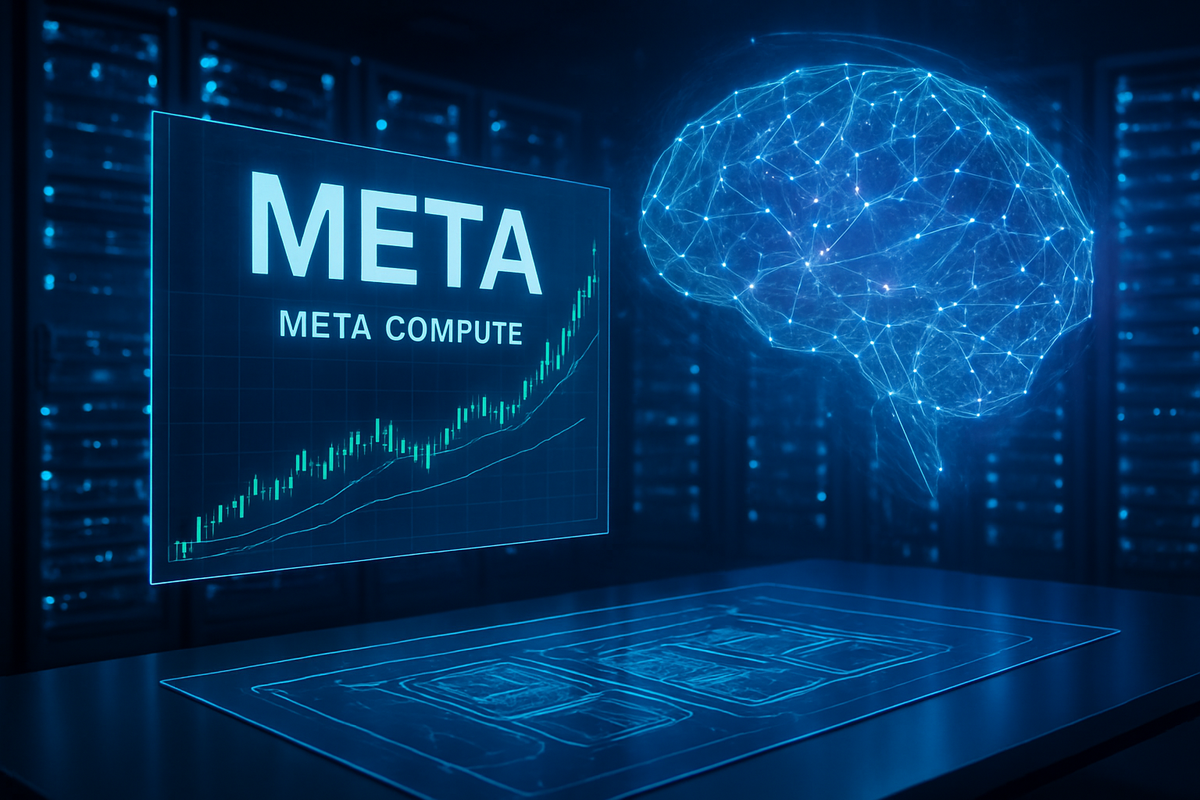
Wall Street analysts are converging on a revenue estimate of $58.45 billion for the fourth quarter, representing a robust 21% year-over-year increase. However, the top-line growth is being overshadowed by the staggering costs of the company’s "Meta Compute" initiative. Guidance for 2026 capital expenditure is expected to land between $105 billion and $117 billion, a massive jump from the $70 billion spent in 2025. This spend is aimed directly at the heart of the AI revolution: securing the massive compute clusters necessary to power the next generation of autonomous agents.
This spending trajectory follows a timeline of intense infrastructure expansion throughout late 2025. Meta recently brought its "Prometheus" cluster online—a 1-gigawatt facility utilizing Nvidia’s (NASDAQ: NVDA) latest GB300 accelerators alongside Meta’s own custom "Clemente" silicon. Under the leadership of infrastructure veteran Santosh Janardhan and Daniel Gross, Meta has prioritized building a unified software stack capable of training trillion-parameter models across geographically dispersed data centers. This infrastructure is the backbone for the highly anticipated Llama 4 Behemoth, a 288-billion-parameter model designed to move Meta from simple chatbots to agentic AI capable of autonomous reasoning.
Winners and Losers in the Age of High-Octane Infrastructure
The primary beneficiary of Meta’s spending binge remains Nvidia (NASDAQ: NVDA), which continues to supply the lion’s share of the 1.3 million GPUs Meta expects to have deployed by mid-2026. However, the narrative is shifting toward diversification. Broadcom Inc. (NASDAQ: AVGO) has emerged as a critical winner, serving as the co-development partner for Meta’s custom MTIA (Meta Training and Inference Accelerator) chips. As Meta seeks to reduce its long-term reliance on external chip designs, Broadcom’s role in networking and custom silicon has made it an indispensable pillar of the Meta ecosystem.
On the losing side of this equation are smaller social media rivals that lack the capital to compete in the generative AI space. Companies like Snap Inc. (NYSE: SNAP) and Pinterest (NYSE: PINS) find themselves increasingly reliant on the infrastructure of their larger competitors or facing a widening gap in ad-targeting efficiency. For Meta, the "Return on Investment" (ROI) is internal. While Microsoft and Alphabet rent out their compute via cloud services, Meta’s ROI is measured by the performance of its "Advantage+" automated ad system. If Meta can prove that its AI can increase advertiser conversion rates by another 20%, the $100 billion spend might just look like a bargain.
Regulatory Headwinds and the ROI Disillusionment Debate
Meta’s aggressive expansion fits into a broader industry trend of "foundational model dominance," where the cost of entry into top-tier AI has become prohibitive for all but a few companies. Yet, this consolidation of power has caught the attention of regulators. On January 20, 2026, the U.S. Federal Trade Commission announced an appeal of a 2025 ruling that had initially cleared Meta of monopoly charges, keeping the threat of a forced divestiture of Instagram and WhatsApp alive. Meanwhile, the European Union’s AI Act reaches full enforcement this August, placing strict transparency requirements on Meta’s open-source Llama models.
The broader market significance lies in the ongoing debate over AI disillusionment. Many value-oriented investors are beginning to question when the "AI summer" will translate into bottom-line profits that outpace infrastructure depreciation. Meta has been the most vocal defender of the "build-now-pay-later" philosophy, arguing that the risk of being under-equipped is far greater than the risk of over-investing. This philosophy has historically served CEO Mark Zuckerberg well, as evidenced by his previous successful pivots to mobile and video, but the sheer scale of the 2026 CapEx guidance is testing the resolve of even the most bullish long-term holders.
The Path Forward: Agentic AI and Autonomous Commerce
Looking ahead, the immediate focus for Meta will be the rollout of "Fully Automated Ad Campaigns" in the first half of 2026. This system is designed to allow a merchant to simply provide a product URL, after which Meta’s AI generates all creative assets, targets the ideal audience, and manages the budget in real-time. If successful, this could turn Meta into the world’s most efficient sales engine, automating the customer journey from discovery to purchase on WhatsApp and Instagram.
In the long term, Meta’s strategic pivot toward "Meta Compute" suggests the company is preparing for a world where every individual has a personal AI agent. These agents will require constant, low-latency compute power to interact with the world on behalf of users. The challenge will be managing the margin pressure as these services scale. Analysts will be watching for any signs of "Capex fatigue" or a strategic pivot if revenue growth fails to stay above the 20% mark in an increasingly saturated digital advertising market.
Final Assessment: A Technical Recovery Meets a Financial Frontier
Meta’s Q4 2025 earnings report is more than a quarterly update; it is a referendum on the future of the company. The stock’s recent technical recovery—reclaiming its 50-day moving average of $643 and 200-day average of $650—suggests that the market is currently giving Zuckerberg the benefit of the doubt. Trading near $673 just ahead of the release, the stock reflects a belief that Meta’s AI infrastructure will yield superior monetization compared to its peers.
Investors should watch for three key things in the coming months: the specific 2026 CapEx range provided by CFO Susan Li, the adoption rate of agentic AI tools among small businesses, and any further developments in the FTC’s appeal. Meta has successfully navigated "pivot years" before, but the move into 2026 represents a leap into a financial frontier where the costs are measured in hundreds of billions and the rewards are measured in the total automation of the digital economy.
This content is intended for informational purposes only and is not financial advice.