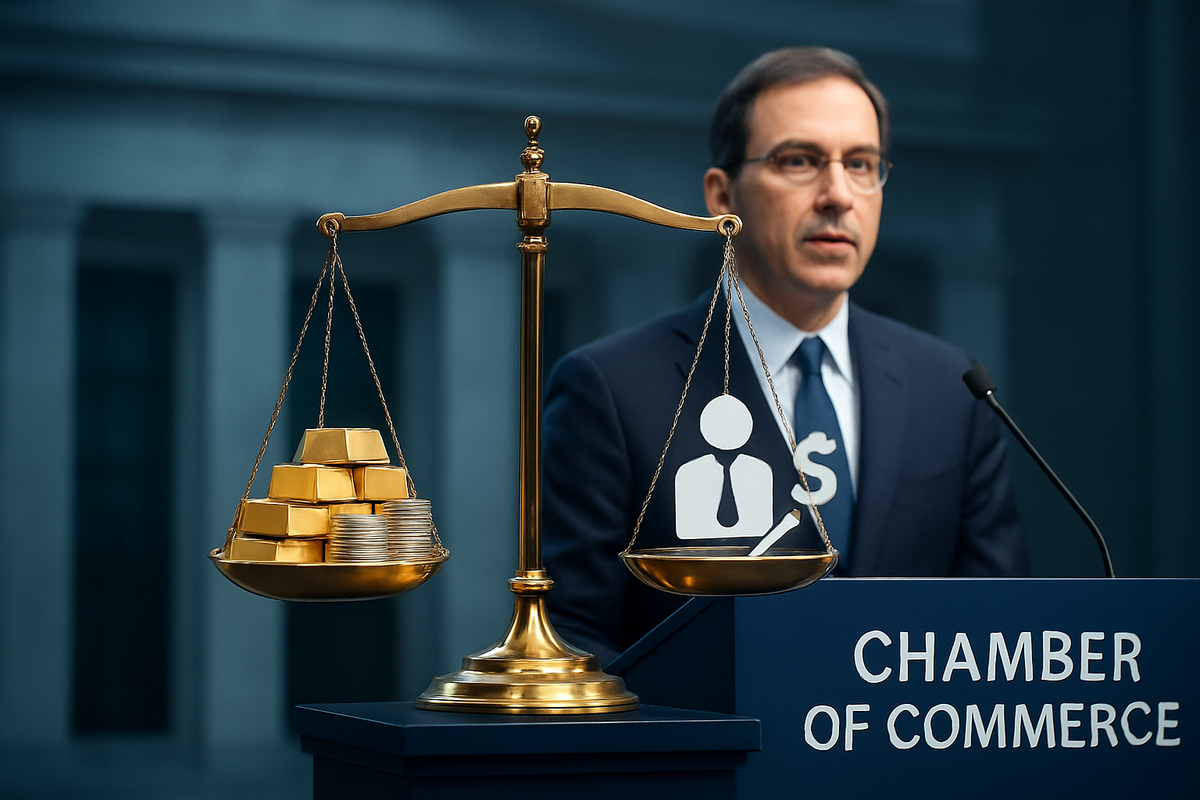
In a high-stakes address that has sent ripples through global commodity markets, Richmond Federal Reserve President Tom Barkin warned on Tuesday that the U.S. central bank is now facing symmetric risks to both sides of its dual mandate. Speaking at a Raleigh Chamber of Commerce meeting on January 6, 2026, Barkin characterized the current economic environment as a "finely tuned" phase where the threat of persistent inflation and a cooling labor market carry equal weight. His comments, first detailed in a comprehensive report by The Economic Times, suggest a significant shift in the Fed’s trajectory as it moves away from the aggressive easing seen in late 2025.
The immediate reaction in the financial markets was one of sharp volatility. While precious metals initially surged on the back of escalating geopolitical tensions in South America, Barkin’s rhetoric—widely interpreted as "hawkishly neutral"—prompted a swift intraday reversal. As investors weighed the likelihood of a pause in interest rate cuts, gold and silver prices retreated from their weekly highs, highlighting the market's extreme sensitivity to the Federal Reserve's next moves in an era of 3.5%–3.75% interest rates.
A Neutral Stance in a Fragile Economy
Barkin’s speech arrived at a critical juncture for the U.S. economy. Following 75 basis points of rate cuts in the final quarter of 2025, the federal funds rate currently sits in the 3.50%–3.75% range. Barkin noted that this level is likely within the "range of estimates of neutral," implying that the period of "insurance cuts" intended to stave off a recession may have reached its conclusion. According to The Economic Times, Barkin emphasized that while the hiring rate has slowed significantly, the Fed must remain vigilant to ensure that inflation expectations do not become permanently embedded above the 2% target.
The timeline leading to this moment has been marked by a period of profound uncertainty. Throughout 2025, the U.S. economy grappled with a government shutdown and a narrowing labor market where job growth was largely confined to the healthcare and artificial intelligence sectors. Barkin’s assessment that the "fog" of 2025 is beginning to lift suggests a transition to a more data-dependent, "adaptive" policy. However, the market’s reaction indicates that this transition will be anything but smooth, as the 81.7% probability of a rate pause in late January has now become the baseline expectation for Wall Street.
Winners and Losers in the ‘Higher for Longer’ Neutrality
The shift toward a potential rate pause creates a complex landscape for public companies, particularly those in the materials and mining sectors. Major gold producers like Newmont Corporation (NYSE: NEM) and Barrick Gold Corporation (NYSE: GOLD) find themselves in a precarious position. While gold prices remain historically high, hovering near $4,500 per ounce, the prospect of a Fed pause limits the non-yielding asset's upside potential. These companies benefit from high spot prices but face pressure if the U.S. dollar remains strong due to the Fed's reluctance to cut further.
In the silver market, the impact has been even more pronounced. First Majestic Silver Corp. (NYSE: AG) and Pan American Silver Corp. (NASDAQ: PAAS) saw their shares fluctuate wildly as silver prices dipped from a peak of $80 per ounce. The "silver price crash" reported by The Economic Times following Barkin's comments was driven by profit-taking and margin hikes, hitting silver-heavy portfolios. Conversely, the iShares Silver Trust (NYSEARCA:SLV) and SPDR Gold Shares (NYSEARCA:GLD) remain popular vehicles for investors seeking a hedge against the geopolitical instability in Venezuela, even as the Fed’s interest rate path becomes less accommodative.
Wider Significance and Historical Precedents
Barkin’s "delicate balance" rhetoric fits into a broader historical trend where the Federal Reserve must pivot from fighting inflation to protecting the labor market without reigniting price pressures. This mirrors the "soft landing" attempts of the mid-1990s, though with the added complexity of modern structural deficits in precious metals and the disruptive influence of AI on employment. The current situation is unique because of the persistent inflation that has remained above target for nearly five years, making the Fed's margin for error exceptionally thin.
The ripple effects of Barkin’s comments extend beyond the U.S. borders. As the Fed signals a potential plateau, other central banks may be forced to recalibrate their own easing cycles to prevent currency devaluations. The geopolitical shock of the U.S. military operation in Venezuela has further complicated this dynamic, as the traditional safe-haven appeal of gold clashes with the reality of a Fed that is no longer in a hurry to lower the cost of capital. This creates a "tug-of-war" between macro-policy and geopolitical risk that could define the first half of 2026.
The Road Ahead: Data Dependency and Strategic Pivots
Looking forward, the market’s focus will shift entirely to incoming labor data, specifically the December Nonfarm Payrolls report. Barkin explicitly stated that the Fed’s next moves would be adaptive to this data, especially after the data scarcity caused by the recent government shutdown. If the labor market shows further signs of deterioration, the Fed may be forced to abandon its "neutral" stance and resume cuts, a scenario that would likely send gold and silver to new record highs.
In the long term, strategic adaptations will be required from both investors and corporations. If the Fed successfully maintains a plateau at 3.5%, the era of "easy money" is officially over. Financial institutions and capital-intensive industries will have to adjust to a higher cost of debt than was expected just two years ago. However, firms like Morgan Stanley remain bullish on the commodities sector, forecasting gold to reach $4,800 by the end of 2026, suggesting that the underlying inflationary pressures and structural supply issues in metals may ultimately outweigh the Fed's interest rate maneuvers.
Summary and Investor Outlook
Tom Barkin’s Raleigh address has served as a sobering reminder that the Federal Reserve’s battle is far from won. By highlighting the risks to both inflation and employment, Barkin has effectively tempered expectations for continued aggressive rate cuts, leading to a stabilization of the U.S. dollar and a cooling of the recent rally in precious metals. The key takeaway for investors is that the Fed has reached its perceived "neutral" zone, and future policy will be dictated by hard data rather than forward guidance.
Moving forward, the market will be characterized by heightened sensitivity to employment figures and geopolitical developments. Investors should keep a close watch on the January FOMC meeting and the subsequent labor reports to see if the "delicate balance" Barkin described holds firm. While the short-term outlook for gold and silver may involve a period of consolidation, the long-term structural drivers for these assets remain potent, especially if the Fed’s attempt at a "finely tuned" landing encounters unexpected turbulence in the coming months.
This content is intended for informational purposes only and is not financial advice.