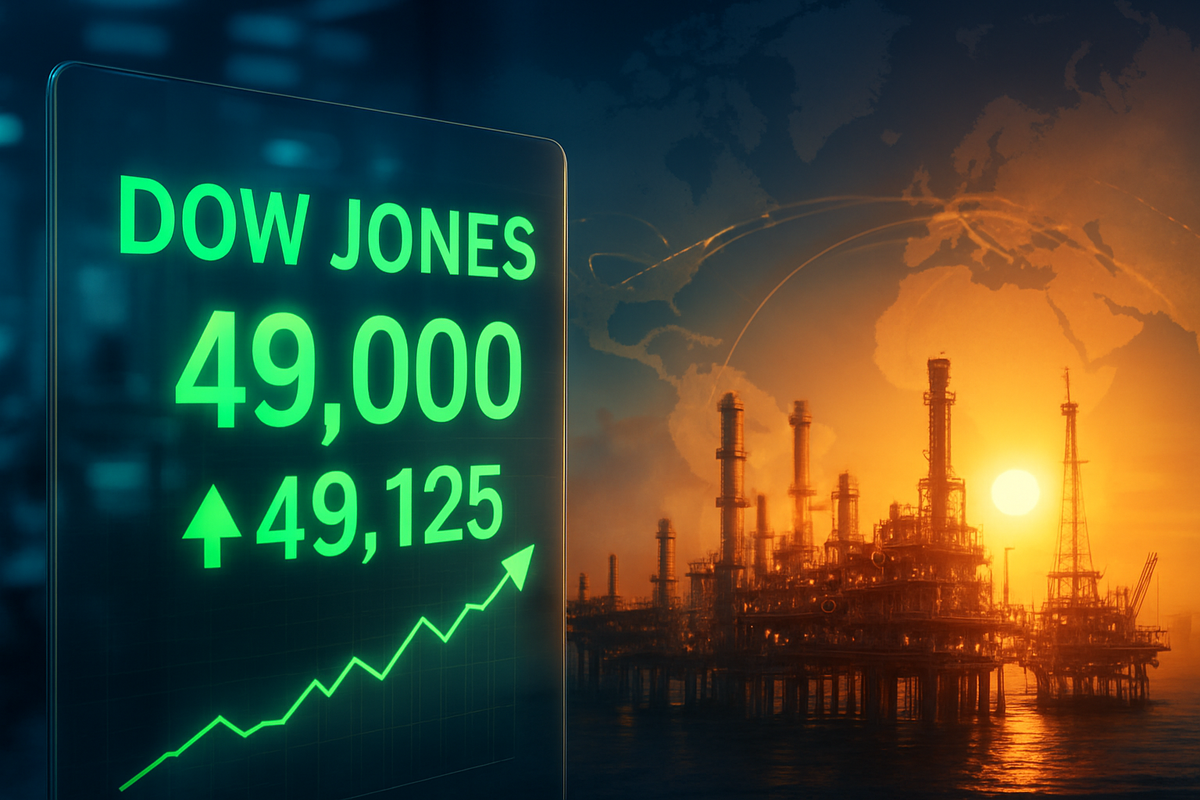
As of January 6, 2026, the financial landscape has been fundamentally reshaped by a seismic geopolitical event in South America. The Dow Jones Industrial Average (DJIA) has surged to record heights, recently breaching the 49,000 mark for the first time in history. This rally is not being led by the technology titans that dominated the previous decade, but by a resurgence in "Old Economy" giants—specifically energy, industrial, and financial stocks—following the dramatic capture of Venezuelan President Nicolás Maduro by U.S. forces on January 3, 2026.
The immediate implications are profound. While global oil markets are currently grappling with a structural oversupply, the "Venezuela Shock" has introduced a significant risk premium and a massive new investment narrative. Investors are betting heavily on a multi-billion dollar reconstruction of Venezuela’s decaying oil infrastructure, a move that has disproportionately benefited the price-weighted Dow, where heavyweights like Chevron and Caterpillar carry significant influence.
The Capture of Maduro and the Market Reaction
The timeline of this historic shift began in the early hours of January 3, 2026, when a targeted U.S. military operation resulted in the capture of Nicolás Maduro. Following the operation, the White House announced an ambitious plan for the U.S. to "temporarily oversee" the reconstruction of Venezuela's energy sector. The goal is to revitalize Petróleos de Venezuela, S.A. (PDVSA), which sits on the world’s largest proven oil reserves—over 300 billion barrels—but currently produces less than 1% of the world’s daily supply due to decades of neglect and sanctions.
Market reaction was instantaneous. On the first full trading day of the year, January 5, the Dow Jones Industrial Average rocketed upward, closing at 48,977 after an intraday peak that neared 49,200. West Texas Intermediate (WTI) crude saw a sharp 1.8% jump to approximately $58.15 per barrel, while Brent Crude stabilized near $61.50. Although prices have cooled slightly as of January 6, the sentiment remains bullish for the companies tasked with the "boots on the ground" work of rebuilding a nation's infrastructure.
The key players in this drama extend beyond the military. The U.S. Department of Energy and major oil majors have reportedly already begun forming task forces to assess the "rotted" state of Venezuelan pipelines and refineries. For the Dow, this has meant a decisive rotation of capital out of the cooling tech sector and into the industrial and energy sectors that are poised to capture the massive contracts required for this geopolitical pivot.
Winners and Losers in the New Energy Landscape
The clear leader in this market surge is Chevron (NYSE: CVX). As the only major U.S. oil company to maintain a persistent, albeit limited, footprint in Venezuela through special licenses, Chevron is widely viewed as the primary beneficiary of the new administration's "Energy Dominance" policy. Shares of Chevron surged 5.6% in the immediate aftermath of the news, acting as the primary engine for the Dow's record-breaking performance.
Close behind are the "pick-and-shovel" winners of the reconstruction era. Caterpillar (NYSE: CAT) saw its shares jump 4.5% as investors anticipated a massive demand for heavy construction and mining equipment to repair Venezuela's crumbling infrastructure. Similarly, Honeywell (NYSE: HON) gained 2.4%, with its specialized refining technologies and industrial automation seen as essential for modernizing PDVSA facilities. Financial giants like Goldman Sachs (NYSE: GS) and JPMorgan Chase (NYSE: JPM) also hit record highs, rising 4.5% and 3.1% respectively, as they are expected to lead the underwriting of billions in new debt and capital investment for the transition.
However, the news is not universally positive for all large-cap stocks. While the Dow has thrived, sectors sensitive to energy costs, such as airlines and consumer discretionary, have faced headwinds. Companies like Boeing (NYSE: BA) have seen a mixed reaction; while their defense segment is bolstered by regional stability efforts, their commercial aviation customers are wary of any sustained increase in fuel prices. Furthermore, if the "Venezuela Shock" keeps oil prices significantly above $60 in a slowing global economy, the broader S&P 500 could see pressure on profit margins for non-energy firms.
Wider Significance and the "Energy Dominance" Trend
This event fits into a broader industry trend of "Energy Dominance" that has been a hallmark of U.S. policy throughout late 2025. By moving to stabilize and control Venezuelan production, the U.S. is effectively attempting to break the influence of OPEC+ and secure a long-term supply of heavy crude that is ideally suited for Gulf Coast refineries. This is a strategic pivot away from the reliance on Middle Eastern supply and a direct challenge to the "shadow fleets" that have allowed sanctioned oil to flow to China and India.
The potential ripple effects are vast. Competitors in the oil services space, such as Halliburton (NYSE: HAL) and SLB (NYSE: SLB), while not in the Dow, have seen double-digit gains, signaling a sector-wide boom. Historically, this intervention invites comparisons to the rebuilding of the Iraqi oil sector in the early 2000s, though the scale of Venezuela’s reserves makes this a potentially more significant long-term market shifter.
Regulators and policymakers are now looking at how this will affect the global supply glut. Prior to the Maduro capture, analysts from Morgan Stanley (NYSE: MS) predicted a surplus of 4 million barrels per day for 2026. If Venezuelan production is successfully brought back online faster than expected, it could lead to a dramatic price collapse in late 2026 or 2027, creating a complex balancing act for the U.S. as it tries to keep domestic producers profitable while lowering costs for consumers.
What Comes Next: The Road to 50,000
In the short term, the market will be laser-focused on the logistical realities of the Venezuelan transition. Investors should expect high volatility in energy names as news of the state of PDVSA’s facilities becomes public. Strategic pivots will be required for companies like Dow Inc. (NYSE: DOW), which must navigate the shifting costs of energy feedstocks while benefiting from the increased demand for industrial materials in South America.
The long-term possibility of the Dow hitting 50,000 hinges on the success of this "reconstruction trade." If Chevron and Caterpillar can demonstrate tangible contract wins and if the financial sector successfully manages the restructuring of Venezuelan debt, the Dow’s price-weighted structure will continue to favor these industrial titans. However, a major challenge remains: the global economy is still sluggish, and a sustained "risk premium" on oil could eventually dampen consumer spending, potentially triggering a recessionary correction if not managed carefully.
Potential scenarios include a "Goldilocks" outcome where Venezuelan oil begins to flow just as Middle Eastern tensions subside, leading to stable, moderate energy prices that support both industrial growth and consumer health. Conversely, a prolonged and expensive military and logistical entanglement in Venezuela could drain resources and lead to market fatigue.
Summary and Investor Outlook
The "Venezuela Shock" of January 2026 has provided a powerful catalyst for the Dow Jones Industrial Average, pushing it to historic highs and reasserting the dominance of value and industrial stocks over growth and technology. The capture of Nicolás Maduro has opened a door to the world’s largest oil reserves, positioning U.S. giants like Chevron and Caterpillar as the vanguard of a new era of energy infrastructure.
Moving forward, the market will transition from the "shock" phase to the "execution" phase. Investors should watch for the first official reports on the condition of Venezuelan oil fields and any announcements regarding the formation of international consortia to manage the reconstruction. The key takeaway is that the Dow has found a new source of momentum, one rooted in tangible assets and geopolitical realignments.
In the coming months, the focus will shift to earnings reports, particularly from the financial and industrial sectors, to see if the "Venezuela premium" is translating into actual guidance raises. For now, the Dow remains the primary beneficiary of a world that is once again prioritizing energy security and industrial might over digital expansion.
This content is intended for informational purposes only and is not financial advice.