As the Federal Open Market Committee (FOMC) prepares for its pivotal March 17-18, 2026, meeting, a heavy silence has descended upon the nation’s capital. The Federal Reserve’s mandatory "quiet period," which began on March 7, has effectively muzzled central bank officials, leaving investors to navigate a sea of conflicting economic signals without the usual guidance from Chair Jerome Powell or his colleagues. In this vacuum of commentary, the market’s focus has intensified on a string of critical macro data releases that have introduced fresh volatility to interest rate expectations.
With today being March 12, 2026, the financial world is still digesting a week of dramatic economic reports. The combination of a surprising contraction in the labor market and stubbornly persistent inflation has created a "data-dependent" nightmare for traders. In the absence of "Fed-speak" to soothe or steer the narrative, the Federal Funds Rate, currently sitting at 3.50%–3.75%, appears destined to remain on hold, despite cracks beginning to show in the broader economy.
The Data Trap: Jobs Slump Meets Sticky Inflation
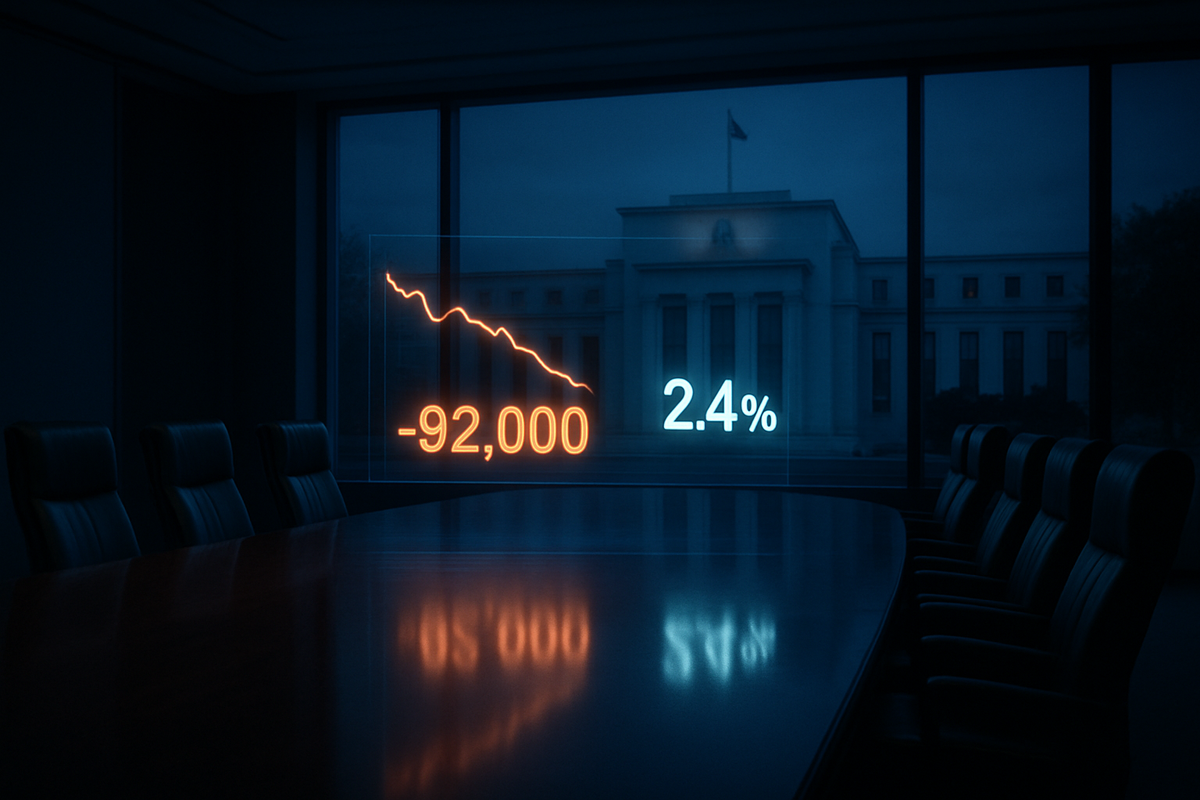
The transition into the blackout period was marked by a jarring contradiction in economic indicators. On March 6, the February Jobs Report sent a shockwave through the markets by reporting a decline of 92,000 jobs, a figure that pushed the unemployment rate up to 4.4%. Under normal circumstances, such a sharp contraction in payrolls would trigger immediate calls for a rate cut to stimulate the economy. However, the narrative shifted just five days later on March 11, when the Consumer Price Index (CPI) showed that inflation rose 0.3% in February, keeping the year-over-year rate at a "sticky" 2.4%.
This sequence of events has left the FOMC in a precarious "wait-and-see" position. The quiet period rules, which prohibit participants and staff from making public comments or granting interviews, mean that officials cannot clarify how they are weighing the job losses against the persistent price pressures. Historically, the Fed uses the weeks leading up to a meeting to "prime" the market for its decision; without that communication channel, the March 11 CPI report effectively became the final word for market pricing. As of today, the CME FedWatch Tool shows a 99.4% probability of a "Hold" at next week’s meeting, a drastic shift from the optimism for a rate cut seen earlier in the year.
The key players in this drama extend beyond Jerome Powell. The "hawks" on the committee, who prioritize inflation control, likely feel vindicated by the core CPI remaining at 2.5%, while the "doves," concerned about the -92k jobs print, are restricted from advocating for a pivot. This internal tension will remain hidden until the release of the "Dot Plot" on March 18, which will provide the first look at officials’ revised interest rate projections for the remainder of 2026.
Winners and Losers in a High-Rate Vacuum
The prolonged "higher-for-longer" environment, reinforced by the recent CPI data and the Fed’s enforced silence, has created a clear divide in the equity markets. Large-cap financial institutions, such as JPMorgan Chase & Co. (NYSE: JPM) and The Goldman Sachs Group, Inc. (NYSE: GS), are often seen as beneficiaries of this landscape. Sustained interest rates allow these banks to maintain healthy net interest margins, provided the economy does not tip into a deep recession. However, the sudden drop in payrolls suggests a looming risk to credit quality that these institutions must now price in without central bank reassurance.
Conversely, the growth-oriented tech sector and the housing market are bearing the brunt of the Fed’s hesitation. Companies like Apple Inc. (NASDAQ: AAPL) and Amazon.com Inc. (NASDAQ: AMZN), which rely on low discount rates for high future valuations and robust consumer spending, have seen their momentum stall as expectations for a March rate cut evaporated. For Amazon.com Inc., the rise in unemployment to 4.4% is particularly concerning, as it signals a potential tightening of the American consumer’s wallet.
The housing and construction sectors are perhaps the most sensitive to this blackout-driven uncertainty. Builders FirstSource, Inc. (NYSE: BLDR) and other residential construction firms are facing a "double whammy": mortgage rates remain elevated due to sticky inflation, while the weakening labor market threatens to sideline potential homebuyers. Without a "dovish" signal from the Fed during this quiet period, these companies are forced to brace for a stagnant spring selling season, traditionally the most lucrative time of the year.
Policy Implications and the 2026 Economic Backdrop
The Fed’s current dilemma is complicated by a broader global shift toward protectionism and geopolitical instability. The 15% global tariffs currently in place have introduced a structural "floor" under inflation, making the Fed’s 2% target harder to reach than in previous decades. This makes the March meeting’s Summary of Economic Projections (SEP) more than just a routine update; it will be a referendum on whether the "neutral rate" of interest has permanently moved higher in the face of these global headwinds.
This situation echoes the market volatility of late 2023 and 2024, but with a more fragile labor market. In past cycles, the Fed could rely on a robust job market to provide a "buffer" while they fought inflation. The -92,000 jobs report from last week suggests that the buffer is gone. The market is now looking for any historical precedent where the Fed held rates steady despite a contracting labor market. The 1970s provide a grim comparison, where "stagflation" forced the central bank to keep rates high even as unemployment rose—a scenario that today’s investors desperately hope to avoid.
Regulatory and policy implications also loom large. As the Fed enters its meeting, there is growing pressure from Capitol Hill for a more accommodative stance to protect the labor market. However, the Fed’s independence is paramount, and the quiet period is designed specifically to insulate the committee from such political noise, ensuring that the March 18 decision is based solely on the data available—however contradictory it may be.
What Lies Ahead: The March 18 Pivot Point
The immediate future hinges on the 2:00 PM ET announcement on March 18. While a "Hold" is almost certain, the market’s focus will shift entirely to the "Dot Plot" and Chair Powell’s press conference. If the Dot Plot shows that officials still expect two or three rate cuts by the end of 2026, the market may rally on the assumption that the Fed views the February job losses as a temporary anomaly. However, if the dots move higher, suggesting only one or zero cuts, we could see a significant "de-risking" event across all asset classes.
Short-term, the market is in a "holding pattern," but a strategic pivot may be required for investors if the Fed acknowledges that the "last mile" of inflation is becoming a permanent fixture. Market participants should prepare for a potential shift in expectations toward a June 2026 rate cut, which is now being viewed as the most likely window for a policy move. In the meantime, the lack of Fed guidance means that every secondary data point—from retail sales to consumer sentiment—will be amplified in its importance.
The volatility seen during this quiet period serves as a stark reminder of the challenges of "data-dependent" policy. For the Fed, the challenge is no longer just hitting a target; it is managing the narrative in an era of economic fragmentation. The outcome of the March meeting will set the tone for the second half of 2026, determining whether the US economy achieves a "soft landing" or enters a period of stagnant growth.
Final Assessment: Navigating the Silent Storm
As we count down the days to the FOMC’s decision, the primary takeaway for investors is that the "Fed put"—the idea that the central bank will always step in to save the market—is being tested by the resilience of inflation. The quiet period has highlighted how much the market relies on the Fed’s "forward guidance" to maintain stability. Without it, the contradiction between a shrinking labor market and rising prices creates a vacuum filled by speculation and heightened sensitivity to every headline.
Moving forward, the market remains in a state of high alert. The March 18 meeting will not just be about interest rates; it will be about the Fed’s credibility in balancing its dual mandate of maximum employment and price stability. Investors should watch for the "tone" of the policy statement—specifically, whether the Fed acknowledges the weakening labor market as a primary concern or continues to emphasize inflation as the "greater of two evils."
In the coming months, the focus will likely shift from "if" the Fed will cut rates to "when" and "by how much." The March meeting will provide the essential roadmap for that journey. Until then, the silence from D.C. remains the loudest signal on Wall Street, reminding everyone that in the world of central banking, what is left unsaid is often as important as what is spoken.
This content is intended for informational purposes only and is not financial advice.