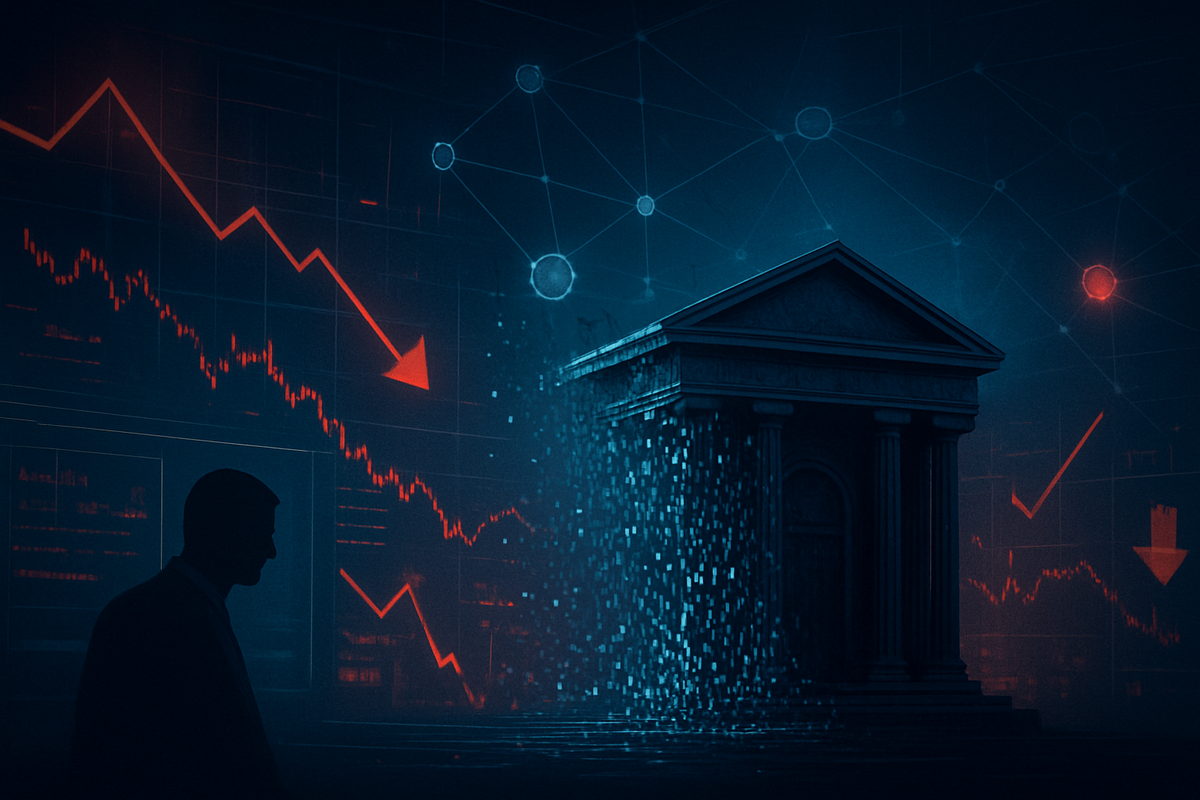
In a startling shift that has sent ripples through Wall Street, the global financial sector has officially become the most "shorted" industry of 2026. According to the latest Prime Services report from Goldman Sachs Group Inc. (NYSE: GS), hedge funds have been aggressively unloading positions in banks, insurance companies, and fintech firms at the fastest pace in nearly a decade. This massive de-leveraging suggests a profound loss of confidence among institutional investors, who are now positioning for a potential systemic downturn or a radical restructuring of the financial landscape.
The immediate implications are stark: the financial sector, once considered a safe haven during the interest rate hikes of 2024 and 2025, is now being treated as a high-risk proxy for global macroeconomic instability. As of mid-March 2026, the short-selling volume for individual financial stocks has reached its highest nominal level since 2016. For the general public, this trend signals a period of heightened market volatility and a tightening of credit as institutions brace for the impact of underlying cracks in the global financial infrastructure.
A Perfect Storm: Why the "Smart Money" is Running for the Exits
The pivot away from financials did not happen overnight. The timeline of this aggressive shorting campaign began in early February 2026, when hedge funds started targeting U.S. stocks with "unprecedented intensity." While the broader market was grappling with the implications of advanced AI models disrupting service sectors, the financial industry was hit with a dual-pronged attack of technological fear and credit anxiety. By early March, Goldman Sachs (NYSE: GS) data showed a short-to-long ratio of 2:1, a level described by analysts as virtually unprecedented in recent market cycles.
A primary catalyst for this surge was a series of "red flag" events involving major institutional players. Specifically, JPMorgan Chase & Co. (NYSE: JPM) sent shockwaves through the market when it reportedly began marking down the value of loans tied to private credit funds. This move exposed the "hidden links" between traditional commercial banks and the burgeoning $1.7 trillion private credit market. Investors quickly realized that the contagion risk—once thought to be isolated to shadow banking—was deeply embedded in the balance sheets of the world’s largest lenders.
The geopolitical landscape has only exacerbated the sell-off. Escalating tensions in the Middle East in early 2026 fueled fears of a global recession, surging energy costs, and a resurgence of inflation. These macro risks made financials a highly liquid and effective "hedge" for funds looking to protect their portfolios. By shorting broad-based financial ETFs and individual giants like Bank of America Corp. (NYSE: BAC), hedge funds are essentially betting that the "higher for longer" narrative is finally beginning to break the back of the global credit system.
Winners, Losers, and the "Barbell" Strategy
The fallout from this aggressive shorting is not distributed equally across the sector. Among the primary "losers" in this environment are diversified financial services and capital markets firms. Companies heavily reliant on consumer finance and traditional asset management have seen their stock prices battered as short sellers bet on AI-driven automation rendering their business models obsolete. Fintech stalwarts such as PayPal Holdings, Inc. (NASDAQ: PYPL) and Block, Inc. (NYSE: SQ) have also faced significant pressure, as the narrative of "disruption" has shifted from fintech disrupting banks to AI disrupting fintech.
Conversely, there are surprising "winners" or at least "survivors" in this climate. Goldman Sachs noted that regional banks have been largely excluded from this specific wave of shorting. Having already undergone a painful deleveraging process following the 2023 regional banking crisis, these smaller institutions are now viewed as having less exposure to the complex private credit and global macro contagion risks currently plaguing the "Too Big to Fail" giants.
Furthermore, institutional investors appear to be adopting a "barbell" strategy. While they are aggressively shorting the sector as a whole, they are maintaining "shared favorite" long positions in high-quality, high-moat companies. Citigroup Inc. (NYSE: C), Mastercard Incorporated (NYSE: MA), and Visa Inc. (NYSE: V) remain on the list of top long holdings for many funds. This suggests that the current shorting wave is less about a total collapse of finance and more about a surgical removal of exposure to firms with low-margin operations or high credit risk.
The AI Factor and Private Credit Shadows
The wider significance of this event lies in the convergence of two major trends: the maturation of the AI revolution and the opaqueness of private credit. For years, the financial sector has been a laggard in digital transformation. Now, the rapid deployment of autonomous AI financial agents in early 2026 has led many to believe that the "human-heavy" cost structures of insurance companies and traditional banks are no longer sustainable. This is not just a market correction; it is a revaluation of what it means to be a "financial service provider" in an era of near-zero marginal cost for intelligence.
Moreover, the regulatory implications are looming. The "aggressive" shorting has caught the eye of the Federal Reserve and the Securities and Exchange Commission (SEC). Historically, such a concentration of short interest in the banking sector preceded the regulatory overhauls of 2008 and 2023. We are likely to see a new wave of transparency requirements for private credit exposures and "indirect" bank lending, as regulators scramble to map the interconnections that hedge funds have clearly already identified as a systemic weakness.
The historical precedent for this is the 2016 "Great Liquidity Crisis" fears, where a similar spike in shorting occurred. However, the 2026 surge is different because it is driven by technological obsolescence as much as credit risk. This makes the current event a unique hybrid of the 2000 Dot-com bubble and the 2008 Credit Crisis, creating a "perfect storm" that hedge funds are uniquely positioned to exploit.
Looking Ahead: A Squeeze or a Slump?
What comes next depends largely on the upcoming Q1 2026 earnings reports. If the major banks can prove that their private credit markdowns are manageable and that their AI implementation is leading to immediate margin expansion, we could witness one of the largest "short squeezes" in history. Hedge funds with 2:1 short-to-long ratios would be forced to buy back shares simultaneously, potentially leading to a massive, albeit artificial, rally in the sector.
However, the more likely scenario is a period of prolonged "strategic pivoting." Companies like Wells Fargo & Co. (NYSE: WFC) and other major lenders will likely need to accelerate their divestiture of non-core assets and aggressively cut headcount to justify their valuations. The challenge for the market will be maintaining liquidity; if the financial sector continues to be the "most sold" sector, the resulting "liquidity vacuum" could make it difficult for other sectors to sustain their growth, leading to a broader market cooling.
In the long term, this event may mark the beginning of a "New Finance" era, where traditional banking models are replaced by leaner, AI-native platforms. The short sellers are essentially the "canaries in the coal mine," signaling that the old ways of doing business are under existential threat.
The Bottom Line for Investors
The Goldman Sachs report serves as a stark reminder that the "smart money" is rarely complacent. The transition of financials from a "recovery play" in 2025 to a "macro risk gauge" in 2026 is a significant shift that demands attention. Key takeaways include the growing danger of private credit contagion and the undeniable impact of AI on financial services valuations.
Moving forward, the market will likely remain on edge until there is more clarity regarding the Middle East conflict and its impact on global inflation. Investors should watch for the Q1 2026 earnings calls of the major banks for any mentions of "credit loss provisions" or "private credit exposure." This is a time for caution and selective investing; while the broader sector is under fire, the "quality" names like Visa and Mastercard may still offer a port in the storm. For now, the "Great Financial De-Leveraging" is the dominant narrative of the 2026 market.
This content is intended for informational purposes only and is not financial advice.