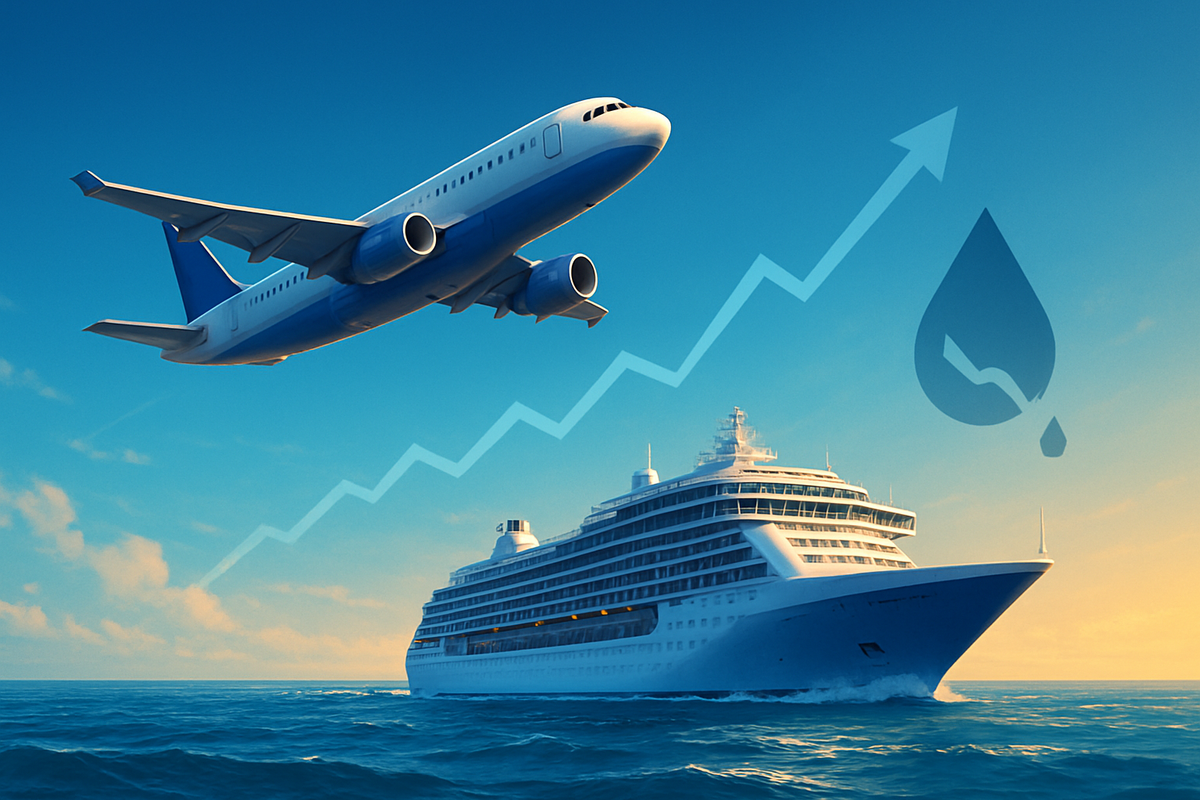
As of March 25, 2026, the travel and leisure sector is witnessing a powerful relief rally, sparked by a dramatic retreat in global oil prices from their recent geopolitical peaks. Investors who had spent weeks bracing for a prolonged energy crisis are now flooding back into fuel-sensitive stocks, pushing industry leaders like United Airlines (NASDAQ: UAL) and Norwegian Cruise Line (NYSE: NCLH) to their highest levels of the month.
The immediate implications of this downward trend in crude are profound, offering a critical tailwind to industries where fuel represents one of the largest operating expenses. With Brent crude falling back toward the $90 range after threatening to breach $120 per barrel just weeks ago, the market is reassessing the profitability of the upcoming 2026 summer travel season, which is already seeing record-breaking booking volumes.
The Great Oil Retreat of March 2026
The turnaround began in earnest on March 23, 2026, following a "15-point ceasefire plan" that signaled a diplomatic breakthrough in the long-standing tensions between major Middle Eastern producers. This de-escalation effectively unwound the "war premium" that had inflated energy costs throughout the first quarter. By the afternoon of March 25, West Texas Intermediate (WTI) crude had settled near $86.72, a sharp decline from its $104 high earlier in the month, while Brent crude retreated to approximately $93.97.
This shift was further accelerated by a coordinated intervention from the International Energy Agency (IEA), which authorized the release of 400 million barrels from global strategic reserves to stabilize the market. Coupled with U.S. shale production maintaining a steady 13.6 million barrels per day, the supply-demand equation shifted from a perceived shortage to a "global glut" scenario almost overnight. The market reaction was swift: the travel sector, as tracked by the Invesco Leisure and Entertainment ETF (NYSEARCA: PEJ), saw a wave of green as fears of a margin-crushing energy spike evaporated.
Industry stakeholders, from airline executives to cruise ship operators, have welcomed the news as a reprieve from the "worst-case scenarios" that dominated boardrooms in February. While travel demand remained resilient even during the price spike, the cooling of energy costs allows these companies to capture more of that revenue as actual profit rather than losing it to the fuel pump.
Winners and Losers: Hedging Strategies and Margin Expansion
In this environment, United Airlines (NASDAQ: UAL) has emerged as a primary beneficiary, though not without significant risk. Unlike many of its peers, United famously operates without a fuel hedging program, leaving it fully exposed to spot price swings. While this strategy led to a sharp sell-off when prices spiked in early 2026—with shares hitting a low of $89.92—the current collapse in oil prices has allowed the stock to bounce back by 4.5% in just 48 hours. Management had previously warned that a sustained spike could add $4.6 billion to their annual fuel bill; the current retreat effectively removes that overhang.
On the high seas, Norwegian Cruise Line Holdings (NYSE: NCLH) saw an even more aggressive surge, jumping 7.9% following the oil news. Norwegian occupies a unique middle ground in the cruise industry; it has locked in approximately 50% of its 2026 fuel costs through hedging. This provided a safety net during the recent volatility, and the current drop in spot prices further improves the outlook for its unhedged requirements. For Norwegian, every 10% move in fuel prices translates into roughly $90 million in net income, making this week's 10% drop in Brent crude a direct $0.07 per share boost to their bottom line.
Other major players are also feeling the lift. Carnival Corporation (NYSE: CCL), which does not hedge its fuel at all, saw a 6.0% jump, reflecting its extreme sensitivity to energy costs. Meanwhile, Delta Air Lines (NYSE: DAL) and American Airlines (NASDAQ: AAL) gained 4.0% and 5.2% respectively. Delta, despite absorbing a $400 million fuel hit in the first quarter, has maintained a "high single-digit" revenue outlook, suggesting that the combination of lower costs and high ticket prices could lead to a record-breaking earnings year for the legacy carriers.
A Fundamental Shift in Market Sentiment
This event marks a significant pivot in the broader 2026 economic narrative. Earlier in the year, the primary concern for the market was "stagflation"—the combination of slowing growth and rising energy-driven inflation. By easing the pressure on fuel, the current oil rally has reinvigorated the "Goldilocks" scenario: robust consumer spending paired with moderating costs. This fits into a broader industry trend where travel has become a "non-negotiable" expense for post-pandemic consumers, regardless of the macroeconomic backdrop.
The ripple effects extend beyond just the airlines and cruise lines. Competitors in the hospitality and booking sectors, such as Marriott International (NASDAQ: MAR) and Expedia Group (NASDAQ: EXPE), are also benefiting as lower travel costs typically encourage longer stays and more frequent bookings. Furthermore, the regulatory environment is shifting; the easing of energy prices takes the pressure off central banks to continue aggressive interest rate hikes, which in turn lowers the cost of capital for capital-intensive companies like Royal Caribbean (NYSE: RCL), which is currently guiding for $18 adjusted EPS for the year.
Historically, the travel sector has always been the first to suffer during energy shocks and the first to recover when they subside. The March 2026 rally mirrors the post-2014 oil crash, where a sudden increase in supply led to a multi-year "golden age" for airline profitability. If the current ceasefire holds and production remains high, the travel industry could be entering a similar era of sustained margin expansion.
Navigating the 2026 Summer Surge
As we look toward the remainder of 2026, the short-term outlook is exceptionally bright. Cruise booking volumes for the year have hit a staggering 37.7 million passengers, and airlines are operating at near-total capacity. The immediate strategic pivot for companies like United and Norwegian will be to lock in these lower fuel costs through new hedges where possible, or to reinvest the savings into fleet modernization and sustainability initiatives—an area that has been sidelined by recent cost pressures.
However, challenges remain. The market must still contend with labor shortages and infrastructure constraints that could limit the total volume of travelers. Additionally, any breakdown in the current diplomatic agreements could send oil prices back into triple digits. Scenarios range from a continued "supply glut" that drives WTI toward $70, to a renewed geopolitical flare-up that tests the $150 mark. For now, investors are betting on the former, but the volatility of the past quarter remains a cautionary tale.
Final Assessment: What to Watch
The rally in United Airlines and Norwegian Cruise Line represents more than just a reaction to a single commodity price drop; it is a vote of confidence in the resilience of the global travel consumer. The key takeaway for investors is that the "fuel fear" that dominated the start of 2026 is beginning to dissipate, replaced by a focus on fundamental demand and operational efficiency.
Moving forward, the market will be closely watching the weekly crude inventory reports and the progress of the Middle East ceasefire. For those holding travel and leisure stocks, the next three months will be critical. If oil stays below $95, the second and third-quarter earnings reports could produce some of the largest beats in the history of the industry. Investors should keep a particularly close eye on the fuel expense ratios in the next round of 10-Q filings to see exactly how much of this "oil dividend" is hitting the bottom line.
This content is intended for informational purposes only and is not financial advice.