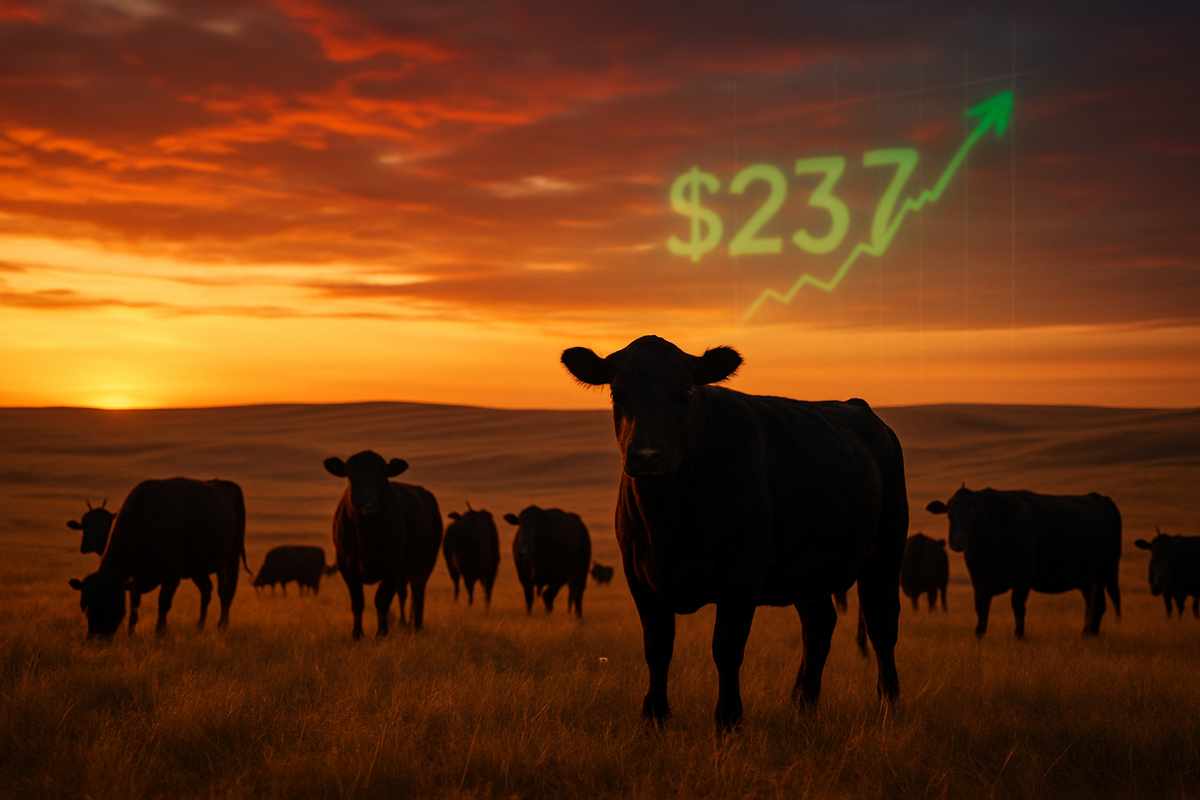
CALGARY, AB — The North American livestock market has ascended into uncharted territory as of March 25, 2026, with D2 slaughter cows in Western Canada reaching a staggering record high of $237 per hundredweight (cwt). This milestone, reported by industry analysts at Canfax, marks a fever pitch in a multi-year rally that has redefined the economics of the beef industry. As feeder cattle prices simultaneously surge to historic peaks, the market is grappling with the reality of a "structural scarcity" that shows no signs of relenting, even as the industry nears what many experts believe is a cyclical apex.
The immediate implications of these record prices are profound, creating a stark divide across the value chain. While cow-calf producers are realizing the highest profit margins in a generation, meat processors and retail consumers are bearing the brunt of the "Protein Paradox." With slaughter cow prices nearly 25% higher than they were a year ago, the cost of ground beef and processed meats is pushing toward levels that threaten to test the limits of consumer elasticity. However, despite the sticker shock, beef demand remains stubbornly resilient, underpinned by a post-pandemic shift in consumer preferences toward high-quality animal proteins.
A Perfect Storm of Scarcity and Demand
The climb to $237 per cwt for D2 cows in Alberta and Saskatchewan did not happen overnight. It is the culmination of a "biological inventory" crisis that began in earnest during the droughts of 2023 and 2024. According to CattleFax, a leading industry research firm, the U.S. and Canadian cattle herds have contracted to their smallest sizes in 75 years. By January 2026, the total U.S. cattle inventory plummeted to 86.2 million head—a level not seen since 1951. This lack of supply was exacerbated in late 2025 by a sudden closure of the U.S. border to Mexican cattle imports following an outbreak of the New World screwworm, effectively removing 1.5 million feeder cattle from the 2026 supply pipeline.
The feeder market has been "on fire" for the better part of eighteen months. In mid-2025, 550 lb steers in Western Canada were already averaging $540 per cwt, while 850 lb yearlings reached record highs of $437 per cwt. This rally was fueled by feedlots aggressively "reloading" their pens, betting that consumer prices would continue to rise fast enough to cover record-high entry costs. Key stakeholders, including major feedlot operators and auction marts, have noted that even "plain" cattle are fetching premium prices, as packers scramble to secure enough volume to keep their facilities operational.
Industry reactions have been a mix of exhilaration and anxiety. While the ranching community in Western Canada is finally seeing a massive return on investment, the logistical strain is immense. Feedlots are currently facing breakeven prices in the mid-$330s per cwt for finished cattle. This high-stakes environment has forced a rapid consolidation of smaller players who cannot afford the capital requirements to purchase replacements at these record-shattering levels.
Winners and Losers in the Great Beef Squeeze
The financial landscape for public companies in the beef sector has become increasingly bifurcated. Tyson Foods (NYSE: TSN) has emerged as one of the primary casualties of the current cycle. In its most recent quarterly report, the protein giant posted a $319 million operating loss in its beef segment, with projections for fiscal 2026 losses reaching as high as $600 million. The company recently shuttered a major facility in Lexington, Nebraska, in an attempt to align its processing capacity with the dwindling supply of available cattle.
Conversely, JBS S.A. (OTC: JBSAY) has demonstrated significant resilience through geographic diversification. While its North American beef margins have thinned to near zero, the company has successfully offset these losses with robust performances in Australia and Brazil, where the cattle cycles are in an expansionary phase. This global hedge has allowed JBS to maintain a more stable balance sheet compared to its purely domestic competitors. Marfrig Global Foods (OTC: MRRTY), which controls National Beef, is also feeling the margin squeeze but has leaned into its recent merger with poultry leader BRF S.A. to mitigate the volatility of beef procurement costs.
The "winners" in this high-priced environment are often found outside the beef segment. Pilgrim’s Pride (NASDAQ: PPC) has seen a surge in demand as consumers "trade down" from expensive ribeyes to more affordable chicken breasts. Meanwhile, in the casual dining sector, Texas Roadhouse (NASDAQ: TXRH) has managed to defy the odds. Despite beef accounting for nearly 50% of its cost of goods sold, the company’s "value-leader" status has driven record foot traffic, as consumers view a $30 steak dinner as a relative bargain compared to surging grocery store prices, where ground beef has topped $6.69/lb.
The Broader Significance of a 75-Year Low
This event fits into a wider industry trend that CattleFax calls "structural scarcity." We are no longer in a typical three-to-five-year cattle cycle; instead, we are witnessing the impact of long-term herd contraction driven by climate volatility and aging producer demographics. Historically, record prices would trigger an immediate retention of heifers to rebuild the herd. However, in 2026, many ranchers are choosing to cash in on record heifer prices rather than keep them for breeding, a decision that essentially "kicks the can" of tight supply further into the future.
The ripple effects are being felt by international partners. With North American beef production at record lows, export markets in Japan and South Korea are seeing a vacuum that is being rapidly filled by Australian and South American beef. This shift has regulatory implications as well; policymakers in Ottawa and Washington are facing increased pressure to address food inflation while balancing the environmental goals of reducing methane emissions—a difficult needle to thread when the industry is already at its smallest footprint in decades.
Comparisons to the 2014-2015 "super-cycle" are frequent, but analysts argue this time is different. In 2015, beef demand was softer, and the supply contraction was purely weather-driven. Today, record-setting beef demand—which sits at a 40-year high—is colliding with a structural lack of animals. This ensures that even when the herd begins to rebuild, prices are likely to remain on a "higher plateau" for the foreseeable future.
What Comes Next: Navigating the "Protein Paradox"
In the short term, the market is bracing for even higher prices. CattleFax projections suggest that 5-area steer prices could average between $224 and $240 per cwt through the remainder of 2026. The strategic pivot for the industry will center on "efficiency over volume." Feedlots and packers will likely continue to invest in automated technology and genetic optimization to extract more value from fewer animals. We may also see a permanent shift in retail, where "Value" and "Select" grades of beef become rarer as the industry focuses almost exclusively on Choice and Prime to satisfy high-end demand.
The long-term scenario hinges on when the herd rebuilding phase truly begins. Current data suggests that a meaningful increase in beef production will not occur until 2028 or 2029. Until then, the primary challenge will be maintaining consumer loyalty as prices continue to climb. There is a risk that if beef becomes a "luxury-only" protein, the industry could lose a generation of middle-class consumers to poultry or plant-based alternatives—though the latter has failed to gain significant ground during this current price spike.
A New Era for the Livestock Market
The $237 record for D2 cows is more than just a number; it is a signal that the livestock market has entered a new era of high-value scarcity. For investors, the takeaway is clear: the "easy money" in the packing sector is gone, replaced by a period of intense margin management and operational discipline. The focus must remain on companies with diversified protein portfolios or those with the pricing power to pass costs through to a still-hungry consumer base.
Moving forward, the market will be watching heifer retention rates and weather patterns in the Southern Plains and Canadian Prairies with hawk-like intensity. Any sign of a meaningful herd rebuild will be the first indicator that the price ceiling has been reached. However, for now, the cattle industry remains the "wild west" of the financial markets, where supply is king, and the king is nowhere to be found.
This content is intended for informational purposes only and is not financial advice.