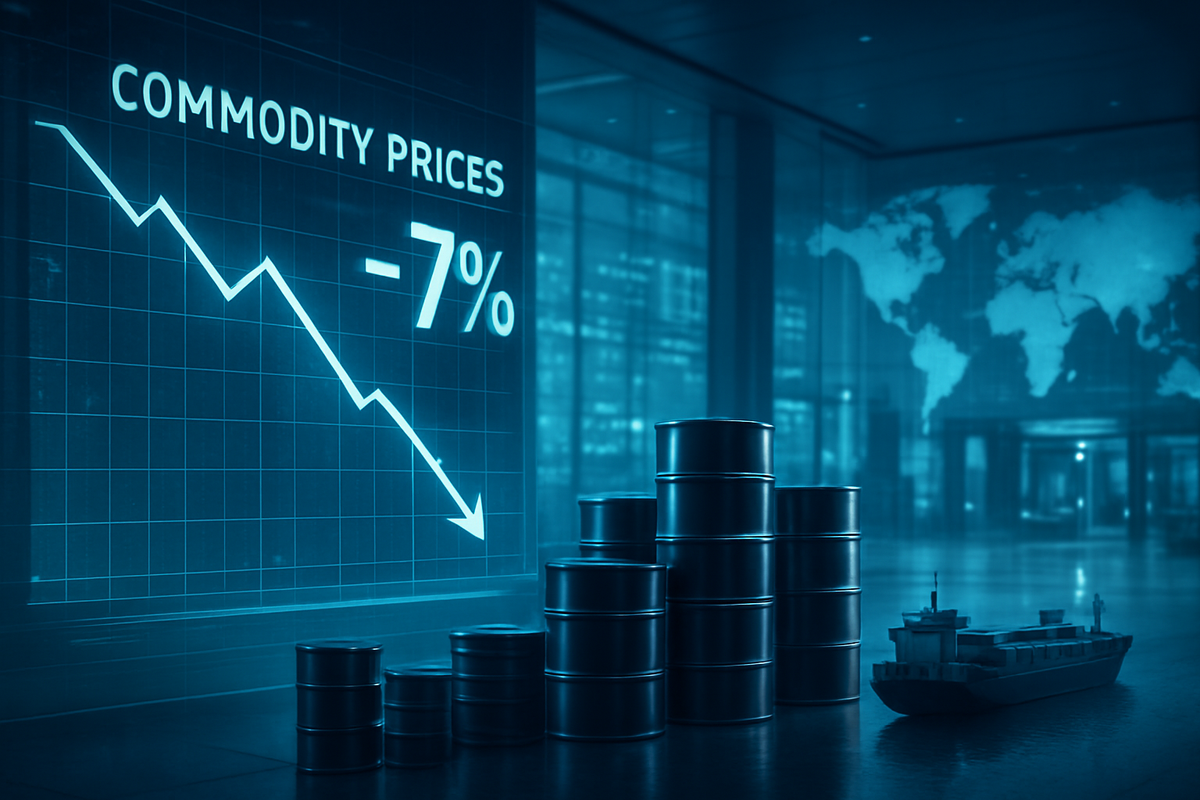
As of March 25, 2026, the global economic landscape is undergoing a profound transformation. The World Bank’s latest Commodity Markets Outlook has delivered a sobering yet optimistic forecast for the year ahead: global commodity prices are projected to plunge to a six-year low. This marks the fourth consecutive year of declining prices, a sustained deflationary streak that is reshaping trade balances, corporate margins, and central bank policies across the globe.
The immediate implications are significant. While the news offers a massive tailwind for major energy-importing nations like India and Japan, it signals a period of intense fiscal pressure for commodity-dependent exporters. With the aggregate commodity price index expected to drop by another 7% this year, the "post-pandemic price spike" has officially been replaced by what many analysts are calling the "Great Commodity Respite."
A Perfect Storm: Oversupply and Cooling Demand
The World Bank’s 2026 report highlights a convergence of three powerful forces: a massive global oil surplus, a structural slowdown in the Chinese economy, and persistent policy uncertainty. Leading the decline is the energy sector, which is forecast to drop by 10% in 2026 following a 12% slide in 2025. This downturn is anchored by a projected Brent crude oil average of just $60 per barrel—a price point not seen consistently since the early 2020s.
The timeline leading to this moment began in late 2023 when non-OPEC+ production began to surge unexpectedly. Over the last two years, the so-called "Americas Quintet"—comprising the United States, Brazil, Canada, Guyana, and Argentina—has aggressively expanded output. This surge has created a global oil surplus of 1.2 million barrels per day, a level of oversupply surpassed only twice in the last three decades: during the 1998 Asian financial crisis and the 2020 COVID-19 lockdowns.
Simultaneously, China, the world’s largest consumer of raw materials, has entered a period of structural stagnation. The World Bank projects China’s GDP growth to slow to 4.4% in 2026 as the nation pivots away from property-led investment. Furthermore, the rapid transition to electric vehicles—now accounting for over 40% of new car sales in China—has permanently eroded global gasoline demand, leaving oil producers with a shrinking market share.
Corporate Winners and Losers in a Low-Cost World
The deflationary trend is creating a stark divide in the equity markets. Companies reliant on high input costs, particularly in the transportation and logistics sectors, are emerging as primary beneficiaries. Delta Air Lines (NYSE: DAL) and United Airlines (NASDAQ: UAL) are seeing significant margin expansion as jet fuel costs plummet toward five-year lows. Similarly, logistics giants like FedEx (NYSE: FDX) and United Parcel Service (NYSE: UPS) are leveraging lower fuel surcharges to offer more competitive pricing, boosting shipping volumes.
Conversely, the "Great Oil Glut" is a direct headwind for traditional energy behemoths. ExxonMobil (NYSE: XOM) and Chevron (NYSE: CVX) are facing a year of reduced capital expenditures and tighter margins. While these companies have diversified their portfolios, the $60-per-barrel environment tests the profitability of high-cost shale projects. In the mining sector, firms like Rio Tinto (NYSE: RIO) and BHP Group (NYSE: BHP) are grappling with a 4% decline in iron ore prices, driven by the continued cooling of the Chinese construction industry.
The retail sector, led by titans like Walmart (NYSE: WMT) and Amazon (NASDAQ: AMZN), stands to win as lower energy and food prices increase discretionary consumer spending. However, the outlook is not universal; gold remains a notable outlier. As global policy uncertainty persists, Newmont Corporation (NYSE: NEM) and other precious metal producers are benefiting from safe-haven demand that has kept gold prices near record highs, even as industrial commodities flounder.
Breaking the Inflationary Cycle
The wider significance of this commodity slump cannot be overstated. After years of central banks struggling to tame post-pandemic inflation, the 2026 commodity crash provides the ultimate "disinflationary tailwind." The Federal Reserve and the European Central Bank are now finding it much easier to hit their 2% inflation targets, potentially clearing the path for further interest rate cuts throughout the second half of the year.
Historically, periods of sustained commodity price declines have preceded significant shifts in global power dynamics. The current situation mirrors the mid-1980s or the late 1990s, where an oil glut weakened the leverage of traditional energy cartels. Today, the massive surplus acts as a "geopolitical buffer." In years past, a conflict in the Middle East would have sent oil prices skyrocketing; in 2026, the existing glut is large enough to absorb major supply shocks, providing a rare sense of stability to global energy markets.
However, this transition is not without its risks. For two-thirds of developing economies that rely on commodity exports for more than half of their revenue, this price collapse is a fiscal emergency. The World Bank warned that without urgent policy reforms, these nations could face a "lost decade" of stagnant growth and rising debt.
The Road to 2027: Adaptation and Strategy
Looking ahead, the market is entering a phase where "efficiency is king." For energy companies, the strategic pivot toward low-carbon technologies and renewable energy is no longer just a climate goal but a financial necessity. Tesla (NASDAQ: TSLA) and BYD (OTC:BYDDF) continue to benefit from the shifting demand landscape, as the lower cost of electricity relative to gasoline makes the total cost of ownership for EVs even more attractive.
In the short term, investors should expect increased volatility in the currencies of commodity-exporting nations, such as the Australian dollar and the Brazilian real. In the long term, the focus will shift to whether this deflationary trend leads to a "soft landing" for the global economy or if the lack of industrial demand signals a deeper, more concerning global recession. The World Bank suggests that as long as consumer spending remains resilient in the West and India, the lower commodity prices will likely serve as a net positive for global growth.
Final Assessment: A New Economic Order
The 2026 Commodity Markets Outlook marks the end of an era of scarcity and the beginning of an era of abundance. The convergence of technological innovation in the Americas, the green energy transition, and a shifting Chinese economy has created a unique window of low prices that could last through the end of the decade.
For investors, the key takeaways are clear: the era of "easy money" from commodity spikes is over. Moving forward, the market will favor sectors that benefit from lower operating costs and consumer-facing industries. While the risk of fiscal instability in developing markets remains a dark cloud on the horizon, the overall narrative for 2026 is one of a "deflationary gift" that could finally put the ghosts of the 2021-2023 inflation crisis to rest. Watch closely for central bank rhetoric in the coming months; if they embrace this trend, we may be on the verge of a sustained bull market for equities.
This content is intended for informational purposes only and is not financial advice.