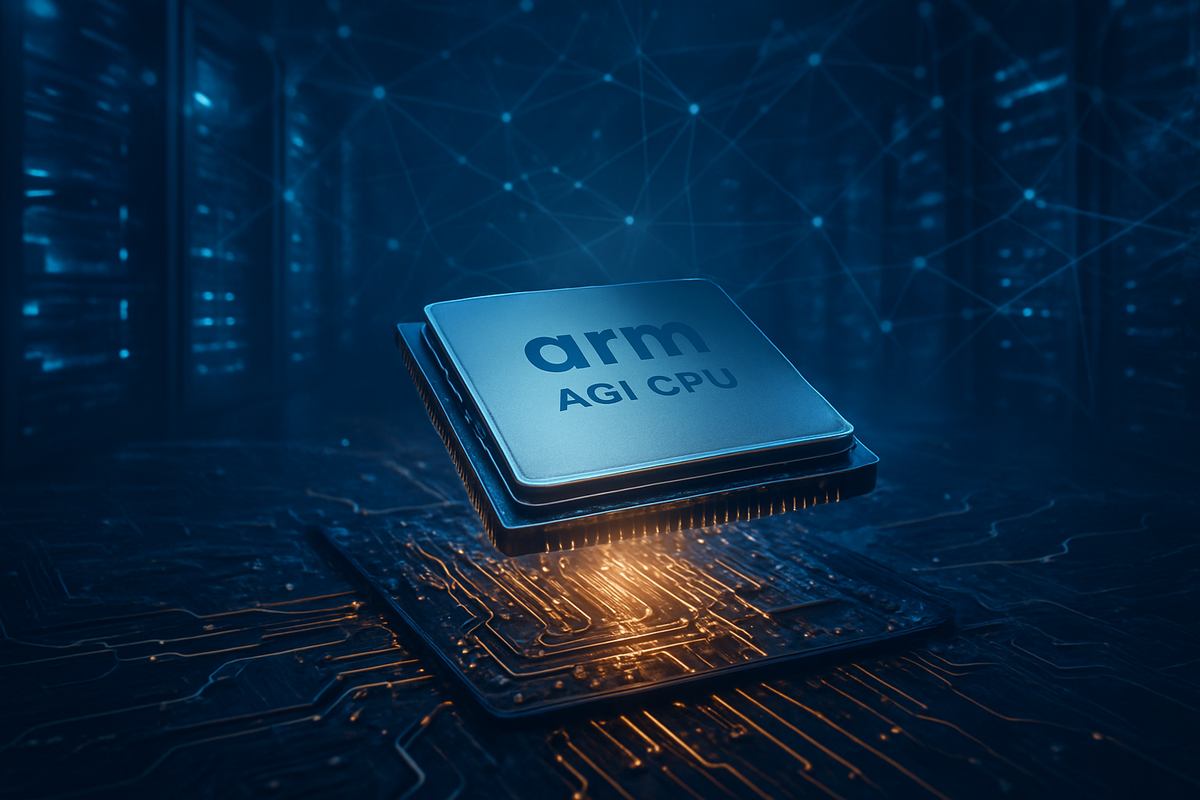
The semiconductor landscape witnessed a historic transformation on Wednesday, March 25, 2026, as shares of Arm Holdings (NASDAQ: ARM) skyrocketed over 16.3% following the unveiling of its first-ever in-house production silicon. At its high-stakes "Arm Everywhere" event in San Francisco, the company pivoted from its 35-year legacy as a neutral intellectual property (IP) licensor to a direct competitor in the high-performance AI chip market. The launch of the "Arm AGI CPU"—a processor specifically engineered for the era of Agentic Artificial General Intelligence—has fundamentally recalibrated how Wall Street values the British chip designer.
This strategic shift has ignited a massive wave of institutional buying, with analysts across major firms aggressively hiking price targets to reflect a new, higher-margin revenue stream. By moving from "selling blueprints" for royalties to "selling finished silicon," Arm is positioning itself as the central orchestration layer for the next decade of AI compute. The immediate market reaction, closing at a record high for the year, signals that investors are betting on Arm’s ability to capture a larger slice of the multi-trillion-dollar AI infrastructure pie.
The Birth of the AGI CPU: Inside the San Francisco Revelation
The center of the excitement is the Arm AGI CPU, a technical marvel built on the TSMC (NYSE: TSM) 3nm process. During the keynote, Arm leadership detailed a dual-chiplet design featuring a staggering 136 Neoverse V3 cores per processor. Unlike traditional general-purpose CPUs, this architecture is optimized for "Agentic AI"—autonomous systems that can reason, plan, and execute complex tasks with minimal human intervention. The chip supports PCIe Gen6 and CXL 3.0, delivering a class-leading 6GB/s memory bandwidth per core, which is critical for the massive data throughput required by the latest autonomous agents.
The timeline leading to this moment was marked by intense collaboration and strategic secrecy. For the past 18 months, Arm has been co-developing the AGI CPU with Meta Platforms (NASDAQ: META) to ensure the hardware was purpose-built for Meta’s Llama 4 and subsequent agentic frameworks. Meta’s Head of Infrastructure, Santosh Janardhan, appeared on stage to confirm that the social media giant would deploy the AGI CPU as the primary "head node" alongside its custom MTIA accelerators, committing to a multi-generation partnership that spans the next five years.
Wall Street reacted with near-unanimous praise. John Difucci of Guggenheim raised his price target to a street-high $240, while Frank Lee at HSBC more than doubled his target to $205, citing that AI-related revenue is poised to eclipse Arm’s traditional smartphone royalties by late 2027. Other major firms, including Needham and Barclays, followed suit with upgrades to $200, highlighting that Arm’s transition to a direct-sales model could yield up to $15 billion in annual silicon revenue by 2031.
Winners and Losers in the New Silicon Order
The immediate winner of this shift is Arm itself, which is effectively trading its "Switzerland of Semiconductors" neutrality for the lucrative potential of vertical integration. By capturing the full value of a $1,000+ chip rather than a $10 license fee, the company’s revenue ceiling has expanded exponentially. Meta Platforms also emerges as a winner, securing a customized, power-efficient compute layer that gives them a competitive edge over rivals who rely on more expensive, off-the-shelf x86 solutions from Intel (NASDAQ: INTC) or AMD (NASDAQ: AMD).
However, this pivot has created significant friction with Arm’s traditional licensees. Nvidia (NASDAQ: NVDA), once a potential acquirer of Arm, has reportedly liquidated its remaining equity stake in the company as of February 2026. With Arm now competing directly for the data center CPU socket, the relationship between the two has shifted from a partnership to a "symbiotic rivalry." Similarly, Qualcomm (NASDAQ: QCOM) has accelerated its pivot toward the open-source RISC-V architecture, recently acquiring Ventana Micro Systems to build an alternative data center ecosystem that avoids the "Arm Tax" and side-steps competition with its former IP provider.
Traditional x86 giants, Intel and AMD, face the most direct threat. Arm claims its AGI CPU provides 2x the performance-per-rack at a fraction of the power consumption (300-watt TDP) compared to current x86 servers. As data centers become increasingly power-constrained, the energy efficiency of the Arm architecture—now coupled with high-performance silicon—could lead to a rapid erosion of x86 market share in the AI inference segment.
The End of Neutrality: Wider Significance and Industry Trends
The launch of the AGI CPU marks the definitive end of the "IP-only" era for high-end computing. We are entering a phase of "Vertical Consolidation," where software giants like OpenAI and Meta are increasingly dictating the hardware specifications they need. Arm’s move is a recognition that in the 2026 market, efficiency is the ultimate currency, and that efficiency can only be achieved by tightly integrating the CPU architecture with the AI software stack.
This event also highlights the growing importance of "Agentic Inference." In 2024 and 2025, the market was obsessed with AI training and GPUs. In 2026, the focus has shifted to the deployment of autonomous agents that require "orchestration CPUs" capable of managing complex logic and high-speed memory access. Arm’s roadmap focuses on this orchestration role, positioning the AGI CPU as the "brain" that coordinates between high-speed networking and specialized AI accelerators.
Furthermore, this move has regulatory and geopolitical implications. By becoming a direct silicon provider, Arm deepens its reliance on TSMC, reinforcing the critical nature of the Taiwan-based foundry in the global AI race. It also invites potential antitrust scrutiny as Arm now competes with the very companies that rely on its base architecture, a dynamic that may force global regulators to re-evaluate the licensing terms of the foundational Arm instruction set.
The 2031 Roadmap: What Comes Next?
Arm has committed to an aggressive 12-to-18-month product cadence, with the Arm AGI CPU 2 and AGI CPU 3 already in the pipeline. The company’s long-term objective is to reach $25 billion in total revenue by 2031, with self-developed silicon accounting for more than 60% of that figure. This transition will require Arm to manage new challenges, including inventory risks, manufacturing yields, and the capital-intensive nature of being a fabless semiconductor firm—a stark contrast to its historically asset-light model.
In the short term, the market will be watching for the first delivery of AGI CPU clusters to Meta and OpenAI. If these early deployments meet the promised performance-per-watt metrics, we could see a "land grab" in the data center space, where hyperscalers like Amazon (NASDAQ: AMZN) and Google (NASDAQ: GOOGL) may be forced to choose between developing their own chips or adopting Arm’s high-performance silicon to remain competitive in the agentic AI era.
Closing Thoughts for Investors
The 16% surge in Arm’s stock is more than just a reaction to a new product; it is a validation of a new business model. For institutional investors, Arm is no longer just a "mobile chip designer"—it is now a central pillar of the global AI infrastructure. The transition to direct silicon sales provides a clear path to high-margin growth that the licensing model simply could not sustain.
However, investors must remain vigilant. The "frenemy" dynamics with Qualcomm and Nvidia, coupled with the rising threat of RISC-V, suggest that the path to $25 billion will not be without its hurdles. The coming months will be critical as Arm begins the transition from a company that designs the future to a company that builds it.
This content is intended for informational purposes only and is not financial advice.