FORT LAUDERDALE, FL — In a move that signals the definitive end of the "HODL at all costs" era for public cryptocurrency miners, MARA Holdings, Inc. (NASDAQ: MARA) announced today, March 26, 2026, the completion of a massive capital restructuring. The company has liquidated over 15,000 Bitcoin from its reserves to fund a $1.0 billion repurchase of its convertible senior notes, marking a radical shift toward a de-leveraged balance sheet and an aggressive expansion into Artificial Intelligence (AI) and High-Performance Computing (HPC) infrastructure.
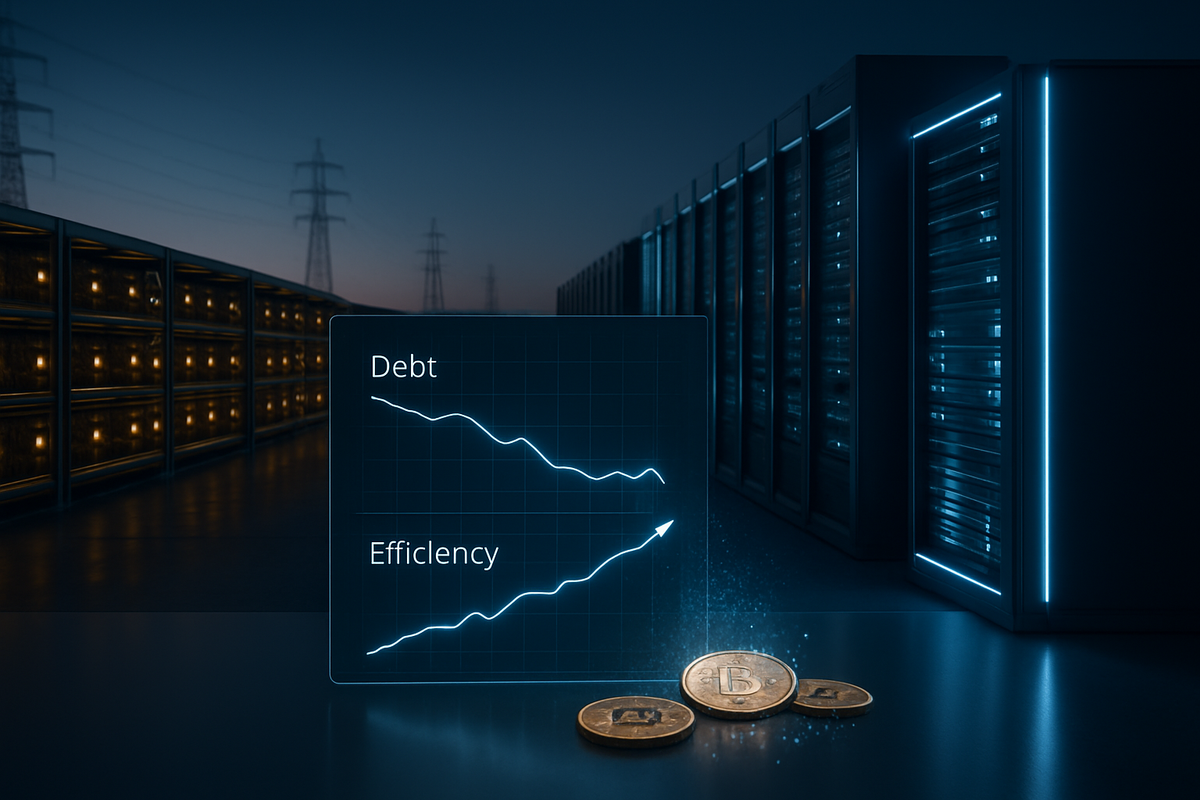
The immediate implications of this maneuver are twofold: MARA has effectively reduced its long-term debt by nearly 30% while securing the necessary capital to pivot away from its volatile "pure-play" mining roots. By selling 15,133 BTC—roughly a quarter of its total holdings—MARA generated approximately $1.1 billion in proceeds, the majority of which were used to retire zero-coupon convertible notes due in 2030 and 2031 at a significant discount. This strategic de-leveraging aims to stabilize the company’s valuation and decouple its stock price from the erratic swings of the Bitcoin market, which has faced significant headwinds as mining costs soared to nearly $80,000 per coin in early 2026.
The $1.1 Billion Liquidation: A Tactical Retreat from Debt
The details of the transaction, disclosed in a regulatory filing early this morning, reveal a high-stakes game of financial engineering. Between March 4 and March 25, 2026, MARA Holdings executed the sale of 15,133 BTC. These proceeds were immediately funneled into private negotiations to repurchase $367.5 million of its 2030 notes and $633.4 million of its 2031 notes. By securing these repurchases at an average 9% discount to par value, the company captured over $88 million in immediate cash savings, effectively wiping a billion dollars in liabilities off its books without the dilutive impact of a secondary stock offering.
This pivot has been months in the making. In late 2025, MARA quietly amended its treasury policy, moving away from a multi-year stance of retaining all mined Bitcoin. The company’s leadership, led by CEO Fred Thiel, recognized that the post-halving environment of 2024 and 2025 required a more agile capital allocation strategy. Initial market reactions were jubilant; shares of MARA surged 12% in early trading as investors cheered the improved balance sheet and the reduction of potential future dilution. Analysts noted that by retiring the zero-coupon notes early, MARA has significantly lowered its risk profile ahead of a tightening global credit environment.
Winners, Losers, and the Battle for Power
The primary winner in this shift is MARA’s equity holders, who now own a company with a drastically cleaner balance sheet and a clear path toward "stable" AI-driven revenue. However, the move has also strengthened the hands of specialized infrastructure providers. Starwood Capital Group, through its Starwood Digital Ventures arm, stands to gain significantly as the primary partner in MARA’s newly announced 2.5-gigawatt (GW) AI data center joint venture. By converting legacy mining sites into hyperscale facilities, the partnership is poised to capture the surging demand for enterprise-grade AI compute capacity.
Conversely, the "losers" in this scenario may be the traditional Bitcoin "maximalist" investors who viewed MARA as a proxy for the cryptocurrency itself. With MARA dropping to the third-largest corporate holder of Bitcoin—behind Twenty One Capital and MicroStrategy (NASDAQ: MSTR)—its status as a "Bitcoin treasury" stock has diminished. Competitors like Riot Platforms (NASDAQ: RIOT) and Core Scientific (NASDAQ: CORZ) are also feeling the heat. While RIOT has maintained a massive 18,000 BTC reserve, it now faces pressure from its own shareholders to prove that its "HODL" strategy is more effective than MARA’s de-leveraging model. Meanwhile, Core Scientific, which already leads the sector with over $10 billion in AI contracts with firms like CoreWeave, now faces a newly capitalized and aggressive competitor in MARA.
A Sector-Wide Metamorphosis: From Mining to Energy Arbitrage
MARA’s strategic shift is not an isolated event; it is a microcosm of a broader industry trend toward "Energy Arbitrage." As the profitability of Bitcoin mining becomes increasingly dependent on volatile hash rates and rising energy costs, companies are repurposing their power-secured sites for AI and HPC. This "toggling" model—where power is shifted between Bitcoin mining and AI compute in real-time based on profitability—is becoming the gold standard for the sector in 2026. MARA’s acquisition of a controlling stake in Exaion, a high-performance computing subsidiary of French energy giant EDF, further underscores this global reach.
The regulatory and policy implications are equally significant. By diversifying into AI and sovereign cloud infrastructure, MARA and its peers are aligning themselves with national interests in "AI sovereignty." This pivot may shield these companies from the regulatory scrutiny often leveled at the energy-intensive crypto-mining sector. Historically, this transition mirrors the evolution of 19th-century railway companies that eventually pivoted into real estate and logistics once the initial boom of track-laying subsided. The "miners" of today are rapidly becoming the "digital utility" companies of tomorrow.
The Road Ahead: Short-Term Gains vs. Long-Term Execution
In the short term, MARA must prove it can execute the 2.5 GW expansion promised in its joint venture with Starwood Capital. Building out AI-ready data centers is a capital-intensive endeavor that requires different expertise than traditional mining. The transition from air-cooled mining rigs to liquid-cooled AI clusters involves complex engineering and longer lead times. Investors will be watching closely for the first 100 megawatts (MW) of "energized" AI capacity to go live, which is expected by Q3 2026.
Long-term, the success of this strategic pivot will depend on MARA’s ability to secure and maintain high-margin AI tenants. While the "toggling" model offers a safety net, the real prize lies in multi-year colocation contracts with Big Tech and sovereign governments. The challenge will be managing the "high-touch" nature of the AI business compared to the "set-it-and-forget-it" nature of Bitcoin mining. If MARA can successfully bridge this gap, it may well provide a blueprint for how a legacy crypto firm can reinvent itself as a cornerstone of the global digital economy.
Summary and Final Assessment
MARA Holdings has sent a clear message to the market: the era of speculative growth at the expense of financial health is over. By liquidating $1.1 billion in Bitcoin to retire $1.0 billion in debt, the company has prioritized survival and diversification in an increasingly competitive AI landscape. The 30% reduction in convertible debt significantly de-risks the company's future, while the 2.5 GW partnership with Starwood Capital provides a tangible growth narrative beyond the next Bitcoin halving.
Moving forward, investors should monitor the execution of the Starwood joint venture and the integration of Exaion's European operations. The "decoupling" of MARA’s stock from Bitcoin price action is likely to continue, making it an attractive play for those looking for AI infrastructure exposure with an "optionality" hedge in crypto. As the lines between energy, data, and finance continue to blur, MARA Holdings has positioned itself as a primary architect of this new digital frontier.
This content is intended for informational purposes only and is not financial advice.