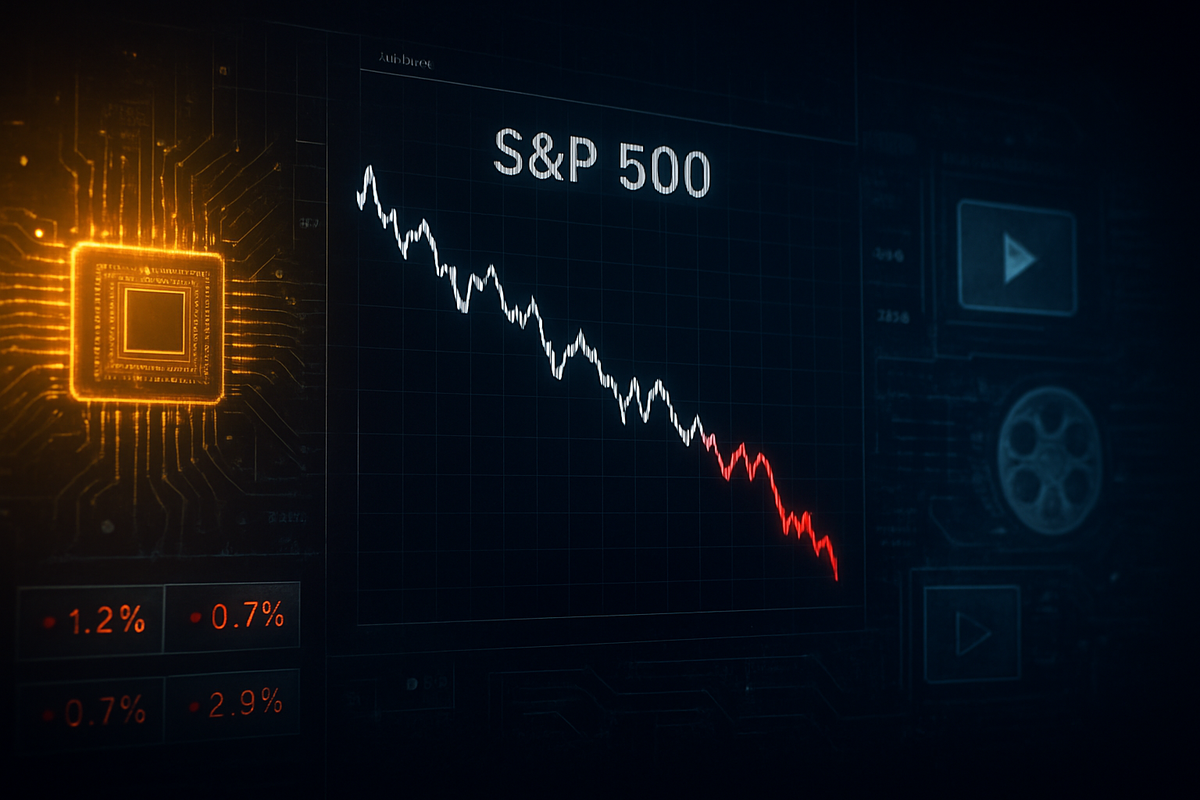
The relentless bull run that defined 2025 hit a significant speed bump in February 2026, as the S&P 500 closed the month in the red, marking a stark departure from the double-digit gains of the previous year. Investors faced a triple threat of declining performance across the daily, weekly, and monthly charts, driven primarily by a turbulent transition in the artificial intelligence sector and a brutal consolidation phase within the media industry. As of March 4, 2026, the market remains on edge, grappling with the reality that the "easy money" era of broad-based index growth may be giving way to a far more selective and volatile environment.
The immediate implications are clear: the market's focus has shifted from speculative potential to proven profitability. While 2025 was characterized by a "rising tide lifts all boats" mentality—particularly in tech—the first two months of 2026 have forced a re-evaluation of high-flying valuations. With the Federal Reserve’s leadership transition looming in May and questions arising about the actual return on investment for massive AI capital expenditures, institutional investors have begun rotating out of overextended growth names, leading to the sharpest monthly pullback since late 2024.
A February of Friction: From AI Peaks to Media Troughs
The downturn in February was not a sudden crash, but rather a calculated retreat as several major market narratives collided. The month began with the S&P 500 hovering near its all-time highs of approximately 7,100, but momentum quickly stalled as earnings reports from the "Magnificent Seven" and their peers suggested that the explosive growth of 2025 was beginning to normalize. The decline accelerated in the third week of February, triggered by a combination of lukewarm guidance from legacy media giants and a "digestive pullback" in the semiconductor space.
Throughout the month, the market was haunted by the "Inference Era" transition. Analysts noted that while the build-out of AI infrastructure—which fueled the 2025 rally—remains robust, the pace of growth in capital expenditures from hyperscalers has decelerated from a staggering 75% to a more modest 25%. This cooling effect was exacerbated by the news that the newly merged media entity involving Paramount Global (NASDAQ: PARA) and Warner Bros. Discovery (NASDAQ: WBD) was struggling under a massive $90 billion debt load, leading to a sector-wide sell-off in communication services that dragged the broader index lower.
Winners, Losers, and the Performance Gap
The divergence in performance among previous market darlings has become the defining story of early 2026. In the semiconductor space, Nvidia (NASDAQ: NVDA) found itself under pressure as it faced a "valuation reset." Despite reporting healthy earnings, the stock fell over 8% in February as investors questioned how much upside remained after its meteoric 2025. Conversely, Broadcom (NASDAQ: AVGO) has emerged as a relative "winner" in the volatility, buoyed by its dominance in custom ASICs and a massive new order from Anthropic, which solidified its position as the leader of the "Inference King" narrative even as the broader sector cooled.
In the media sector, the contrast was even more pronounced. Netflix (NASDAQ: NFLX) managed to weather the storm more effectively than its peers by maintaining a disciplined focus on its advertising tier and avoiding the "merger mania" that plagued its competitors. While the S&P 500 slid, Netflix’s share price showed resilience as it moved toward a milestone of 325 million subscribers. On the other end of the spectrum, the combined Paramount-WBD entity saw its shares tumble to new lows as credit agencies downgraded its debt to "junk" status (BB+), forcing management to announce aggressive layoffs and a reduction in original content spend to preserve cash.
The Shift Toward a Selective Market
The volatility of early 2026 fits into a broader historical pattern of "mid-cycle transitions." After the exuberant expansion of 2025, the market is now entering a period where the "AI ROI" (Return on Investment) is being put under the microscope. Industry experts suggest that the current environment is reminiscent of the post-dot-com recovery, where investors moved away from companies that simply used the "AI" buzzword and toward those that could demonstrate tangible productivity gains and bottom-line growth. This shift is also being driven by regulatory scrutiny, with a looming Supreme Court ruling on international trade policies threatening to impact corporate margins across the tech and manufacturing sectors.
Furthermore, the "Powell Pivot" of 2024-2025 is reaching its conclusion. With Jerome Powell’s term as Fed Chair ending in May 2026, the market is pricing in significant uncertainty regarding his successor. This "leadership vacuum" has led to higher volatility in the bond market, which has historically acted as a drag on the S&P 500’s performance. As yields fluctuate based on speculation about the next Chair's stance on inflation, the equity market has struggled to find a solid floor, leading to the choppy price action seen throughout February and the first week of March.
Looking Ahead: The Road to Q2
In the short term, the market is looking for a "stabilization catalyst," which may come in the form of late-March earnings from software enterprises that are finally integrating AI features into their core products. If these companies can prove that AI is driving subscription revenue and operational efficiency, the sector-wide valuation reset could find a bottom. However, if the data remains murky, the 5-10% correction that many analysts predicted for the first half of 2026 may have further to run.
The long-term outlook remains cautiously optimistic, provided that the transition to the "Inference Era" continues to bear fruit. Investors should watch for strategic pivots from companies like Paramount-WBD, which may be forced to sell off more assets to manage their debt, potentially creating acquisition opportunities for "cash-rich" tech giants. Additionally, the custom silicon market, led by Broadcom, will be a critical bellwether for the health of the broader tech ecosystem as we move toward the second half of the year.
Closing Thoughts for the Modern Investor
The February 2026 recap serves as a potent reminder that markets do not move in a straight line. The transition from the "AI Honeymoon" of 2025 to the "Selective Era" of 2026 was always going to be turbulent. While the S&P 500’s decline across all timeframes this past month is discouraging for passive index investors, it represents a healthy normalization of valuations and a necessary clearing of the decks for the next leg of the cycle.
Moving forward, the primary focus for investors should be on quality over growth at any price. The era of buying the "AI dip" indiscriminately is over; the focus must now shift to companies with strong balance sheets, sustainable margins, and a clear path to debt reduction. As we approach the Fed leadership transition in May, expect volatility to remain the rule rather than the exception. The "Magnificent Seven" may have led the way in 2025, but 2026 will belong to the companies that can prove their worth in a more disciplined economic landscape.
This content is intended for informational purposes only and is not financial advice.