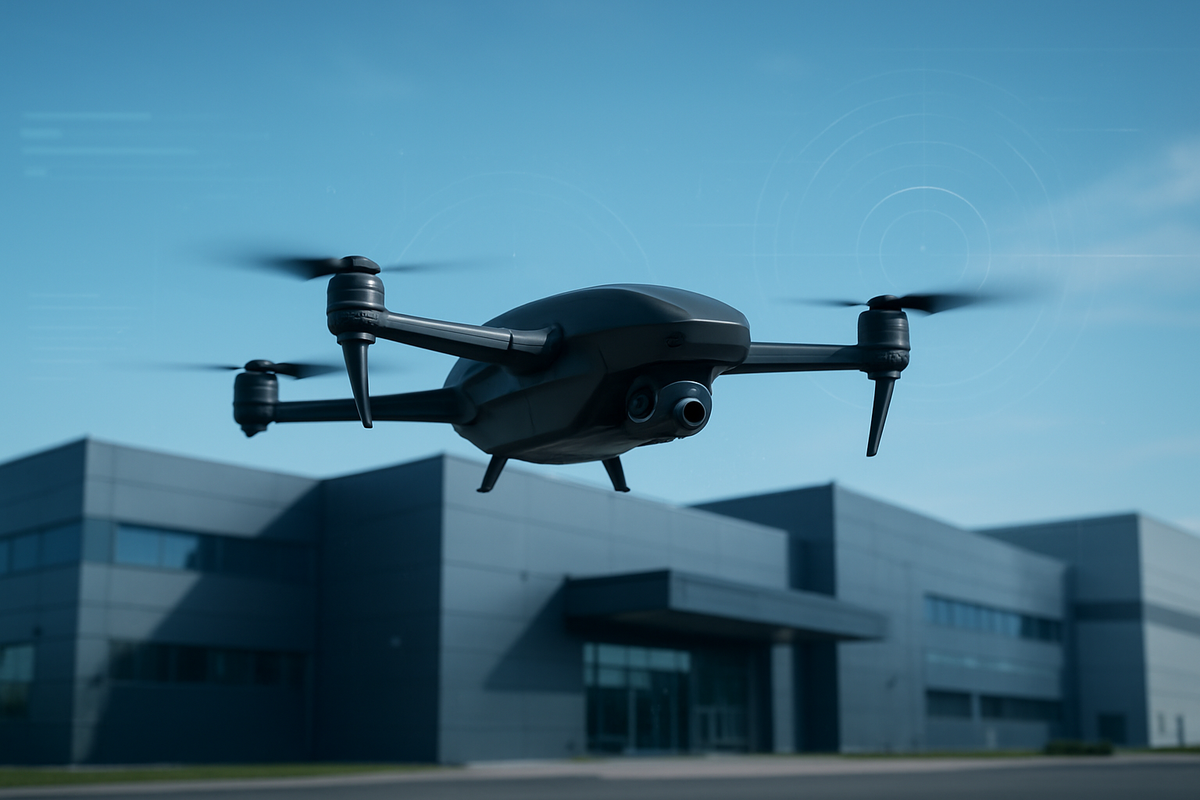
In a move that fundamentally reshapes the landscape of autonomous defense technology, Ondas Holdings Inc. (NASDAQ: ONDS) announced today, March 9, 2026, a definitive agreement to acquire Bethesda-based defense prime Mistral Inc. in an all-stock transaction valued at approximately $175 million. The merger represents a strategic pivot for Ondas, catapulting the company from a specialized technology developer to a Tier-1 defense prime contractor with immediate access to massive U.S. Department of Defense (DoD) contract vehicles and domestic manufacturing infrastructure.
The immediate implications of this deal are profound: Ondas effectively "onshores" its sophisticated autonomous drone and counter-UAS (C-UAS) technologies, aligning them with the strict National Defense Authorization Act (NDAA) and "Buy American" requirements. By integrating Mistral’s established $1 billion-plus pipeline of Indefinite Delivery/Indefinite Quantity (IDIQ) contracts, Ondas secures a direct channel to provide the U.S. military with its flagship Optimus and Iron Drone Raider platforms, bypassing the traditional hurdles faced by smaller tech firms attempting to penetrate the complex defense procurement ecosystem.
Scaling the Fortress: The Mechanics of the $175 Million Merger
The $175 million acquisition is structured to ensure long-term alignment between the two entities. According to the filing, Ondas Holdings (NASDAQ: ONDS) will issue $122.5 million in common stock upfront and in installments, with an additional $52.5 million held in deferred escrow to be released over the next three years. The transaction, expected to close in the second quarter of 2026, follows a period of increasing collaboration between the two companies, most notably in the deployment of autonomous systems for border security and tactical intelligence.
Mistral Inc. brings to the table a formidable portfolio of active military contracts. Most notably, in late 2025, Mistral was awarded a staggering $982 million multi-year IDIQ contract by the U.S. Army for the Lethal Unmanned System (LUS) program. The company also holds a $73.6 million contract with the U.S. Special Operations Command (USSOCOM) for ground-organic loitering munitions. These contract vehicles are essentially "hunting licenses" that allow the DoD to rapidly purchase hardware and services without reopening the competitive bidding process for every individual order—a massive competitive advantage for Ondas’ proprietary technology.
Initial market reaction has been optimistic, with analysts noting that the merger solves Ondas’ "last-mile" problem in the defense sector. While Ondas’ subsidiaries, Airobotics and American Robotics, have long possessed industry-leading "drone-in-a-box" technology, they often lacked the prime-contractor status required to lead major Programs of Record. With Mistral’s Maryland-based manufacturing facility now under the Ondas umbrella, the company can facilitate the large-scale production of the Optimus System and the Iron Drone Raider within the United States, satisfying the security mandates of the Defense Contract Management Agency (DCMA).
Winners and Losers: A New Hierarchy in Autonomous Defense
Ondas Holdings (NASDAQ: ONDS) is the clear primary beneficiary of this consolidation. By acquiring Mistral, Ondas transitions from a subcontractor role to a top-tier systems integrator. This move allows them to capture higher margins on hardware and software and secures their position within the lucrative C-UAS market. The integration of the Iron Drone Raider—an AI-powered interceptor that captures hostile drones in a physical net—into Mistral’s existing loitering munition offerings creates a comprehensive "offensive and defensive" UAS suite that few competitors can match.
However, the merger may present challenges for existing defense giants like AeroVironment, Inc. (NASDAQ: AVAV) and smaller, venture-backed startups like Skydio. While AeroVironment remains a dominant force in the tactical UAS space, the Ondas-Mistral combination introduces a highly agile competitor with a specialized focus on total autonomy and C-UAS. Furthermore, other mid-tier contractors who relied on Mistral for integration services may now find themselves competing against the very platform they once partnered with, potentially shifting the dynamics of existing joint ventures.
Private partners of Mistral, such as Israel-based UVision, may see mixed results. On one hand, UVision’s HERO-120 loitering munitions will now have the backing of a publicly traded U.S. entity with deeper capital reserves; on the other hand, the prioritization of Ondas’ internal drone platforms could eventually crowd out third-party hardware. For the Department of Defense, the winner is clear: the merger provides a streamlined, U.S.-based source for advanced autonomous systems that are already integrated into existing military command-and-control frameworks.
Broader Significance: The Era of the "Autonomous Prime"
This event fits into a broader industry trend where the "Silicon Valley" model of rapid tech iteration is merging with the "Beltway" model of long-term defense contracting. The Pentagon has grown increasingly frustrated with the slow pace of legacy defense primes in adopting AI and autonomous flight. By acquiring a prime contractor, Ondas (NASDAQ: ONDS) is demonstrating a new blueprint for tech-first companies: instead of waiting for the procurement system to change, they are buying their way into the system's inner circle.
The ripple effects of this deal will likely be felt in the counter-drone sector, which has become a top priority following recent geopolitical conflicts that highlighted the vulnerability of traditional armor to small, cheap drones. The Ondas-Mistral merger allows for a "layered" defense architecture, where autonomous Optimus drones provide persistent surveillance, and the Iron Drone Raider acts as a kinetic interceptor—all managed through a single contract vehicle. This holistic approach is likely to become the new standard for border protection and base security contracts.
Historically, this merger draws comparisons to the early 2000s when mid-sized sensor and radar companies were consolidated into larger primes to create integrated platform providers. However, the 2026 merger is unique in its focus on "Type Certified" autonomous systems. With the Optimus system already holding FAA Type Certification for automated flight, Ondas is uniquely positioned to bridge the gap between military and civil applications, a feat that traditional defense primes have often struggled to achieve due to their strictly military-focused hardware designs.
What Comes Next: Integration and Execution
In the short term, the market will be watching the integration of Ondas’ technology into Mistral’s Nottingham, Maryland, manufacturing facility. The success of this transition will be a key indicator of whether Ondas can meet the "Buy American" requirements necessary to scale their $20 million border protection orders into much larger, multi-year programs. Investors should also look for the first joint bid between the two entities, likely focusing on the U.S. Army's next-generation "Soldier Borne Sensor" or "Short Range Reconnaissance" tranches.
Long-term, Ondas (NASDAQ: ONDS) may pivot toward becoming a broader autonomous infrastructure provider. With the Mistral acquisition providing the defense backbone, Ondas can leverage its 2026 revenue guidance of $170–$180 million to further invest in its private LTE and 5G mission-critical networks (Ondas Networks). The synergy between secure communications and autonomous drones is the "holy grail" of modern battlefield management, and Ondas is now one of the few companies that owns both ends of that spectrum.
Potential challenges remain, particularly in the cultural integration of a high-growth tech firm and a established defense prime. Regulatory scrutiny regarding "dual-use" technologies—those with both civilian and military applications—could also complicate future international sales. However, the strategic advantage of being a "domestic prime" in the 2026 defense budget environment cannot be overstated, especially as the U.S. continues to diversify its supply chain away from foreign-manufactured drone components.
Summary and Investor Outlook
The merger of Ondas Holdings (NASDAQ: ONDS) and Mistral Inc. is a watershed moment for the autonomous systems industry. It signals the end of the "subcontractor era" for high-tech drone firms and the beginning of a new class of "Autonomous Primes." By securing over $1 billion in contract pipeline and a state-of-the-art U.S. manufacturing base, Ondas has effectively derisked its path to large-scale military adoption.
Moving forward, the market will shift its focus from Ondas’ technology "potential" to its "execution" as a prime contractor. The key takeaways for investors are clear: Ondas now possesses the regulatory clearances, the manufacturing capacity, and the contract vehicles to compete at the highest levels of the defense industry. Watch for news regarding the second-quarter closing of the deal and any updates on the HERO-120 and LUS program fulfillment, as these will be the primary drivers of Ondas' stock performance through the end of 2026.
As the lines between tech and defense continue to blur, Ondas has positioned itself as a central player in the defense of the future—one where autonomy is not just a feature, but the foundation of the mission.
This content is intended for informational purposes only and is not financial advice.