In the early months of 2026, the morning coffee ritual has undergone its most significant transformation since the invention of the mobile order. Starbucks (NASDAQ: SBUX) has officially entered its "generative era," integrating sophisticated AI tools designed to do more than just suggest a croissant with your latte. By leveraging a "ChatGPT twist" that bridges the gap between third-party AI interfaces and its own retail ecosystem, the coffee giant is attempting to recapture its identity as a "premium third place" while solving the operational friction that has plagued its stores for years.
The move marks a strategic pivot under the leadership of CEO Brian Niccol, who took the helm with a mandate to modernize the brand. As of mid-April 2026, the company’s new "Green Dot Assist" and "ChatGPT" integrations are no longer experimental pilots but are now live in thousands of locations across North America. This digital overhaul is not just about speed; it is an ambitious attempt to use artificial intelligence to restore the "human connection" by offloading the mental and administrative heavy lifting from baristas to silicon.
The Siren’s New Brain: AI-Powered Personalization and the Siren Craft System
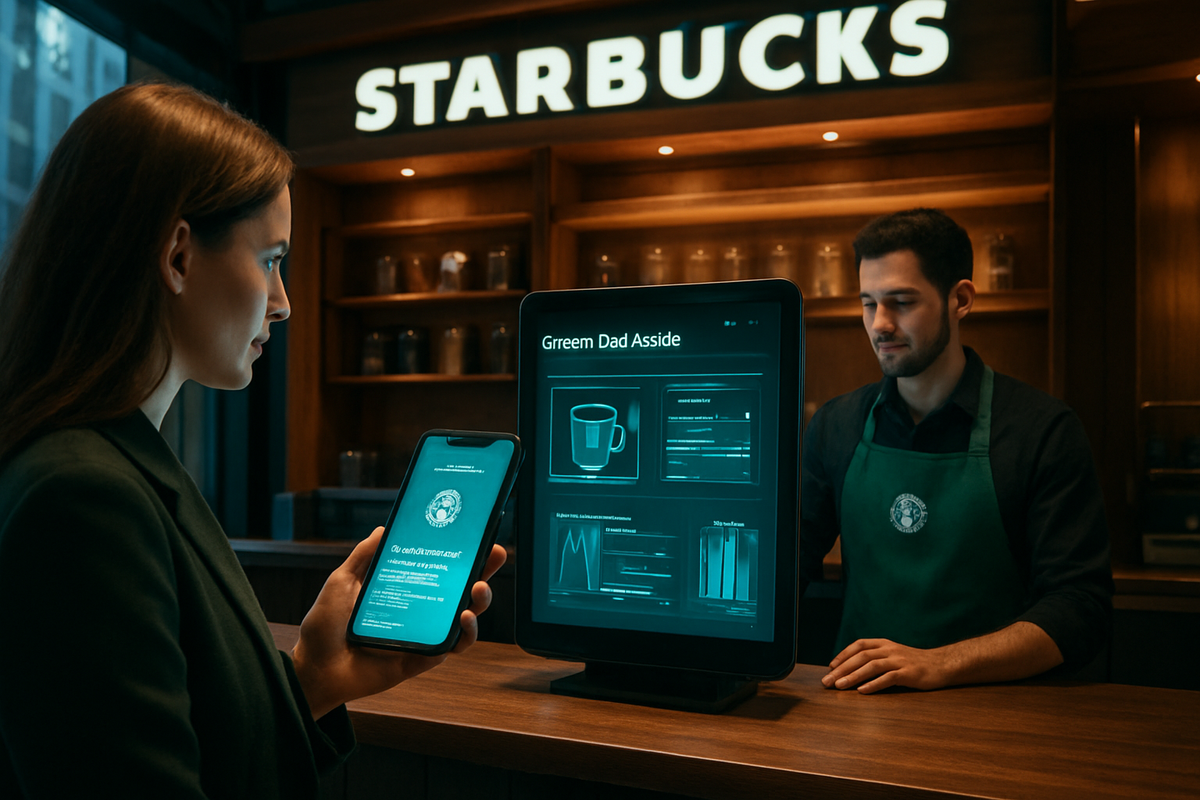
The cornerstone of this transformation is the "ChatGPT Twist," a dedicated application within the ChatGPT ecosystem. For the first time, a major retailer has allowed a full order-to-payment journey to begin within a third-party generative AI interface. Customers can now prompt the AI with natural language requests like, "I’m feeling tired but want something cold and not too sweet for a rainy day," and receive a curated recommendation. Once the user selects a drink, the order is seamlessly transferred to the Starbucks app via a deep-link integration for payment and fulfillment. This move into "conversational commerce" has helped Starbucks reach a younger, tech-savvy demographic that increasingly uses AI agents as their primary interface for the web.
Behind the counter, the technology is even more robust. The "Green Dot Assist," developed in partnership with Microsoft (NASDAQ: MSFT) using its Azure OpenAI platform, acts as a co-pilot for baristas. This generative assistant allows staff to ask complex questions about beverage recipes, equipment maintenance, or real-time shift adjustments using voice commands. This integration is part of the "Siren Craft System 2.0," which rolled out in early 2026. The system uses AI to intelligently sequence orders across four channels—in-store, drive-thru, mobile, and delivery—preventing the "barista burnout" that became a flashpoint for labor unrest in 2024 and 2025.
The timeline for this rollout reached a crescendo during the Starbucks Investor Day on January 29, 2026. At the event, leadership revealed that these AI investments were already yielding results, contributing to the company’s first positive U.S. transaction growth in eight quarters. Initial market reactions were cautiously optimistic, as investors had been wary of the high capital expenditures required for the Siren Craft System. However, as quarterly data showed a reduction in peak-hour wait times by an average of 45 seconds, the narrative shifted from "cost-heavy" to "efficiency-driven."
Winners, Losers, and the Battle for the Beverage Dollar
Starbucks stands as the primary potential winner in this technological arms race. By March 2026, the stock had recovered from its 2025 lows of $75 to trade in the $95.00 to $98.00 range. Analysts at firms like RBC and TD Cowen have noted that if AI-driven efficiency can help the company hit its 15% operating margin target by 2028, the stock could see further re-rating. Microsoft also emerges as a winner, solidifying its position as the preferred cloud and AI partner for blue-chip retailers looking to implement generative solutions at scale.
Conversely, traditional competitors and "beverage-only" challengers face a steep uphill battle. McDonald's (NYSE: MCD), which closed its experimental "CosMc's" locations in 2025 to focus on its core McCafé line, has been forced to accelerate its own AI deployments. In early 2026, McDonald’s began rolling out Google Cloud-powered voice chatbots across 27,000 drive-thrus. While McDonald’s leads in pure speed and scale, it lacks the "premium" personalization that Starbucks is aiming for with its ChatGPT integration. Meanwhile, Dutch Bros (NYSE: BROS) remains a formidable threat by focusing on "speed and friendliness" over complex tech. Dutch Bros led the industry in drive-thru satisfaction in late 2025, and their refusal to "over-automate" has carved out a niche for customers who still prefer a human-first interaction without the digital friction.
A Wider Significance: The "Third Place" in a Digital World
The significance of Starbucks' AI pivot extends far beyond the coffee industry. It represents a broader trend in retail where generative AI is being used not to replace humans, but to "de-task" them. Historically, Starbucks’ 2008 turnaround focused on the quality of the coffee and the warmth of the environment. In 2026, the company is betting that technology is the only way to save that environment. By automating the most stressful parts of the job—such as managing a chaotic queue of mobile orders—Starbucks hopes to allow baristas to return to their role as community fixtures.
This event also signals a shift in regulatory and policy discussions. As Starbucks integrates more AI into its workflow, labor unions have raised concerns about "algorithmic management." The company must navigate a delicate path to ensure that its AI tools are viewed as assistants rather than digital overseers. Furthermore, the data privacy implications of allowing a third-party AI like ChatGPT to handle ordering data will likely invite scrutiny from regulators who are increasingly wary of the "platform-to-retailer" data pipeline.
The Road Ahead: Scaling the Smart Cafe
In the short term, the market will be looking for "proof of concept" in international markets, particularly China, where Starbucks faces intense competition from local tech-integrated rivals. The long-term success of the "ChatGPT Twist" depends on whether it can move beyond a novelty and become a recurring revenue driver. Strategic pivots may still be required if the cost of maintaining high-frequency AI interactions outweighs the gains in transaction volume.
Investors should watch for whether Starbucks can sustain its transaction growth without relying on deep discounting. The goal of the AI integration is to drive "premiumization"—convincing the customer that a $7.00 latte is worth the price because the experience was seamless and personalized. If the company can successfully pair its "Siren Craft System 2.0" with its new AI interfaces, it may finally solve the throughput issues that have capped its growth for half a decade.
Wrapping Up: The Generative Jolt
The early 2026 integration of generative AI at Starbucks is more than just a marketing gimmick; it is a fundamental re-engineering of the retail experience. By embracing the "ChatGPT Twist," Starbucks is positioning itself at the forefront of the next evolution of commerce—one where the boundary between the digital agent and the physical store evaporates.
For investors and the public, the key takeaway is that Starbucks is no longer just a coffee company; it is a tech-enabled logistics firm that happens to sell lattes. The market moving forward will be defined by who can best harness AI to improve the customer experience without losing the "soul" of the brand. In the coming months, watch for transaction counts and the "connection score" in employee surveys; these will be the true indicators of whether the Green Dot’s AI gamble has paid off.
This content is intended for informational purposes only and is not financial advice.