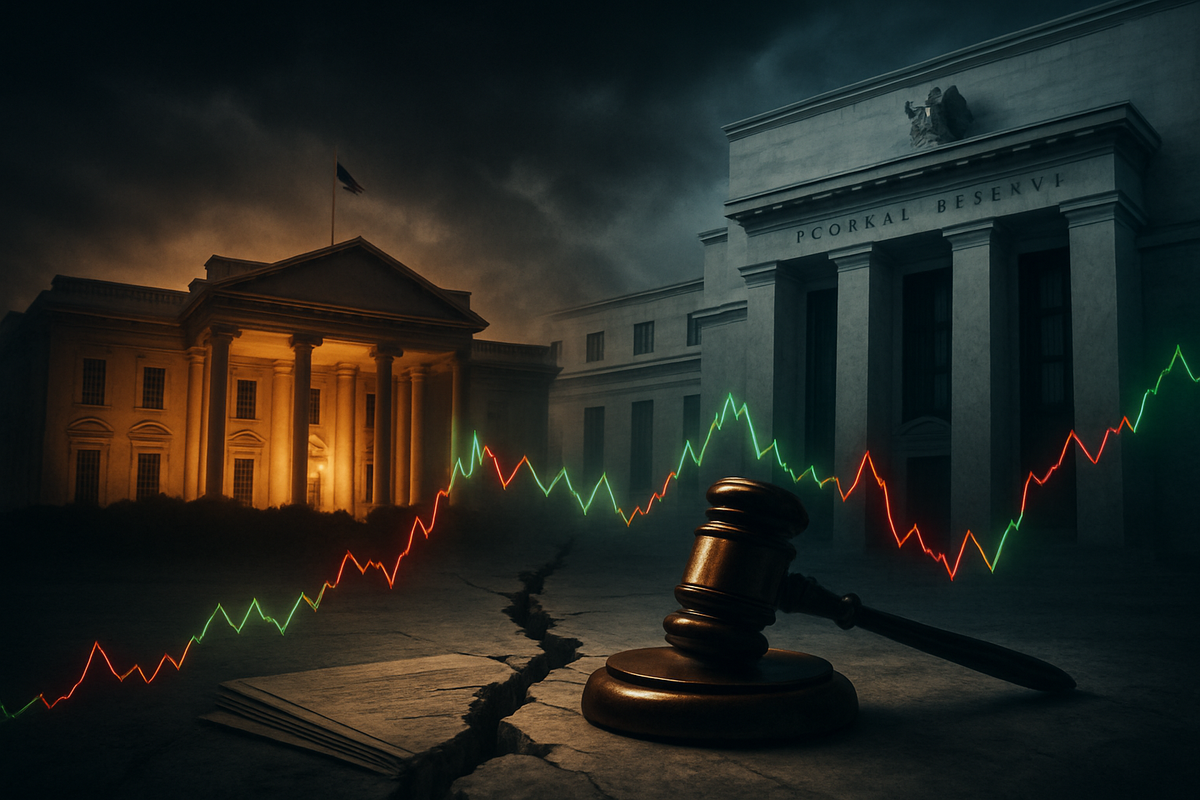
WASHINGTON, D.C. — In a dramatic escalation of the long-standing feud between the executive branch and the central bank, President Donald Trump issued a direct ultimatum to Federal Reserve Chair Jerome Powell during a televised interview on Wednesday morning. Speaking with Maria Bartiromo on Mornings with Maria, the President stated he is prepared to forcibly remove Powell from his post if he does not voluntarily step aside when his term as Chairman expires next month. The threat has sent shockwaves through global financial markets, raising urgent questions about the legal boundaries of the Federal Reserve’s independence and the stability of the U.S. dollar.
The confrontation comes at a precarious moment for the American economy. With Powell’s four-year term as Chair set to end on May 15, 2026, a "constitutional game of chicken" has developed. While the President has already nominated a successor, the transition has been paralyzed by a Department of Justice investigation and a Senate deadlock. Trump’s comments on Wednesday suggest that the White House is no longer willing to wait for a diplomatic resolution, potentially triggering a legal battle that could reach the Supreme Court and redefine the power of the presidency over the nation's monetary policy.
The Bartiromo Interview and the Road to the Ultimatum
During his appearance on Fox Corporation (NASDAQ: FOXA), President Trump was blunt about his intentions regarding the Fed Chair. When asked by Bartiromo what would happen if Powell refused to vacate his office in May, Trump replied, "Then I’ll have to fire him. I’ve held back firing him. I’ve wanted to fire him, but I hate to be controversial. I want to be uncontroversial. But he’s left me no choice." The President framed the potential firing as a response to what he termed "gross incompetence," specifically citing an ongoing DOJ probe into a $2.5 billion renovation of the Federal Reserve’s headquarters.
The tension between the two men has been building since Trump’s return to the White House in January 2025. The administration has repeatedly pressured the Federal Open Market Committee (FOMC) for aggressive interest rate cuts to fuel economic growth, but Powell has maintained a data-dependent approach, citing persistent inflationary pressures. This policy divergence led the administration to appoint U.S. Attorney Jeanine Pirro to lead an investigation into the Fed’s building costs, which have ballooned by nearly 80% over the original budget. Trump has utilized this probe as a "for cause" justification for removal, a legal requirement under the Federal Reserve Act.
The timeline of this conflict is rooted in a decade of public animosity. After nominating Powell in 2017, Trump quickly soured on his pick as the Fed began raising rates in 2018. Following a brief period of cooperation during the 2020 pandemic, the relationship permanently fractured during the 2024 campaign, where Trump labeled Powell "political." Now, as the May 15 deadline approaches, the situation is compounded by a Senate stalemate. Senator Thom Tillis has blocked the confirmation of Trump’s nominee, former Fed Governor Kevin Warsh, insisting that no vote occur until the DOJ investigation into Powell is resolved.
Market Winners and Losers in a Volatile Climate
The prospect of a forced removal of the Fed Chair has injected significant uncertainty into the markets, with the SPDR S&P 500 ETF Trust (NYSEARCA: SPY) and the Invesco QQQ Trust (NASDAQ: QQQ) showing increased intraday volatility following the interview. Financial institutions, in particular, are bracing for the fallout. Large-cap banks like JPMorgan Chase & Co. (NYSE: JPM) and The Goldman Sachs Group, Inc. (NYSE: GS) are viewed as potential losers in this scenario. A politicized Federal Reserve could lead to a "risk premium" being attached to U.S. assets, increasing borrowing costs for banks and destabilizing the bond market where yield curves are already reacting to the threat of executive interference.
Conversely, some "Trump-aligned" sectors may see short-term speculative gains. Energy companies and heavily regulated industrial firms might benefit if the market anticipates a post-Powell Fed will aggressively slash rates to appease the White House, regardless of inflation. However, even these potential winners face the specter of a weakened U.S. dollar (ICE: DX), which could lose its status as the world’s ultimate safe-haven currency if the central bank’s autonomy is compromised. Gold and alternative assets have historically served as hedges during such periods of institutional instability.
For the broader market, the primary concern is the precedent. If the "for cause" standard is successfully expanded to include policy disagreements or administrative cost overruns, the Federal Reserve’s ability to act as a non-partisan stabilizer of the economy could be permanently damaged. This would likely lead to higher long-term interest rates as investors demand higher returns to compensate for the unpredictability of a politically driven monetary policy.
The Eroding Foundation of Central Bank Independence
The current crisis represents the most significant challenge to Federal Reserve independence since its inception in 1913. Historically, the "for cause" provision was intended to protect Fed Governors from being fired for simply doing their jobs, such as raising rates to combat inflation. However, by leveraging the DOJ investigation into building renovations, the Trump administration is attempting to create a legal pretext that bypasses traditional protections. This mirrors historical tensions seen in the 1960s between Lyndon B. Johnson and William McChesney Martin, though those disputes never reached the level of a formal firing threat.
The wider significance of this event extends to the global stage. Central bank independence is a cornerstone of modern macroeconomics, used by developed nations to decouple long-term monetary stability from short-term political election cycles. If the United States—the issuer of the global reserve currency—successfully subordinates its central bank to executive whim, it could trigger a "race to the bottom" globally. Emerging markets that have struggled to build credible, independent institutions may follow suit, leading to a worldwide era of higher structural inflation and reduced fiscal discipline.
Regulatory and policy implications are also profound. A Powell removal would likely lead to immediate litigation in the D.C. Circuit Court of Appeals. Earlier this year, Federal Judge James Boasberg already signaled skepticism, quashing DOJ subpoenas and ruling that the investigation into the Fed appeared to be a "pretext" for political harassment. A forced firing would set the stage for a landmark Supreme Court case that would test the "unitary executive theory," which posits that the President should have absolute control over all executive branch agencies.
What Comes Next: A May 15 Showdown
As the May 15 deadline nears, the short-term outlook is one of heightened legal and political maneuvering. Powell has indicated he has "no intention" of leaving the Board of Governors, where his term as a member—distinct from his term as Chair—runs until 2028. If Trump follows through on his threat to fire him as Chair, Powell could theoretically remain on the Board as a regular Governor, creating a fractured leadership structure within the FOMC. This would lead to a period of unprecedented paralysis in monetary policy precisely when the market is looking for clear guidance.
A long-term possibility is the emergence of a "shadow" Fed, where the White House’s preferred leadership issues guidance while the legally embattled Powell continues to assert his authority. Such a scenario would be catastrophic for market clarity. Investors should watch for any movement in the Senate regarding Kevin Warsh's nomination. If Senator Tillis or other moderate Republicans signal a willingness to break the deadlock, it could provide a "soft landing" exit for both the President and the Fed Chair. However, if the Senate remains frozen, the likelihood of a forced removal—and the subsequent legal firestorm—increases daily.
Wrap-Up and Investor Takeaways
The threat to fire Jerome Powell is more than a personal feud; it is a fundamental challenge to the architecture of the American financial system. The key takeaway for investors is that the "Fed Put"—the idea that the central bank will always step in to support the market—is now complicated by the "White House Pressure." While lower rates may be the ultimate goal of the administration, the path to achieving them through the removal of the Chair could be so disruptive that the market benefits are entirely neutralized by the resulting chaos in the bond and currency markets.
Moving forward, the market will likely remain in a "wait and see" mode, with volatility spikes expected around every major announcement from the DOJ or the White House. Investors should closely monitor the 10-year Treasury yield and the dollar index as barometers of institutional confidence. The coming weeks will determine whether the Federal Reserve remains an independent guardian of the economy or becomes a subordinate arm of the executive branch. In either case, the decision made by May 15 will have lasting impacts on the global financial landscape for decades to come.
This content is intended for informational purposes only and is not financial advice.