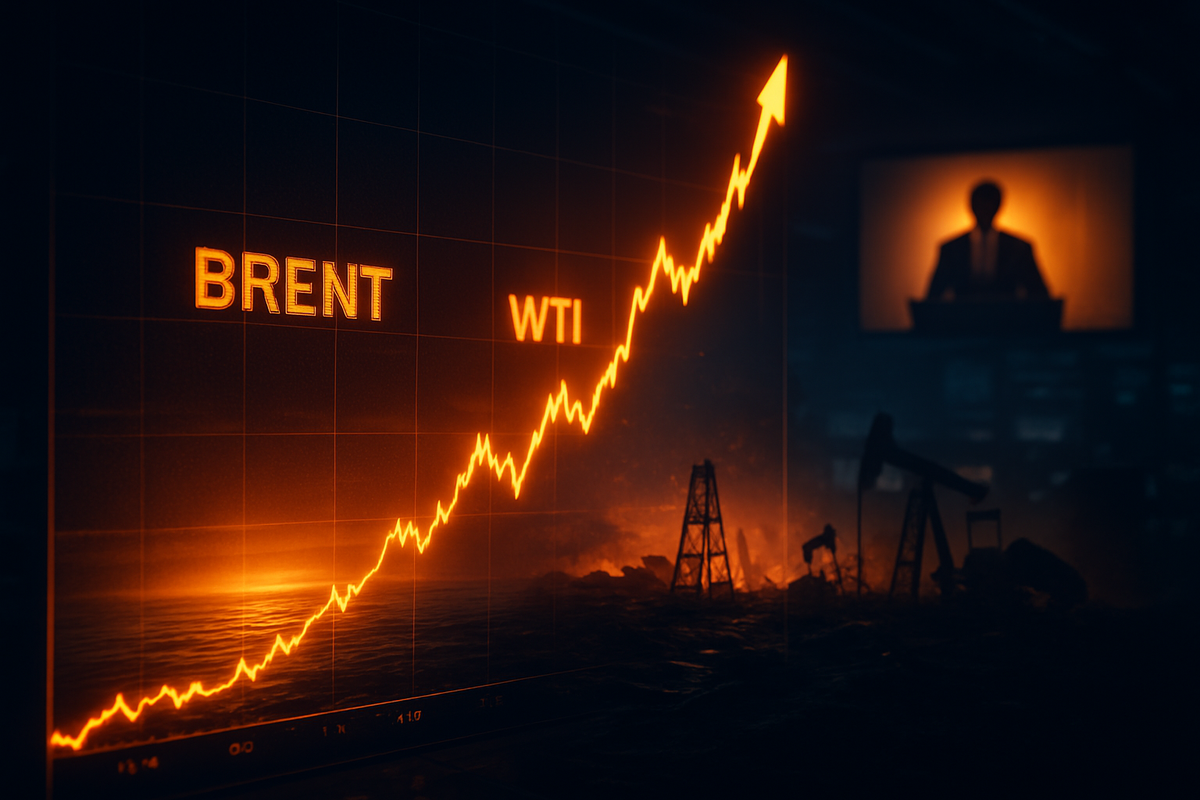
The global energy markets were sent into a tailspin on April 1, 2026, as a fleeting moment of geopolitical optimism was shattered by a prime-time televised address from President Donald Trump. Brent crude, which had drifted down to a low of $101 per barrel earlier in the day on rumors of a diplomatic breakthrough in the Middle East, reversed course violently following the President’s rhetoric. Within hours of the broadcast, the international benchmark spiked 8%, surging toward $109, while West Texas Intermediate (WTI) followed suit with an even more aggressive double-digit rally.
This sudden return of the “war premium” has profound implications for a global economy already grappling with structural shifts in energy policy. As the administration doubles down on its "Energy Dominance" agenda, the renewed volatility underscores the fragile state of global supply chains, particularly as the blockade of the Strait of Hormuz continues to threaten nearly 20% of the world’s daily oil consumption. For investors, the session served as a stark reminder that in the current geopolitical climate, market fundamentals are frequently taking a backseat to the stroke of a pen or a single televised speech.
From Fragile Peace to Market Panic: The $101 Floor Dissolves
The trading day began with a sense of relief that now appears to have been misplaced. Throughout the morning of April 1, reports circulated of a potential ceasefire in the burgeoning conflict involving the U.S., Israel, and Iran. This "fragile optimism" pressured Brent crude down to the $101 mark, its lowest level in weeks, as traders began to unwind hedges placed against a wider regional war. However, the sentiment shifted 180 degrees during the evening's televised address from the Oval Office, where President Trump adopted a "Maximum Pressure 2.0" stance, vowing to hit Iranian interests "extremely hard" unless specific military and nuclear concessions were met immediately.
The timeline of events highlights the market's extreme sensitivity to executive rhetoric. By 9:00 PM ET, as the President spoke of a commitment to maintaining a blockade-response strategy without a clear diplomatic exit ramp, algorithmic trading intensified. The lack of a de-escalation timeline forced a massive wave of short-covering. By the time Asian markets opened on April 2, Brent crude had breached $109 per barrel. This 8% jump represents one of the largest single-session volatility events since the initial outbreak of hostilities in late February 2026, effectively erasing all gains made by energy consumers during the brief period of de-escalation hopes.
Key stakeholders, including OPEC+ ministers and Western refinery operators, were caught off-guard by the intensity of the rhetoric. While the administration has pushed for increased domestic production, the immediate reality of a potential long-term closure of the Strait of Hormuz has created a supply vacuum that domestic drilling cannot fill overnight. The result is a market characterized by "bifurcation," where the promise of future American energy abundance is clashing with the immediate, cold reality of physical supply disruptions in the Persian Gulf.
Winners and Losers: Big Oil Capitalizes on the Chaos
Among the primary beneficiaries of this price surge are the U.S. "Supermajors," which have spent the last year streamlining operations under a friendly regulatory environment. Exxon Mobil (NYSE: XOM) saw its shares jump nearly 3% in after-hours trading following the President’s address. Exxon Mobil has been a standout performer in early 2026, bolstered by record-breaking production in the Permian Basin and high-margin offshore projects in Guyana. With the company’s internal "break-even" price hovering around $65 per barrel, the current $100+ environment is generating massive surplus cash flow, much of which is being funneled into a recently expanded $20 billion share buyback program.
Similarly, Chevron (NYSE: CVX) shares rose more than 2% as the market priced in higher long-term realizations for its domestic shale assets. Chevron's 2025 integration of Hess Corporation has proven timely, giving the company significant exposure to the Bakken shale and additional Guyanese assets just as global supply tightens. Investors have increasingly viewed Chevron as a "safe haven" within the energy sector, citing its 39-year streak of dividend increases and a remarkably low debt-to-equity ratio of 0.22. For these companies, the "war premium" acts as a massive tailwind, accelerating their ability to fund future projects and return capital to shareholders.
However, the picture is less rosy for the refining sector and mid-market industrial consumers. While the majors win on the upstream side, refineries—particularly those in the Midwest—are facing a double whammy of high feedstock costs and the threat of a 25% tariff on Canadian and Mexican crude imports proposed by the administration earlier this year. Companies reliant on heavy crude imports may see their margins compressed even as the price of the finished product rises at the pump, creating a complex landscape where only the fully integrated giants are truly insulated from the volatility.
A New Era of Energy Dominance and Geopolitical Risk
The current market turmoil fits into a much broader trend of "Energy Dominance" that has defined the U.S. policy landscape since the passage of the "One Big Beautiful Bill Act" in July 2025. This landmark legislation dismantled many previous climate-related restrictions, restored tax advantages for fossil fuel producers, and streamlined federal permitting to a mere 28 days. By reopening the Arctic National Wildlife Refuge (ANWR) and expanding offshore drilling, the administration has signaled a long-term shift toward maximizing domestic output. However, the April 2026 spike illustrates that even record-high U.S. production cannot fully decouple domestic prices from global geopolitical shocks.
The ripple effects are being felt far beyond U.S. borders. In Eastern Europe, the ongoing conflict between Russia and Ukraine has already taken nearly 40% of Russia’s refining capacity offline due to drone strikes. With the Middle East now in a state of high-intensity friction, Russian Urals crude hit a 13-year high of $110 in March 2026, as global buyers scrambled for any available non-Gulf alternatives. This creates a paradoxical situation where sanctions-hit Russian oil is commanding a premium, complicating international efforts to isolate Moscow financially while simultaneously driving up costs for European allies.
Historically, this period draws comparisons to the oil shocks of the 1970s, but with a modern twist: the U.S. is now a net exporter of energy. Unlike previous eras, the current volatility is not just a threat to the American consumer but also a strategic tool of American foreign policy. The administration’s willingness to use energy as a "maximum pressure" lever against Iran suggests that the "Energy Dominance" era will be marked by higher-than-average price floors and frequent, rhetorically-driven spikes, as the White House prioritizes geopolitical objectives over short-term price stability at the pump.
The Road to $120: What Lies Ahead for the Energy Markets
Looking ahead, the short-term forecast for oil markets remains skewed to the upside. Analysts at several major investment banks have revised their mid-year targets, with some now predicting Brent could breach $120 per barrel if the "Maximum Pressure" campaign transitions into a broader kinetic conflict. The critical factor to watch will be the status of the Strait of Hormuz. If the blockade persists through the second quarter of 2026, the global supply deficit could reach 8 million barrels per day, a gap that no amount of SPR releases or Permian Basin growth can bridge in the near term.
Strategic pivots will be required for energy-intensive industries. Airlines and shipping companies, which had enjoyed a period of relative stability in late 2025, are now facing a rapid escalation in fuel surcharges. We may see a renewed interest in hedging strategies that had been abandoned during the brief de-escalation phase. Furthermore, the administration’s focus on refilling the Strategic Petroleum Reserve (SPR) at these elevated prices suggests that a high-price floor is becoming a matter of national policy, potentially keeping oil above $90 for the foreseeable future regardless of geopolitical outcomes.
Market opportunities may emerge in the infrastructure and services sector. As the U.S. pushes to expand its LNG export capacity—which hit a record 100 million metric tons in late 2025—companies specializing in midstream logistics and terminal construction are likely to see sustained demand. However, the overarching challenge remains the unpredictability of the "headline risk." In an environment where a single televised address can swing the market by 8%, traditional technical analysis is increasingly being supplemented by "geopolitical sentiment" monitoring.
Conclusion: Navigating a High-Stakes Energy Landscape
The events of early April 2026 have redefined the boundaries of oil market volatility. The transition from $101 to $109 in a single evening serves as a definitive end to the hopes of a quiet de-escalation in the Middle East. The key takeaway for investors is that the "energy security" premium is no longer a temporary fixture but a structural component of the market. As the U.S. continues to aggressive pursue its "Energy Dominance" agenda, the byproduct is a more confrontational geopolitical stance that inevitably leads to the type of price spikes witnessed this week.
Moving forward, the market will remain on high alert for further signals from the White House and the Iranian Revolutionary Guard. Investors should pay close attention to the upcoming Q1 earnings reports from Exxon Mobil and Chevron, which are expected to showcase record profits and provide further details on how these giants plan to deploy their growing cash piles in an era of $100+ oil. The resilience of the American consumer to these higher prices will also be a critical metric as we head into the summer driving season.
Ultimately, the lasting impact of the April 2026 spike may be the realization that the world has entered a new era of "Politicized Energy." Where once the market was governed by the cold calculus of supply and demand, it is now increasingly dictated by the heat of geopolitical ambition and the rhetoric of national power. For those trading in the energy space, the ability to read a political map may now be just as important as the ability to read a balance sheet.
This content is intended for informational purposes only and is not financial advice.