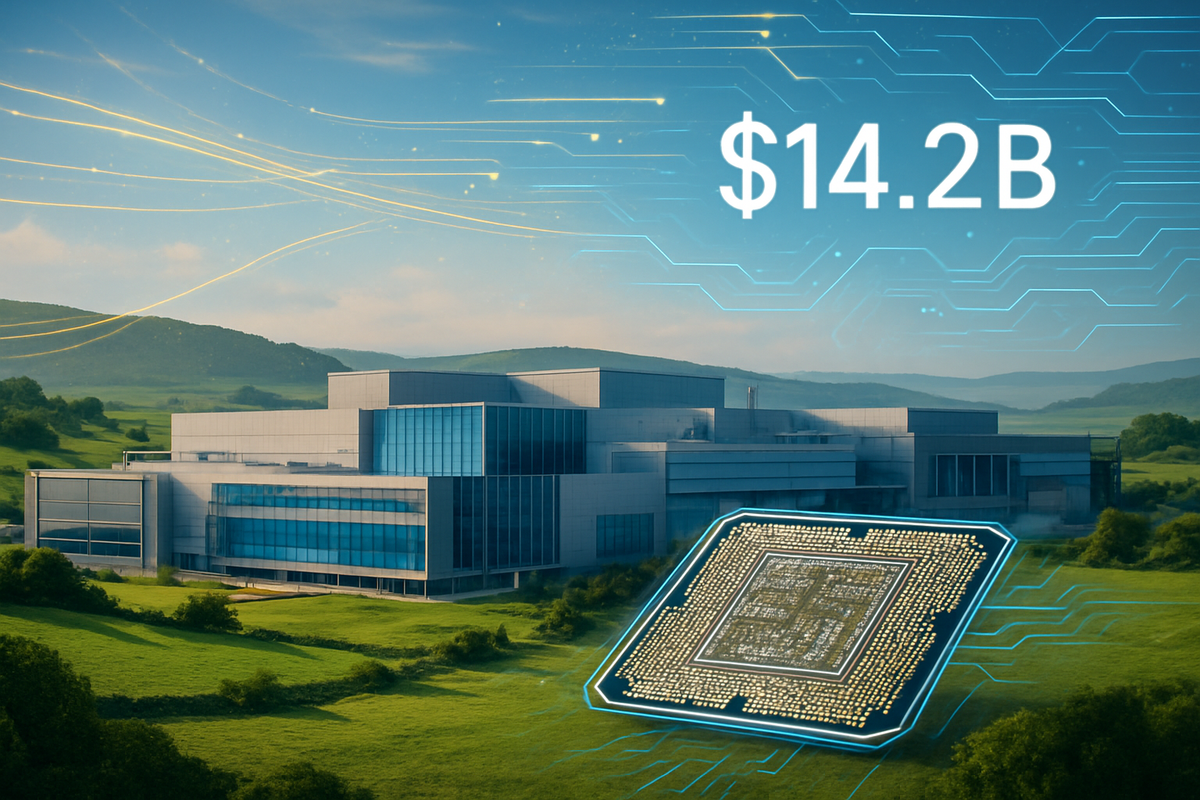
Intel Corp. (Nasdaq: INTC) has officially signaled the end of its era of financial caution, reaching a definitive $14.2 billion agreement to repurchase the 49% stake in its Ireland Fab 34 joint venture previously held by Apollo Global Management (NYSE: APO). The move, announced this week, marks a pivotal shift for the semiconductor giant as it transitions from a "capital-saving" mode to a "margin-expansion" phase, effectively unwinding a multi-billion dollar co-investment deal that provided much-needed liquidity during its most turbulent restructuring period.
By regaining 100% ownership of its Leixlip, Ireland facility, Intel secures total operational and financial control over its most advanced manufacturing base in Europe. The transaction—funded through a combination of existing cash reserves and $6.5 billion in new debt—is designed to immediately bolster Intel’s bottom line. Industry analysts anticipate the deal will be accretive to earnings per share (EPS) by eliminating the complex "cost-plus-margin" payment structure that Intel previously owed to its private equity partner for every wafer produced at the site.
The Road to Full Ownership: Unwinding the 2024 "Bridge"
The path to this $14.2 billion repurchase began in June 2024, when Intel was grappling with a massive capital expenditure burden required to fuel its "five nodes in four years" roadmap. At the time, Intel sold the 49% stake in Fab 34 to Apollo for approximately $11 billion. This "Semiconductor Co-Investment Program" (SCIP) acted as a high-stakes bridge loan, allowing Intel to keep its Arizona and Ohio projects on track without diluting its stock or over-leveraging its balance sheet during a cyclical downturn in the PC and data center markets.
The buyback price represents a roughly $3.2 billion premium paid to Apollo over the course of 22 months—a price Intel is apparently more than willing to pay to simplify its corporate structure. Since the initial deal, Fab 34 has become a cornerstone of Intel’s strategy, serving as the high-volume manufacturing hub for Intel 4 and Intel 3 process nodes. These technologies are essential for the company’s newest AI-optimized chips, including the Core Ultra and Xeon 6 lineups.
Market reaction has been cautiously optimistic. While the $6.5 billion in new debt adds a layer of leverage, the consensus among institutional investors is that the long-term margin benefits outweigh the interest costs. By removing a third-party partner from its most critical European node, Intel can now optimize its foundry services without seeking external approval for capacity shifts or technological upgrades, providing the agility needed to compete with rivals like Taiwan Semiconductor Manufacturing Co. (NYSE: TSM).
Winners and Losers: Apollo’s Exit and Intel’s Re-entry
For Apollo Global Management (NYSE: APO), the deal represents a textbook success in the "capital-as-a-service" model. By stepping in when Intel needed liquidity, Apollo secured a massive, low-risk return on a critical piece of global infrastructure. The roughly 29% nominal gain over less than two years underscores the lucrative nature of private equity’s growing role in financing the Western world’s re-industrialization. Apollo exits the venture with its pockets lined, having proven its ability to handle complex, large-scale technology financing.
For Intel (Nasdaq: INTC), the "win" is more strategic than immediate. The company now captures the full upside of the European Union’s push for semiconductor sovereignty. As the only facility in Europe currently utilizing Extreme Ultraviolet (EUV) lithography at scale, Fab 34 is a strategic asset that Intel can now leverage for its burgeoning "Intel Foundry" business. This allows Intel to keep 100% of the profits from external customers who seek to manufacture chips on European soil to comply with local supply chain regulations.
On the other side of the ledger, traditional lenders and bondholders may keep a wary eye on Intel’s debt levels. While the $14.2 billion deal is described as accretive to EPS, the addition of $6.5 billion in debt comes at a time when the company is still heavily investing in its 18A process node. However, with the "CHIPS Act" subsidies from both the U.S. and the EU now largely distributed, Intel's cash flow stability appears significantly more robust than it was in 2024.
A Wider Significance: Sovereignty and the New Tech Economy
This transaction fits into a broader global trend of "onshoring" and "friend-shoring" of critical technology. Intel’s full control of Fab 34 aligns perfectly with the goals of the European Chips Act, which seeks to double the EU's share of global semiconductor production to 20% by 2030. Having a fully Intel-owned, EUV-capable fab in Ireland makes the company the de facto leader of European advanced manufacturing, potentially distancing it from competitors like GlobalFoundries (Nasdaq: GFS) or STMicroelectronics (NYSE: STM), who operate at less advanced nodes.
Historically, semiconductor companies have avoided such expensive buybacks during heavy growth cycles, but the "Intel Foundry" model necessitates a clean balance sheet for manufacturing assets. When Intel was a purely integrated device manufacturer (IDM), sharing fab costs was a survival tactic. As a foundry seeking to win contracts from Nvidia (Nasdaq: NVDA) or Apple (Nasdaq: AAPL), having a partner like Apollo involved in the manufacturing economics added a layer of complexity that deterred some potential clients.
Furthermore, this deal sets a precedent for how tech giants might interact with private equity in the future. We may see more "buy-to-build" partnerships where private equity provides the initial "dry powder" for construction, only to be bought out once the facility reaches high-volume production and becomes a reliable cash-flow generator.
Looking Ahead: The 18A Era and Margin Recovery
In the short term, Intel must successfully navigate the issuance of $6.5 billion in debt without triggering a credit rating downgrade. The company’s management has signaled that the interest payments will be dwarfed by the savings achieved by not paying Apollo its share of fab margins. The immediate focus will be on the Q3 2026 closing date, during which Intel will likely provide more granular guidance on how this impacts its 2027 fiscal year projections.
Long-term, the success of this move hinges on the "Intel 18A" process node. If Intel can successfully transition its clients to 18A and fill its fabs—including the now fully-owned Fab 34—with high-margin AI silicon, this buyback will be remembered as the moment Intel reclaimed its crown. If the foundry business struggles to attract third-party customers, however, the added debt could become a heavy anchor.
Strategic pivots are already underway. Intel is expected to use its total control of Ireland's capacity to offer more aggressive pricing to European automotive and industrial clients who are desperate for localized, high-performance computing. This could see Intel capturing a larger slice of the European "Edge AI" market throughout the latter half of the decade.
Summary and Investor Takeaways
Intel’s $14.2 billion repurchase of Apollo’s stake in Ireland’s Fab 34 is a bold declaration of confidence. It signifies that the company has moved past the "emergency" phase of its turnaround and is now focused on optimizing its long-term profitability. By consolidating ownership of its most advanced European asset, Intel simplifies its operations, boosts its potential EPS, and cements its position as the leading edge of Western semiconductor manufacturing.
For investors, the key takeaway is Intel's shift toward margin health. While the $3.2 billion premium paid to Apollo might seem steep, the removal of "cost-plus" payments to a partner is a structural improvement that will pay dividends for years to come. In the coming months, watchers should keep a close eye on Intel’s foundry customer announcements and the specific terms of the $6.5 billion debt issuance.
Ultimately, this deal suggests that Intel believes its most expensive days of building are behind it, and its most profitable days of producing are just beginning. As the world becomes increasingly reliant on AI-capable hardware, having full control of the "printing press" for that hardware is perhaps the most valuable asset Intel could own.
This content is intended for informational purposes only and is not financial advice.