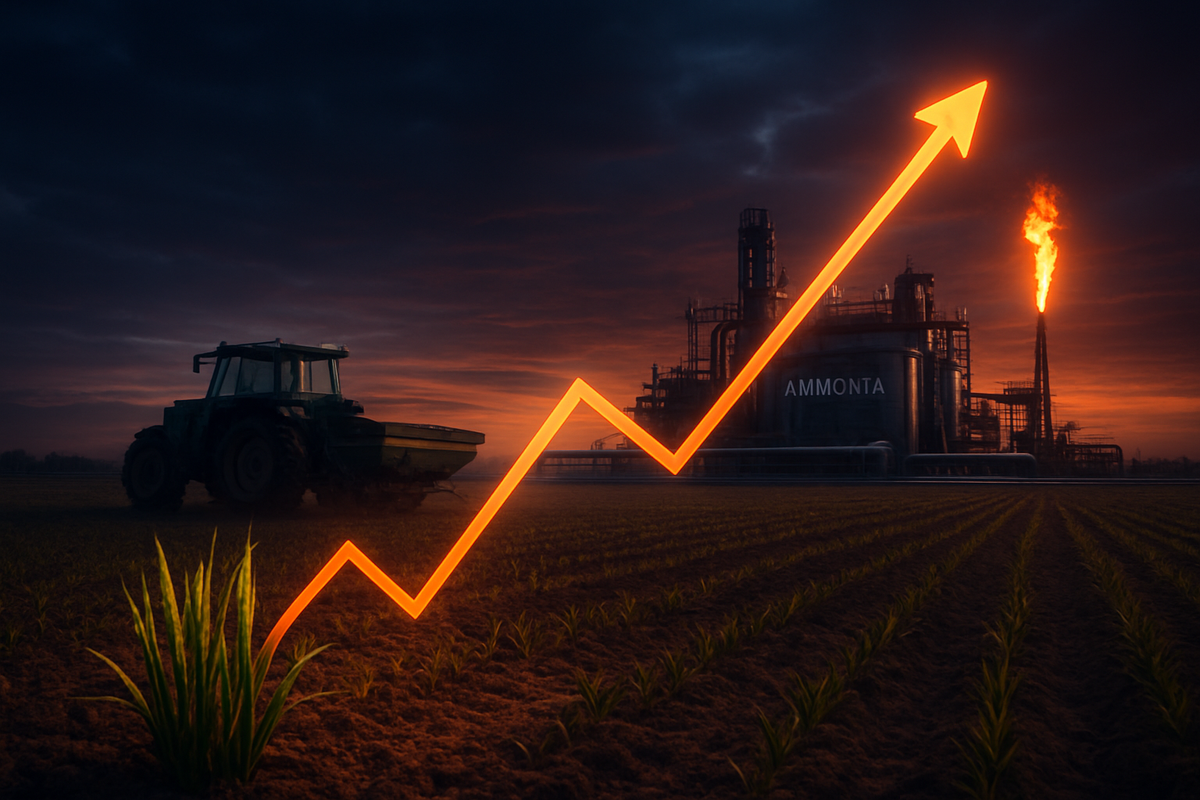
The global agricultural landscape has been thrown into a state of high alert following a staggering 26.2% spike in fertilizer prices reported by the World Bank. The surge, documented in the April 2026 commodity "Pink Sheet" report, represents the sharpest monthly increase in years, effectively erasing the cautious optimism of late 2025. This sudden inflationary pressure is primarily driven by a "physical availability crisis" in the energy sector, which has sent the cost of natural gas—the lifeblood of nitrogen-based fertilizer production—to levels not seen since the peak of the 2022 energy crisis.
The immediate implications are dire for global food security. As farmers across the globe prepare for the 2026/27 planting season, the prohibitive cost of essential nutrients like urea and phosphate threatens to trigger a "yield cliff," where reduced fertilizer application leads to significantly lower crop outputs. With the World Food Program estimating that an additional 45 million people could face acute hunger due to these rising costs, the market is no longer just grappling with an economic challenge, but a burgeoning humanitarian emergency.
A Perfect Storm: The Path to the 26.2% Spike
The road to this unprecedented spike began in early February 2026, when geopolitical escalations in the Middle East led to a partial blockade of the Strait of Hormuz. This critical chokepoint for Liquefied Natural Gas (LNG) shipments saw transit volumes drop by nearly 40% in a matter of weeks, causing European natural gas prices—benchmarked by the Dutch TTF—to soar by 60%. Because natural gas accounts for up to 80% of the variable cost of producing ammonia and urea, fertilizer manufacturers were forced to make impossible choices. By mid-March, several major production facilities across the European Union had announced indefinite curtailments, reducing regional capacity to below 75%.
The World Bank’s data highlights that urea prices were the primary driver of the index, skyrocketing by 53.7% in March alone. This was exacerbated by ongoing export quotas from China, which sought to protect its domestic supply, effectively removing one of the world's largest exporters from the global spot market. The timeline of this crisis is particularly damaging; the price surge hit just as major agricultural hubs in the Northern Hemisphere were finalizing their spring nutrient purchases. Industry analysts at the World Bank had originally projected a 7% decline in commodity prices for 2026, but those forecasts have been rendered obsolete by the reality of the energy shock.
Key stakeholders, including the International Fertilizer Association and various national ministries of agriculture, have spent the last three weeks in emergency sessions. The initial market reaction was one of shock, with spot prices for Diammonium Phosphate (DAP) and Potash also seeing double-digit gains as buyers scrambled to secure remaining inventories. The "stabilizing" narrative that characterized the end of 2025 has been replaced by a "risk-on" environment where supply chain reliability has become more valuable than the price itself.
Winners and Losers in a Bifurcated Market
The financial fallout from this event has created a stark divide between fertilizer producers based on their access to low-cost feedstock. CF Industries Holdings (CF:NYSE) has emerged as a primary beneficiary of the crisis. With the majority of its production based in North America, CF Industries utilizes cheap, domestic shale gas, allowing it to maintain high margins while global urea prices soar. The company’s stock reached an all-time high of approximately $137 in late March 2026, as investors bet on record-breaking quarterly earnings driven by the widening "energy spread" between the U.S. and Europe.
Conversely, Nutrien (NTR:NYSE) has faced a more volatile environment. While Nutrien is a titan in the potash and nitrogen markets, its global footprint and high exposure to international logistics have led some analysts to downgrade the stock to a "Hold." The company is grappling with the dual challenge of managing high production costs in certain regions while navigating a potential pullback in demand from cash-strapped farmers. Similarly, The Mosaic Company (MOS:NYSE) has seen its stock fluctuate wildly. While Mosaic benefited from the U.S. government’s decision in late 2025 to designate phosphate and potash as "Critical Minerals," providing it with some policy-based tailwinds, the rising costs of sulfur—a key input for phosphate production—have squeezed its bottom line.
Beyond the producers, the losers of this event are the equipment manufacturers and agricultural processors. Deere & Company (DE:NYSE) and CNH Industrial (CNHI:NYSE) may face headwinds as farmers divert their capital away from machinery upgrades to cover the soaring cost of inputs. Meanwhile, food processing giants like Archer-Daniels-Midland Company (ADM:NYSE) are bracing for higher raw material costs, which they will eventually have to pass on to consumers, further fueling the global inflationary spiral.
Historical Precedents and the Wider Significance
This 2026 price spike mirrors the "fertilizer crisis" of 2022, but with a more fragile global economy as the backdrop. The wider significance of this event lies in its exposure of the continued dependence of the global food system on volatile energy markets. Despite years of talk regarding "green ammonia" and alternative nutrient sources, the world remains tethered to natural gas. This event fits into a broader trend of "resource nationalism," where countries like China and Russia prioritize domestic stability over global trade obligations, a move that is becoming the new normal in the mid-2020s.
The ripple effects are reaching far beyond the agricultural sector. In Brazil, a major exporter of soybeans and corn, the "Yield Cliff" is a genuine fear, as the country imports nearly 85% of its fertilizer requirements. If Brazil’s productivity slips, the global supply of animal feed will tighten, leading to higher meat prices globally. Regulatory bodies are already taking notice; the European Commission is under pressure to reconsider its energy transition timelines to provide more support for domestic ammonia production, highlighting a conflict between climate goals and food security.
From a historical perspective, the 26.2% jump is a rare "black swan" event for a single month. It highlights the vulnerability of "just-in-time" supply chains for critical agricultural inputs. Unlike the 2022 crisis, which was largely seen as a one-off geopolitical shock, the 2026 event suggests a structural instability in the market, where any minor disruption in energy transit can lead to a massive spike in food production costs.
The Road Ahead: Short-Term Pain and Strategic Pivots
In the short term, the agricultural market is likely to remain in a "high-volatility" state. We can expect to see a surge in "precision agriculture" technologies as farmers look to maximize every ounce of fertilizer they apply. This could provide a mid-to-long-term opportunity for tech-focused ag companies that provide soil sensing and variable-rate application tools. However, for the 2026 harvest, the damage may already be done; the lag between price spikes and harvest yields means that the true impact on food prices will likely manifest in late 2026 and early 2027.
Strategically, the fertilizer industry is at a crossroads. Companies may accelerate their investment in "Blue" and "Green" ammonia—produced using carbon capture or renewable energy—to decouple themselves from the volatility of natural gas markets. However, these technologies are still years away from reaching the scale needed to replace traditional methods. In the interim, we may see a trend toward "bilateral supply agreements" where governments secure fertilizer supplies directly from producers in exchange for energy or trade concessions, further fragmenting the global market.
Conclusion: A Market Under Pressure
The 26.2% spike in fertilizer prices is a wake-up call for the global economy. It underscores the fact that food security is, at its core, an energy issue. While North American producers like CF Industries (CF:NYSE) are currently positioned to profit from this imbalance, the broader agricultural sector is facing its most significant challenge in years. The "stabilizing but risky" outlook for 2026 has tilted firmly toward "risky," with the potential for a multi-year inflationary cycle in the food sector.
For investors, the coming months will require a focus on "feedstock advantaged" companies and those providing efficiency-increasing technologies. The market will be watching the Strait of Hormuz and European natural gas storage levels closely. If energy costs do not retreat by the third quarter of 2026, the "Yield Cliff" could become a reality, leading to a profound and lasting impact on global stability and the bottom lines of every company in the food value chain.
This content is intended for informational purposes only and is not financial advice.