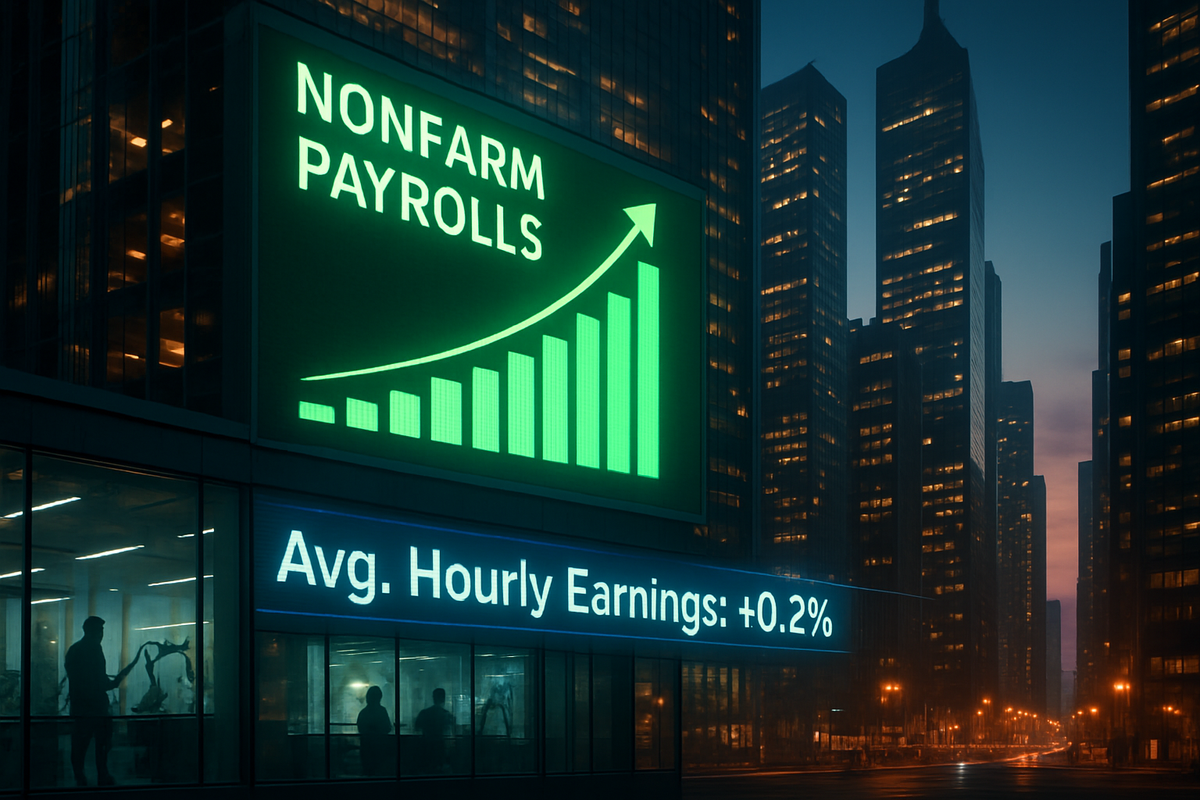
The U.S. labor market delivered a profound "plot twist" on April 3, 2026, as the March jobs report revealed a massive headline payroll beat that defied recessionary fears and geopolitical headwinds. While the economy added 178,000 jobs—nearly triple the consensus estimate of 60,000—the real story for Wall Street and the Federal Reserve lay in the "soft" 0.2% monthly wage growth. This deceleration in average hourly earnings has emerged as a critical cooling mechanism, potentially preventing a wage-price spiral even as hiring remains unexpectedly robust.
As of today, April 6, 2026, the financial community is still digesting the implications of this bifurcated data. With the 10-year Treasury yield jumping to 4.35% in the wake of the report, the markets are pricing in a "higher for longer" interest rate environment, but the tepid wage figures provide a glimmer of hope that inflation can be tamed without a significant spike in unemployment. This "Goldilocks" reading on wages suggests that the labor market is reaching a state of "low-hire, low-fire" equilibrium, where workers are staying put rather than jumping for inflationary pay raises.
A Tale of Two Reports: Headline Strength Meets Wage Weakness
The March 2026 employment situation report was released during a period of high anxiety, following a February that saw a revised loss of 133,000 jobs. The rebound to 178,000 new positions in March caught most analysts off guard, especially given the ongoing energy shock and international tensions. The unemployment rate also edged down to 4.3% from 4.4%, suggesting a labor market that is far from breaking. However, underneath the surface of these strong headline numbers, the 0.2% month-over-month increase in wages—the lowest annual growth rate since May 2021 at 3.5%—tells a different story of cooling demand for labor.
The timeline leading up to this moment has been marked by a shift in corporate strategy toward automation and efficiency. Throughout the first quarter of 2026, the technology and finance sectors have faced significant headwinds, with companies like Oracle Corporation (NYSE: ORCL) and Meta Platforms, Inc. (NASDAQ: META) announcing substantial layoffs as they pivot budgets toward Artificial Intelligence (AI). This "AI-driven efficiency" has started to show up in the data, where high-paying white-collar roles are being trimmed while essential service roles in healthcare and construction continue to see growth.
Initial market reactions were restricted due to the Good Friday holiday, but futures markets and bond yields immediately responded to the paradox. While the hiring surge initially signaled a need for more rate hikes, the soft wage reading acted as a stabilizer. San Francisco Fed President Mary Daly characterized the report as "really good news," noting that it grants the central bank more time to assess the impact of energy costs on the broader economy before making their next move.
Winners and Losers in a Cooling Wage Environment
In this unique economic landscape, sectors with high labor intensity and those leading the AI transition are seeing divergent outcomes. Healthcare and social assistance remain the primary engines of job growth, with UnitedHealth Group (NYSE: UNH) and other major providers benefiting from a resolution of previous physician strikes and an aging population’s inelastic demand for care. For these companies, the 0.2% wage growth is a boon, as it keeps labor costs manageable while they continue to expand their workforces to meet demand.
Conversely, the technology sector continues to be the primary "loser" in terms of headcount, though a "winner" in terms of strategic pivot. Companies like NVIDIA Corporation (NASDAQ: NVDA) continue to thrive as the infrastructure backbone for the AI shift, but firms that are late to automate are feeling the squeeze. The retail sector, led by giants like Amazon.com, Inc. (NASDAQ: AMZN) and Walmart Inc. (NYSE: WMT), is navigating a treacherous path. While these companies are seeing flat hiring, they are aggressively investing in robotics and autonomous logistics to offset the $4.00-per-gallon gasoline prices that are currently eroding consumer purchasing power.
For the banking sector, the "higher for longer" narrative bolstered by the payroll beat is a double-edged sword. While it supports net interest margins, the risk of a prolonged period of high rates increasing loan defaults remains a concern. The soft wage growth specifically hurts the consumer finance segment, as real wages—adjusted for the current energy-driven inflation—are effectively contracting, leaving households with less disposable income to service debt.
The Macro Significance: Defusing the Wage-Price Spiral
The broader significance of the March report lies in how it challenges traditional economic models like the Phillips Curve, which suggests that low unemployment must lead to high inflation. The 2026 labor market is proving that it is possible to have a "tight" market in terms of job availability but a "loose" market in terms of wage pressure. This phenomenon, often called the "Low-Hire, Low-Fire" equilibrium, indicates that while companies are reluctant to let go of existing staff (keeping unemployment low), they are also not aggressively competing for new talent with high sign-on bonuses.
This event fits into a broader industry trend of "labor hoarding" and automation. Historical precedents from the late 1990s show that productivity gains from technology can sometimes allow for low unemployment without triggering inflation. In 2026, AI appears to be playing that role. By automating mid-office and back-office tasks, companies are maintaining output with fewer expensive human hours, which naturally curbs the "wage-push" inflation that the Federal Reserve fears most.
Regulatory and policy implications are also coming into focus. With the U.S. currently navigating 10% tariffs on various imports and an energy crisis, the Fed is walking a tightrope. If wage growth had matched the payroll beat (e.g., a 0.5% reading), a May rate hike would have been a certainty. Instead, the 0.2% figure gives Chair Jerome Powell the "cover" he needs to maintain the current benchmark rate of 3.5%–3.75%, focusing instead on the external supply shocks rather than internal overheating.
Looking Ahead: The May FOMC Meeting and Strategic Pivots
In the short term, the market will be looking toward the May Federal Open Market Committee (FOMC) meeting for a definitive signal. The 0.2% wage growth has effectively "deleted" any expectations for immediate rate cuts in the first half of 2026, but it has also silenced the calls for emergency hikes. Corporations are likely to continue their strategic pivots toward AI-integrated operations. We expect to see further consolidation in the tech and finance sectors as companies prioritize "per-employee revenue" over raw headcount growth.
Market opportunities may emerge in "late-cycle" winners—companies that provide efficiency solutions to the retail and manufacturing sectors. As real wages contract due to high energy prices, consumer-facing companies will need to adapt their pricing strategies to a more price-sensitive public. The potential for a "soft landing" remains on the table, but it is a landing where the "ground" is being shifted by technological disruption rather than traditional monetary tightening alone.
Closing Thoughts: A Precarious Balance
The March 2026 labor report is a reminder that headline numbers rarely tell the whole story. The "massive beat" of 178,000 jobs would, in any other cycle, be cause for inflationary alarm. Yet, the 0.2% wage growth acts as a vital heat shield, protecting the economy from a full-blown wage-price spiral. For the Federal Reserve, this data is the "saving grace" of an otherwise volatile spring, providing a pathway to stable prices without necessitating a recession-inducing spike in unemployment.
Moving forward, the market remains in a state of cautious optimism. Investors should watch the labor force participation rate and the "quits rate" in the coming months; if workers begin to move more freely again, the 0.2% wage "whisper" could quickly turn into a roar. For now, the "Goldilocks" labor market of 2026 survives another month, even if the "porridge" is being cooled more by AI and energy costs than by the Federal Reserve's own hands.
This content is intended for informational purposes only and is not financial advice