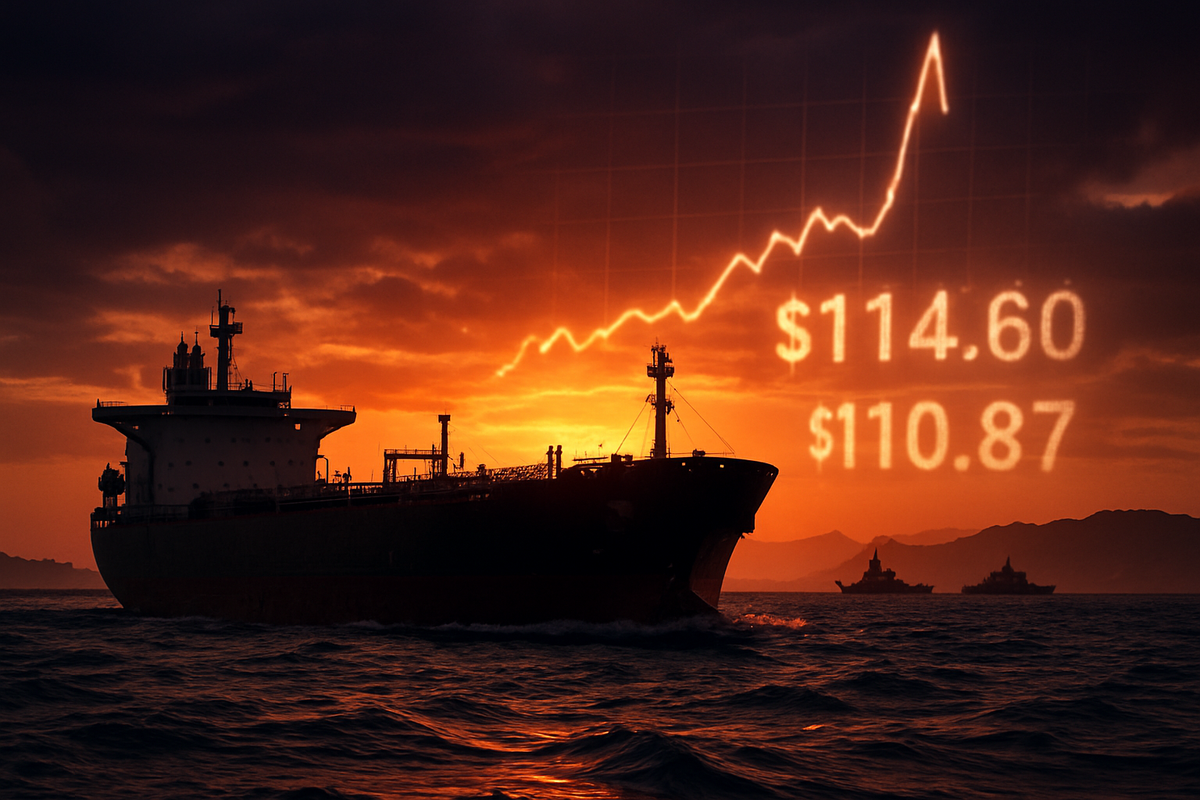
As the sun sets over Washington on this Tuesday, April 7, 2026, the global energy market is held in a state of suspended animation. Crude oil prices have breached the psychological barrier of $110 per barrel, driven by the looming 8 PM EDT deadline set by US President Donald Trump for Iran to reopen the Strait of Hormuz. With Brent crude currently trading at $110.87 and West Texas Intermediate (WTI) surging to $114.60, the volatility index has reached levels not seen since the early days of the 2022 energy crisis.
The standoff, which has effectively choked off nearly 20% of the world’s petroleum supply, has placed the global economy on a war footing. The ultimatum is clear: if the Islamic Revolutionary Guard Corps (IRGC) does not clear the mines and allow merchant vessels to pass through the world's most critical maritime chokepoint by the 8 PM deadline, the United States has authorized "total obliteration" strikes against Iranian energy infrastructure.
The Escalation of the Hormuz Blockade
The current crisis began in late February 2026, following a series of escalatory maritime skirmishes and the failure of back-channel diplomatic efforts regarding regional security. On March 15, the IRGC officially declared the Strait of Hormuz a "restricted zone," citing national security concerns and effectively blockading the transit of tankers from the Persian Gulf. In the weeks that followed, oil prices began a relentless ascent, climbing from a stable $75 in early February to the triple-digit territory where they sit today.
President Donald Trump, maintaining a hardline "America First" stance on energy security, returned to the White House with a mandate to stabilize domestic prices by any means necessary. Over the last 48 hours, the administration has moved carrier strike groups into the North Arabian Sea and issued a final warning. Key stakeholders, including Saudi Arabia and the United Arab Emirates, have gone on high alert, with many of their export facilities currently sitting idle as the blockade holds. Market reactions have been visceral, with energy futures spiking $5 in a single trading session as the deadline approaches.
Market Winners and Losers in the Energy War
The surge in crude prices has created a stark divide between the winners and losers in the equity markets. US-based energy giants, particularly those with significant upstream assets and domestic production, have seen their valuations soar. Exxon Mobil Corp. (NYSE: XOM) and Chevron Corp. (NYSE: CVX) have both seen their share prices climb by over 7% this week as investors bet on record-breaking margins from their non-Middle Eastern assets. Occidental Petroleum (NYSE: OXY) has been a standout performer, fueled by its aggressive expansion in the Permian Basin, which now serves as a critical strategic reserve for the Western world.
Conversely, the sectors reliant on fuel are in freefall. The airline industry is facing a "cost-of-operation" crisis. American Airlines Group Inc. (NASDAQ: AAL) and United Airlines Holdings (NASDAQ: UAL) have seen their stock prices plummet by nearly 15% since the blockade began, as the cost of jet fuel threatens to wipe out annual profits. Logistics and delivery firms are also reeling; FedEx Corp. (NYSE: FDX) has signaled that it will likely introduce "emergency fuel surcharges" that could stifle consumer spending and exacerbate inflationary pressures across the globe.
Geopolitical Shifts and the "Hormuz Premium"
The significance of this event transcends simple price fluctuations; it represents a fundamental challenge to the global energy order. The Strait of Hormuz is the world's most important oil artery, and its closure has historically been the "doomsday scenario" for energy economists. By allowing prices to top $110/bbl, the market is pricing in a "Hormuz Premium" that reflects the fear of a prolonged regional conflict. This event fits into a broader trend of deglobalization and the weaponization of energy resources, reminiscent of the 1973 oil embargo, but with the added volatility of modern drone warfare and cyber capabilities.
Furthermore, the threat of military strikes on Iranian infrastructure—specifically the Kharg Island oil terminal—could lead to a permanent loss of Iranian supply, regardless of whether the Strait is reopened. This would force a massive reallocation of global capital into renewable energy and nuclear power in the long term, though in the short term, it forces a desperate scramble for remaining fossil fuel reserves. Regulatory bodies are already considering emergency measures to curb price gouging at the pump, a move that could have lasting implications for how energy is traded in the United States.
Scenarios for the Post-Deadline World
The next few hours will determine the trajectory of the global economy for the remainder of 2026. If the 8 PM EDT deadline passes without an Iranian retreat, market analysts predict a "gap up" in oil prices, with WTI potentially hitting $130/bbl overnight as military operations begin. A strategic pivot toward the Strategic Petroleum Reserve (SPR) is expected, though experts warn that even a massive release may only offer temporary relief if the conflict widens to include damage to Saudi or Emirati production facilities.
In the alternative scenario, where a last-minute diplomatic concession is reached, the market could see a historic "relief rally." However, the volatility is likely to remain high. Even with a reopened Strait, the "geopolitical risk discount" has likely vanished for good. Companies will be forced to adapt by building more resilient supply chains that do not rely on the volatile Middle Eastern corridor, potentially accelerating the development of the "Atlantic Energy Bridge" between the Americas and Europe.
Summary and Investor Outlook
In summary, the April 7, 2026, oil surge is a watershed moment for the financial markets. The $110/bbl threshold is not just a number; it is a signal of a world on the brink of a major military and economic realignment. For investors, the takeaway is clear: the era of cheap energy is currently on hiatus, and the geopolitical risk is now the primary driver of market sentiment.
Moving forward, the market will likely remain in a high-volatility regime until a definitive resolution is reached in the Persian Gulf. Investors should watch for the 8 PM EDT deadline as the immediate catalyst, but more importantly, they should monitor the durability of the current US energy policy and the potential for a wider inflationary spiral. The lasting impact of this week will be measured not just in dollars per barrel, but in the structural shifts of the global energy map.
This content is intended for informational purposes only and is not financial advice