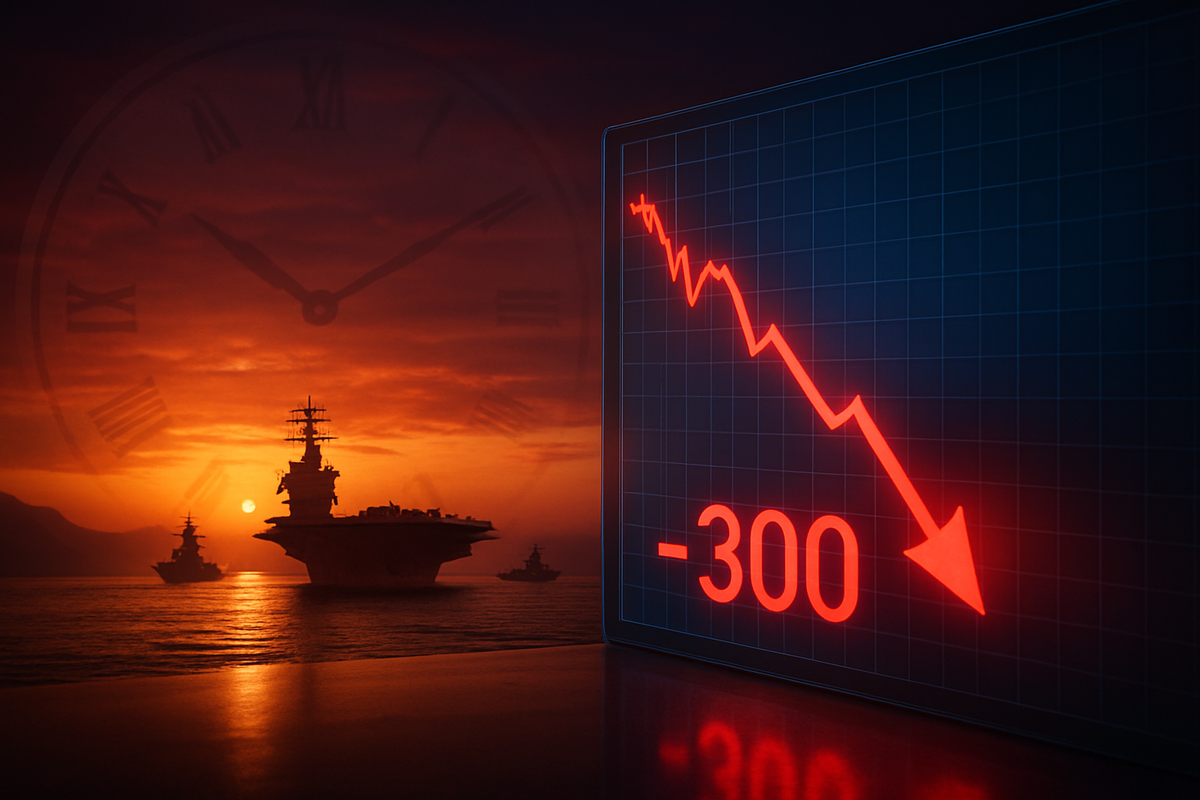
WASHINGTON, D.C. — Fear gripped Wall Street on Tuesday as President Donald Trump’s 8 p.m. ET deadline for Iran to reopen the Strait of Hormuz loomed over the global economy. The Dow Jones Industrial Average plummeted 300 points during the trading session, reflecting widespread investor anxiety that the three-year-old administration is on the precipice of a full-scale kinetic conflict in the Middle East. With just hours remaining until the ultimatum expires, the market’s "fear gauge" spiked, and energy prices surged to levels not seen in years.
The current standoff, which many analysts are calling the "2026 Iran Crisis," has effectively paralyzed one of the world's most critical maritime arteries. As the clock ticks toward the evening deadline, the rhetoric from the White House has reached a fever pitch, with the President warning of "unprecedented consequences" if Iranian forces do not immediately cease their blockade. The immediate implication for the market is a "flight to safety," as capital exits volatile equities and pours into defense contracts and domestic energy commodities.
The 8 P.M. Ultimatum: A Nation on Edge
The tension reached a boiling point today, April 7, 2026, following a series of escalatory events that began in late February. The crisis was triggered on February 28, 2026, when coordinated U.S. and Israeli airstrikes targeted Iranian nuclear facilities and key military infrastructure. In retaliation, the Islamic Revolutionary Guard Corps (IRGC) declared the Strait of Hormuz closed, effectively trapping 20% of the world’s oil supply and 19% of its liquefied natural gas (LNG). Tehran has since demanded a "new legal regime" for the waterway, including transit fees to compensate for war damages—a demand the Trump administration has characterized as "maritime piracy."
President Trump’s ultimatum was delivered via a series of characteristically blunt social media posts and a mid-day press briefing. Labeling the impending action "Power Plant Day and Bridge Day," the President signaled that if the Strait is not cleared by 8 p.m. ET, the U.S. military is prepared to strike Iran’s domestic power grid and transportation networks. "Open the Strait, or you'll be living in the dark—JUST WATCH!" the President posted, a statement that sent Dow futures into a tailspin before the opening bell.
Throughout the day, diplomatic mediators from Pakistan, Egypt, and Turkey have been engaged in "eleventh-hour" shuttle diplomacy, attempting to find a face-saving compromise for the Iranian leadership. However, with the IRGC calling for "human chains" to protect industrial sites and the U.S. Fifth Fleet moving into strike positions, the market has largely priced in the likelihood of a military engagement. The Dow's 300-point slide is a direct reflection of this "worst-case scenario" planning.
Profiting from Peril vs. Paying the Price
The market reaction has been sharply bifurcated, creating a "war economy" that favors defense contractors and domestic energy producers while punishing transportation and consumer-facing sectors. Lockheed Martin (NYSE: LMT) has emerged as a primary beneficiary, with its stock rising nearly 6% as the Pentagon accelerates orders for Patriot PAC-3 missile segments to protect regional allies. Similarly, Northrop Grumman (NYSE: NOC) saw significant gains as its B-2 Spirit stealth bombers are expected to lead any potential strike package. Other defense players like RTX Corp (NYSE: RTX) and the data-analytics firm Palantir (NYSE: PLTR) also saw upward movement as the conflict shifts toward high-tech, AI-driven warfare.
Conversely, the "tax" of $150-per-barrel oil is devastating the travel and logistics industries. United Airlines (NASDAQ: UAL) and JetBlue (NASDAQ: JBLU) saw their shares tumble as jet fuel prices soared, forcing capacity cuts and emergency surcharges. The logistics giants FedEx (NYSE: FDX) and UPS (NYSE: UPS) are also under immense pressure, as the rising cost of diesel erodes profit margins and threatens to slow global e-commerce.
In the energy sector, the impact is a double-edged sword. ExxonMobil (NYSE: XOM) and Chevron (NYSE: CVX) have seen their share prices reach historic highs due to the massive premium on crude oil. However, these gains are tempered by the risk of regional contagion. ExxonMobil, in particular, faces exposure through its LNG joint ventures in Qatar, which are within striking distance of Iranian proxy forces. Meanwhile, manufacturing heavyweights like Dow Inc. (NYSE: DOW) and DuPont (NYSE: DD) are struggling with the soaring costs of petroleum-based feedstocks, leading to significant margin compression that has alarmed institutional investors.
A Seismic Shift in Global Energy and Trade
This event is not merely a temporary market tremor; it represents a fundamental shift in the global trade landscape. The closure of the Strait of Hormuz is the largest supply disruption in history, surpassing the oil shocks of the 1970s. It fits into a broader trend of "de-globalization" and "energy nationalism," where control over physical chokepoints is being used as a primary tool of geopolitical leverage. The 2026 crisis has accelerated the pivot toward domestic energy independence, but the transition is proving painful for a global economy still reliant on Middle Eastern flows.
The ripple effects extend far beyond oil. The blockade has halted shipments of critical minerals and fertilizers, leading to fears of a secondary "food and tech" inflation spike. Competitors in the shipping industry, such as Maersk (OTC: AMKBY), have already rerouted vessels around the Cape of Good Hope, adding weeks to delivery times and sending freight rates to record levels. This "Hormuz Premium" is expected to persist even if the immediate military threat is neutralized, as insurance premiums for the region are being recalibrated for a permanent state of high-risk.
Historically, the U.S. has maintained the "Carter Doctrine," which views any attempt by an outside force to gain control of the Persian Gulf as an assault on the vital interests of the U.S. President Trump's current stance is a maximalist interpretation of this doctrine. Unlike the 2019 tanker attacks, which resulted in measured "tit-for-tat" responses, the 2026 deadline represents a binary choice: total reopening or total infrastructure war. This shift in policy implications suggests that the era of "strategic patience" in the Middle East has officially ended.
The Strategic Crossroads: Diplomacy vs. Destruction
In the short term, the market is bracing for two potential scenarios. The first is a "tactical retreat" by Iran, where a last-minute deal mediated by regional powers allows for a partial reopening of the Strait. This would likely trigger a massive relief rally, with the Dow potentially recovering its 300-point loss overnight as oil prices retreat toward the $100 mark. However, many analysts believe the "rhetorical corner" both leaders have backed into makes this outcome unlikely.
The second scenario is a military escalation following the 8 p.m. deadline. If the U.S. initiates strikes on Iranian power plants, the market could see a much deeper correction. A breach of the $150 oil threshold is viewed by many as a "recession trigger," which could lead to a protracted bear market for consumer-discretionary stocks. Companies will be forced to adapt by further diversifying supply chains and investing in energy-efficient technologies, but these strategic pivots take years, not days.
Conclusion: Navigating a War Economy
The 300-point drop in the Dow is more than just a reaction to a headline; it is a signal of deep-seated uncertainty about the future of the global order. The key takeaways for investors are the resilience of the defense sector and the extreme vulnerability of fuel-dependent industries in a world where geopolitical "ultimatums" have replaced diplomatic "dialogues." The 8 p.m. deadline will likely determine the market's trajectory for the remainder of 2026.
Moving forward, the market will remain in a state of high sensitivity to any developments in the Persian Gulf. Investors should closely watch for signs of "escalation fatigue" or, conversely, a widening of the conflict into a broader regional war. Regardless of tonight’s outcome, the "Hormuz Risk" has been permanently re-priced into the global economy. In the coming months, the focus will shift from "if" a conflict will happen to "how long" it will last and how many companies can survive a sustained $150-oil environment.
This content is intended for informational purposes only and is not financial advice.