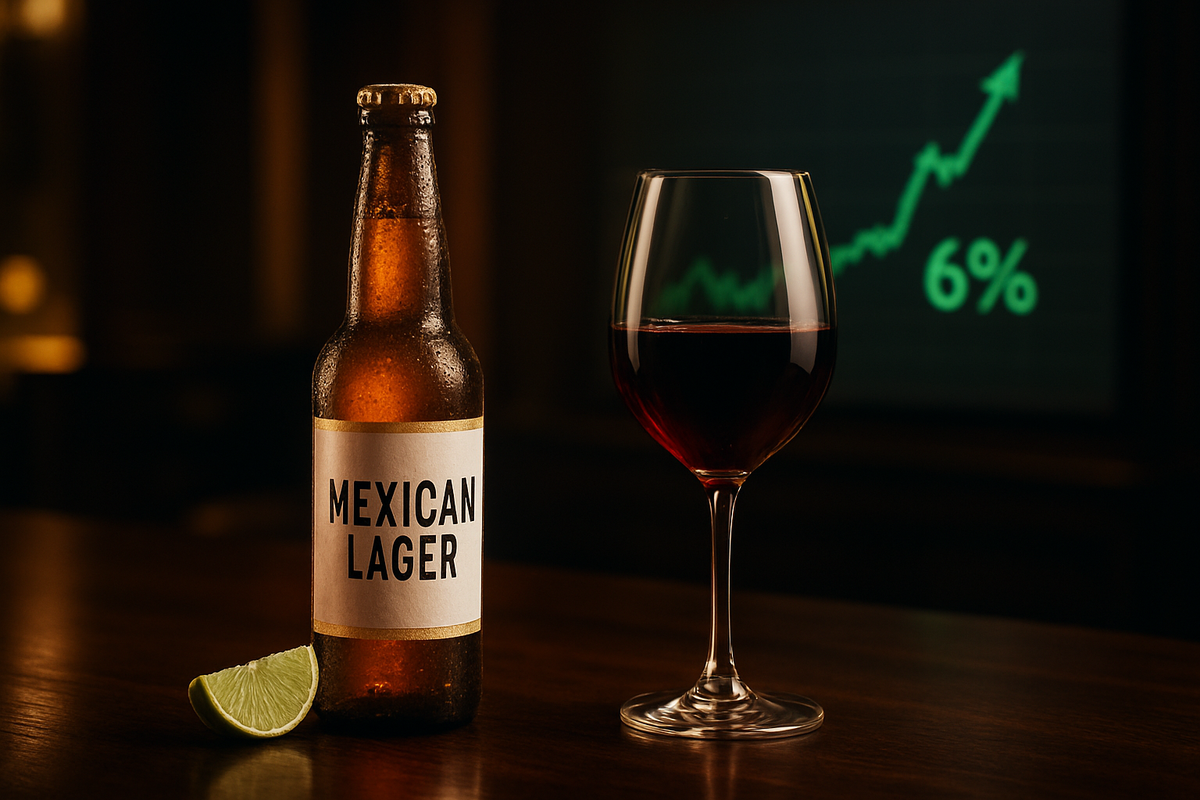
In a complex display of market resilience, Constellation Brands (NYSE: STZ) saw its share price climb over 6% on April 9, 2026, following a fiscal fourth-quarter earnings report that managed to exceed Wall Street’s immediate profit expectations. The rally came as a relief to investors after several volatile quarters for the beverage industry, driven by the continued dominance of the Modelo brand family and a stabilizing, albeit leaner, premium wine portfolio led by Robert Mondavi.
However, the gains were tempered by a stark admission from management regarding the future. Citing "limited near-term visibility" in a rapidly shifting consumer landscape, the beverage giant took the unusual step of withdrawing its fiscal 2028 forward guidance. This move signals a pivot toward caution as the company grapples with macroeconomic headwinds that are beginning to reshape how Americans consume alcohol.
A "Beat-and-Withdraw" Narrative Takes Hold
The fiscal fourth-quarter results, released on April 8, 2026, provided a much-needed win for Constellation Brands. The company reported an adjusted earnings per share (EPS) of $1.90, comfortably surpassing the analyst consensus of $1.71 to $1.74. Quarterly revenue also edged out projections, coming in at $1.92 billion against an estimated $1.88 billion. The market reaction was swift; on the morning of April 9, 2026, STZ stock jumped approximately 6.9% as traders prioritized the immediate earnings beat and the company’s aggressive $900 million share buyback program over its long-term reservations.
The timeline leading to this moment has been defined by a strategic narrowing of the company's focus. Over the previous twelve months, Constellation aggressively divested lower-performing wine and spirit assets to double down on "premiumization." The results for the Robert Mondavi brand showed the fruits of this labor; while the broader wine segment’s net sales plummeted 58% due to those divestitures, the remaining organic portfolio showed more resilience. Nevertheless, the wine and spirits division operated on a razor-thin 1.3% margin, highlighting the immense pressure the industry faces as consumers increasingly trade down to value-tier products or exit the category altogether.
Within the beer business, the results were a study in contrasts. Modelo Especial maintained its crown as the top-selling beer brand in the United States by dollar sales, though it faced a rare, slight decline in depletions of nearly 1%. Management attributed this to "subdued" demand within its core Hispanic consumer base, likely a reflection of broader inflationary pressures. Offsetting this was the meteoric rise of Pacifico, which saw a 21% increase in depletions, suggesting that Constellation’s portfolio still has significant room for growth in high-end, lifestyle-oriented Mexican imports.
Winners and Losers in a Fragmented Market
Constellation Brands (NYSE: STZ) currently stands as a primary winner in the high-end beverage space, proving that premium Mexican imports can still command price power even when volume growth slows. By focusing on brands like Pacifico and the higher-margin Robert Mondavi labels, the company has insulated itself from the more severe declines seen in the value beer and wine sectors. However, the withdrawal of long-term guidance suggests that even the "winner" is feeling the heat of an unpredictable 2026 economy.
On the losing side of this earnings cycle is Molson Coors Beverage Company (NYSE: TAP). In February 2026, Molson Coors saw its stock tumble 6% after issuing a dire 2026 forecast, predicting an 11% to 15% drop in annual profit. Unlike Constellation, which has successfully pivoted to the "high-end" segment, Molson Coors remains more exposed to the "core-light" beer segment, which has been disproportionately hit by rising aluminum costs and a shift in consumer preference toward non-alcoholic and alternative beverages.
The broader wine industry also appears to be in a losing streak. With Constellation’s wine margins squeezed to near zero, smaller competitors without the balance sheet of a major conglomerate are likely facing existential threats. The "trading down" phenomenon—where consumers opt for $10 bottles over $30 bottles—favors large-scale producers with efficient distribution but punishes premium-only labels that cannot justify their price points in a high-interest-rate environment.
Shifting Trends and the GLP-1 Factor
The decision to withdraw guidance is not an isolated event but a reflection of systemic shifts within the global beverage industry. One of the most significant disruptors in 2026 has been the widespread adoption of GLP-1 weight-loss medications. Analysts have noted a correlating "subdued" appetite for high-calorie beverages, including traditional beer and wine, which is starting to show up in the volume data of industry leaders like Anheuser-Busch InBev (NYSE: BUD).
Furthermore, the industry is navigating a minefield of regulatory and cost pressures. Persistent aluminum tariffs and rising energy costs have forced brewers to hike prices, often at the expense of consumer loyalty. Constellation’s struggle to forecast beyond the next few months is a direct result of these volatile input costs. This mirrors historical precedents like the 2008 financial crisis, where beverage companies similarly pulled guidance as "predictable" consumer habits vanished overnight.
There is also a mounting shift toward alternative categories. While traditional beer volumes are stagnant, growth is accelerating in non-alcoholic beers and THC-infused beverages. Constellation's strategic hesitation may stem from a need to pivot more capital toward these emerging segments to compensate for the "subdued" demand in its legacy portfolio. As the 2026 FIFA World Cup approaches, the industry is bracing for a massive marketing spend that will test whether these high-end brands can still capture the public's imagination—and their wallets.
Navigating a "Limited Visibility" Future
Looking ahead, Constellation Brands is entering a period of strategic adaptation. For the fiscal year 2027, the company issued a cautious EPS guidance range of $11.20 to $11.90, notably below the analyst consensus of $12.36. This suggests that the 6% stock gain seen today may be a short-term reaction to a "less bad than expected" report, rather than a signal of a new bull run. The company must now prove it can protect its margins in the face of persistent inflation and a consumer base that is increasingly price-sensitive.
In the short term, investors should expect Constellation to maintain its focus on debt reduction and share buybacks to support the stock price. Long-term, the company may be forced to seek out new growth engines, possibly through further acquisitions in the non-alcoholic or wellness-focused beverage sectors. The "limited near-term visibility" cited by management may lead to a more defensive stance, with a focus on operational efficiency over aggressive expansion.
Conclusion: A Market in Flux
The April 2026 earnings report from Constellation Brands serves as a bellwether for the broader consumer staples sector. While the 6% stock gain highlights the enduring power of brands like Modelo and the Robert Mondavi name, the withdrawal of long-term guidance is a sobering reminder that the "old rules" of consumer behavior are being rewritten. The beat-and-withdraw narrative suggests that while the present is manageable, the future is increasingly opaque.
For investors, the key takeaway is that quality and premium positioning still matter, but they are no longer a total shield against macroeconomic volatility. Moving forward, the market will be watching for signs of stabilizing demand in the Hispanic consumer segment and whether Pacifico can continue its double-digit growth trajectory to offset headwinds elsewhere. As the industry heads into a high-stakes summer season, the ability to navigate this "limited visibility" environment will separate the true market leaders from those simply treading water.
This content is intended for informational purposes only and is not financial advice.