As the 2026 legislative session kicks off in Albany, the future of the prediction market industry in the United States is being decided not in a courtroom or on a trading floor, but in the halls of the New York State Assembly. The Oversight and Regulation of Activity for Contracts Linked to Events (ORACLE) Act, also known as Assembly Bill A9251, has emerged as the most significant threat to the burgeoning "event contract" sector since its mainstream explosion in 2024.
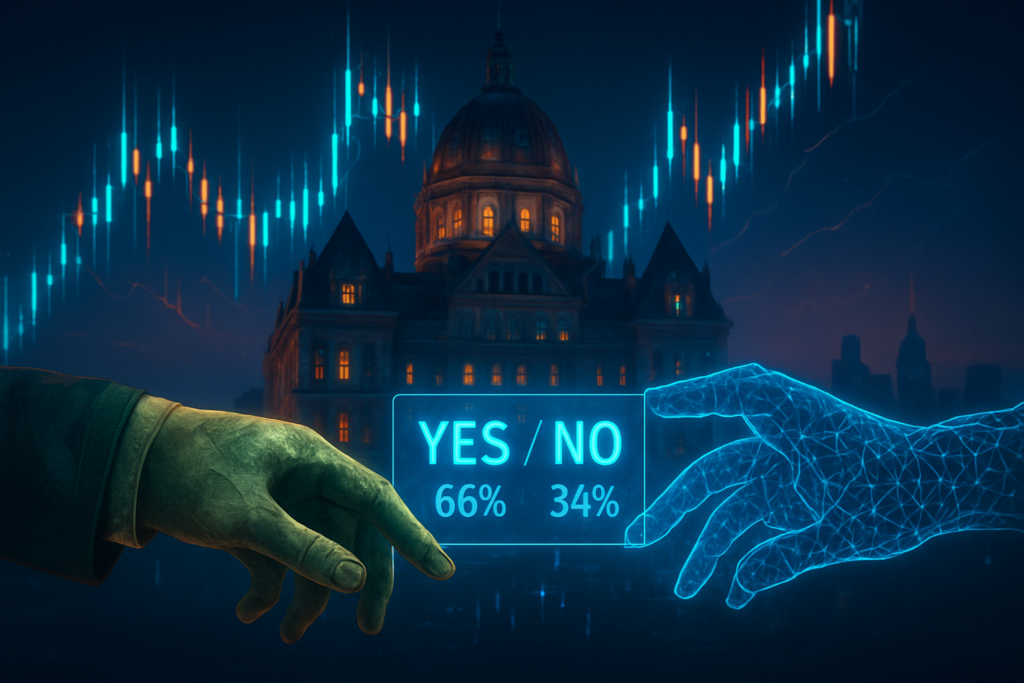
Currently, decentralized markets on platforms like Polymarket are pricing in a 64% probability that New York will successfully enact a ban on key prediction categories by the end of 2026. This legislative surge follows a period of rapid growth and high-profile controversy, most notably a series of trades linked to geopolitical events that have lawmakers questioning whether these platforms are "truth machines" or high-stakes casinos for insider trading.
The Market: What's Being Predicted
The legislative battle in New York has become a market in its own right. On Polymarket, the world’s largest decentralized prediction platform, tens of millions of dollars are riding on the outcome of "New York Ban" contracts. These markets surged to a 64% "Yes" probability in mid-January 2026, immediately following the re-introduction of the ORACLE Act (A9251) on January 7.
The bill, sponsored by Assemblymember Clyde Vanel (D-Queens), is often referred to by industry insiders as the "Nuclear Option." If passed, it would classify prediction market trading on politics, sports, and "catastrophic events"—such as wars or mass shootings—as unlicensed gambling. The penalties are draconian: any platform failing to comply with a court-ordered injunction would face a staggering $1 million per day fine.
While the "ban" side remains the favorite on decentralized platforms, the outlook on regulated exchanges like Kalshi tells a more nuanced story. A proxy market on Kalshi reflecting the state’s regulatory climate saw the probability of a ban drop from 65% to 38% in the third week of January. This volatility is largely attributed to a competing, more moderate piece of legislation: Senate Bill S8889. Introduced by Senator Jeremy Cooney, S8889 seeks to license and tax prediction markets under the New York Department of Financial Services (DFS), treating them as financial derivatives rather than gambling.
Why Traders Are Betting
The primary driver behind the ORACLE Act’s momentum is the "insider trading" narrative. Lawmakers in Albany have been fixated on the so-called "Maduro Trade" of early January 2026, where a single Polymarket whale allegedly turned a $32,000 position into $400,000 just hours before a U.S.-led operation in Venezuela. Assemblymember Vanel has used this incident as a rallying cry, arguing that these markets invite "corruption and the gamification of tragedies."
However, institutional "whales" are increasingly betting on a compromise. Notable large-scale positions have recently been taken on the "No Ban" side, fueled by several key factors:
- Industry Pushback: A newly formed "Coalition for Prediction Markets," led by Interactive Brokers (NASDAQ: IBKR) and Robinhood (NASDAQ: HOOD), has launched a massive lobbying effort in Albany. They argue that banning these markets would drive innovation out of the world’s financial capital.
- The "MSG Strategy": In a bold attempt to win over public sentiment, Polymarket recently signed a sponsorship deal with the New York Rangers, displaying live event odds on the scoreboards at Madison Square Garden. Traders believe this "normalization" strategy makes a total ban politically difficult for Governor Kathy Hochul.
- Federal Preemption: Legal experts betting on the "No" side believe that because platforms like Kalshi are regulated by the Commodity Futures Trading Commission (CFTC), federal law will ultimately override (or "preempt") state-level bans under the Commodity Exchange Act.
Broader Context and Implications
The New York battle is a microcosm of a larger national struggle over the definition of "gambling" versus "hedging." For years, prediction markets operated in a gray area, but the recent entry of major public firms has forced the issue. DraftKings (NASDAQ: DKNG) and Flutter Entertainment (NYSE: FLUT), the parent company of FanDuel, have recently split from traditional gaming trade groups to support a regulated prediction market framework, signaling that the line between sports betting and financial forecasting is permanently blurring.
If the ORACLE Act passes in its current form, it could set a dangerous precedent for other states. New York’s aggressive stance contrasts sharply with states like New Jersey and Illinois, which are exploring ways to tax these markets as a new revenue stream. For the industry, New York is the "must-win" state. A ban here would not only lock out a massive retail market but would also threaten the liquidity and accuracy of global contracts that rely on the participation of New York-based financial professionals.
The debate also reveals a fundamental shift in how the public consumes information. Proponents, including IBKR Chairman Thomas Peterffy, describe these markets as "Truth Discovery Engines" that outperform traditional polling and expert analysis. Critics, meanwhile, view them as an unregulated "Wild West" that incentivizes bad actors to profit from chaos.
What to Watch Next
The next 60 days will be critical for the ORACLE Act. Traders are closely monitoring the Assembly Committee on Consumer Affairs and Protection, where A9251 is currently being debated. A vote to move the bill out of committee would likely send the "Ban" odds back toward the 80% range.
Key dates to watch:
- February 24, 2026: A major ruling is expected in the Southern District of New York (SDNY) regarding Kalshi’s ongoing litigation with the New York Gaming Commission. This court case will serve as a bellwether for whether the state has the legal authority to override federal oversight.
- The Budget Deadline (April 1, 2026): Governor Kathy Hochul has signaled a desire to "safeguard" the public from gamified finance. If she includes language from the ORACLE Act in her executive budget, it would be a near-certain sign that a ban is coming.
- The Cooney Bill Hearings: Keep an eye on Senator Cooney’s S8889. If this bill gains support from the Department of Financial Services, it could offer a "third way" that keeps prediction markets legal but strictly regulated.
Bottom Line
The legislative fight in New York represents a defining moment for prediction markets. On one side, the ORACLE Act seeks to slam the door shut on what it views as a predatory and dangerous new form of gambling. On the other, a coalition of fintech giants and retail traders is fighting to preserve a tool they believe is essential for the 21st-century information economy.
As of late January 2026, the markets remain split. While the political momentum in the Assembly favors a ban, the sheer weight of the financial and legal arguments from firms like Interactive Brokers (NASDAQ: IBKR) and Robinhood (NASDAQ: HOOD) suggests that a total shutdown is far from guaranteed. For now, the safest bet is that New York’s regulatory landscape is about to get much more complicated, and the "truth" about these markets will be decided by the highest bidder in Albany.
This article is for informational purposes only and does not constitute financial or betting advice. Prediction market participation may be subject to legal restrictions in your jurisdiction.
PredictStreet focuses on covering the latest developments in prediction markets.
Visit the PredictStreet website at https://www.predictstreet.ai/.