Technology giant Microsoft (NASDAQ: MSFT) beat Wall Street’s revenue expectations in Q2 CY2026, with sales up 17.7% year on year to $90.01 billion. Its non-GAAP profit of $4.81 per share was 14.1% above analysts’ consensus estimates.
Is now the time to buy Microsoft? Find out by accessing our full research report, it’s free.
Microsoft (MSFT) Q2 CY2026 Highlights:
- Revenue: $90.01 billion vs analyst estimates of $87.71 billion (2.6% beat)
- EPS (GAAP): $4.81 vs analyst estimates of $4.22 (14.1% beat)
- Gross Margin: 67.2%, down from 68.6% in the same quarter last year
- Operating Margin: 45.1%, in line with the same quarter last year
- Free Cash Flow Margin: 21.8%, down from 33.4% in the same quarter last year
- Market Capitalization: $2.92 trillion
Revenue Growth
Microsoft shows that fast growth and massive scale can coexist despite conventional wisdom. The company’s revenue base of $168.1 billion five years ago has nearly doubled to $331.8 billion in the last year, translating into an exceptional 14.6% annualized growth rate.
Over the same period, Microsoft’s big tech peers Amazon, Alphabet, and Apple put up annualized growth rates of 11.7%, 15.1%, and 6.1%, respectively. Comparing the four is relevant because investors often pit them against each other to derive their valuations. With these benchmarks in mind, we think Microsoft’s price is attractive. 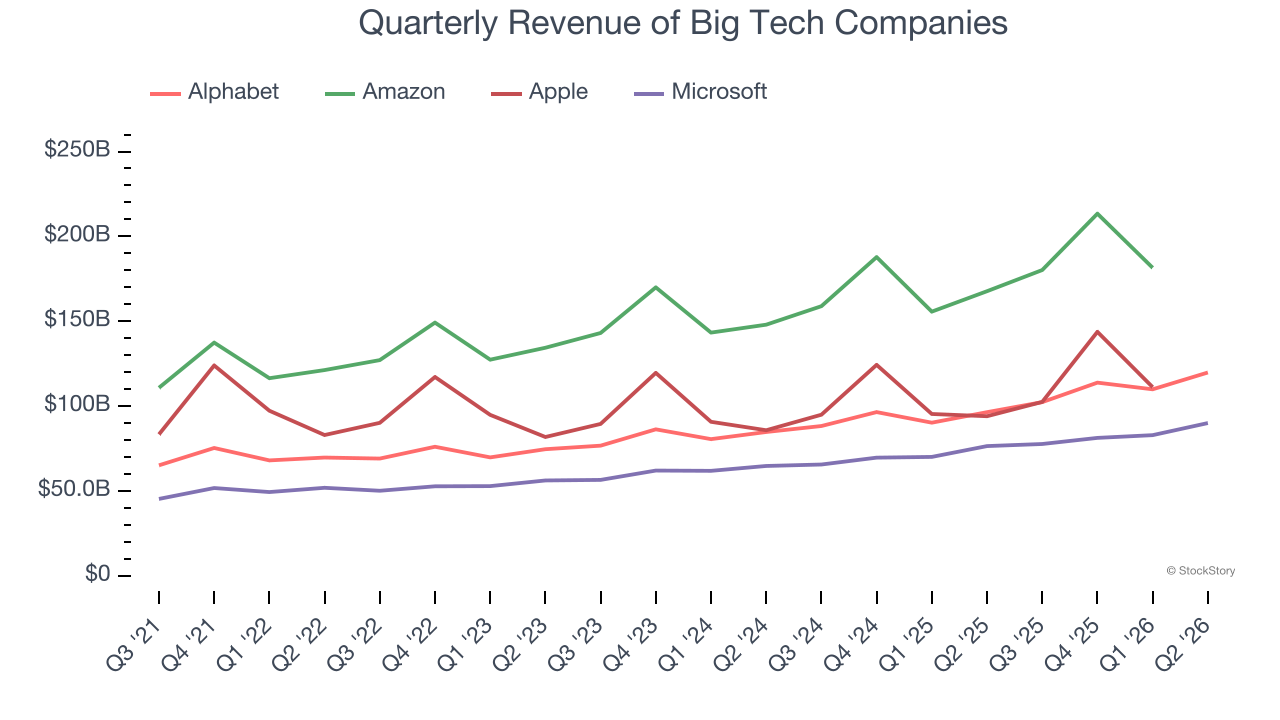
We at StockStory emphasize long-term growth, but for big tech companies, a half-decade historical view may miss emerging trends in AI. Microsoft’s annualized revenue growth of 16.4% over the last two years is above its five-year trend, suggesting its demand was strong and recently accelerated. 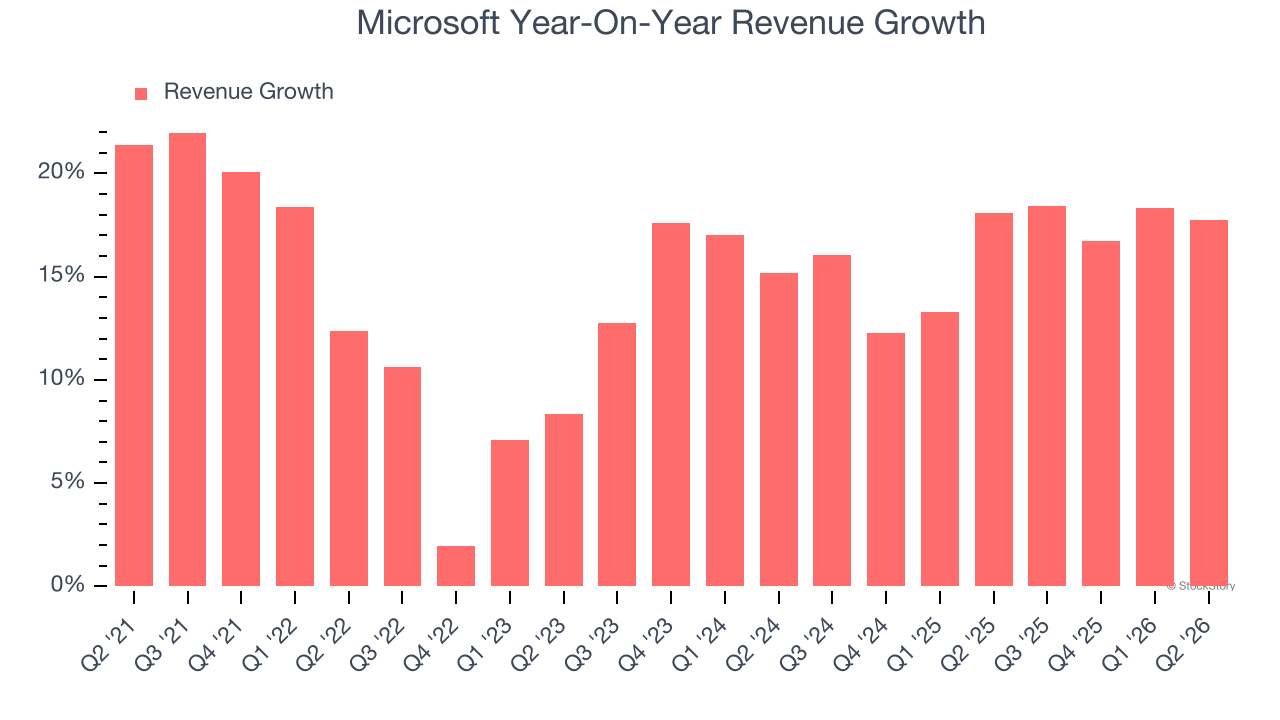
This quarter, Microsoft reported year-on-year revenue growth of 17.7%, and its $90.01 billion of revenue exceeded Wall Street’s estimates by 2.6%. Looking ahead, sell-side This projection is admirable for a company of its scale and illustrates the market sees some success for its newer AI-enabling products.
WHILE YOU’RE HERE: The Next Palantir? One satellite company captures images of every point on Earth. Every single day. The Pentagon wants it. Hedge funds are using it to beat earnings. You’ve probably never heard of it.
This is what the early days of Palantir looked like before it became a giant. Same playbook. Different technology. If you missed Palantir, you need to see this. Claim The Stock Ticker for Free HERE.
Intelligent Cloud: Azure & Cloud Computing
The most pressing question about Microsoft’s business is how much AI can boost its revenues. The company’s cloud computing division, Intelligent Cloud, is one we watch carefully because its Azure platform and server/database offerings could be the biggest beneficiaries of the AI megatrend.
Intelligent Cloud is 41.5% of Microsoft’s total sales and grew at a 17.9% annualized rate over the last five years, faster than its consolidated revenues. The previous two years saw deceleration as it grew by 14.4% annually.
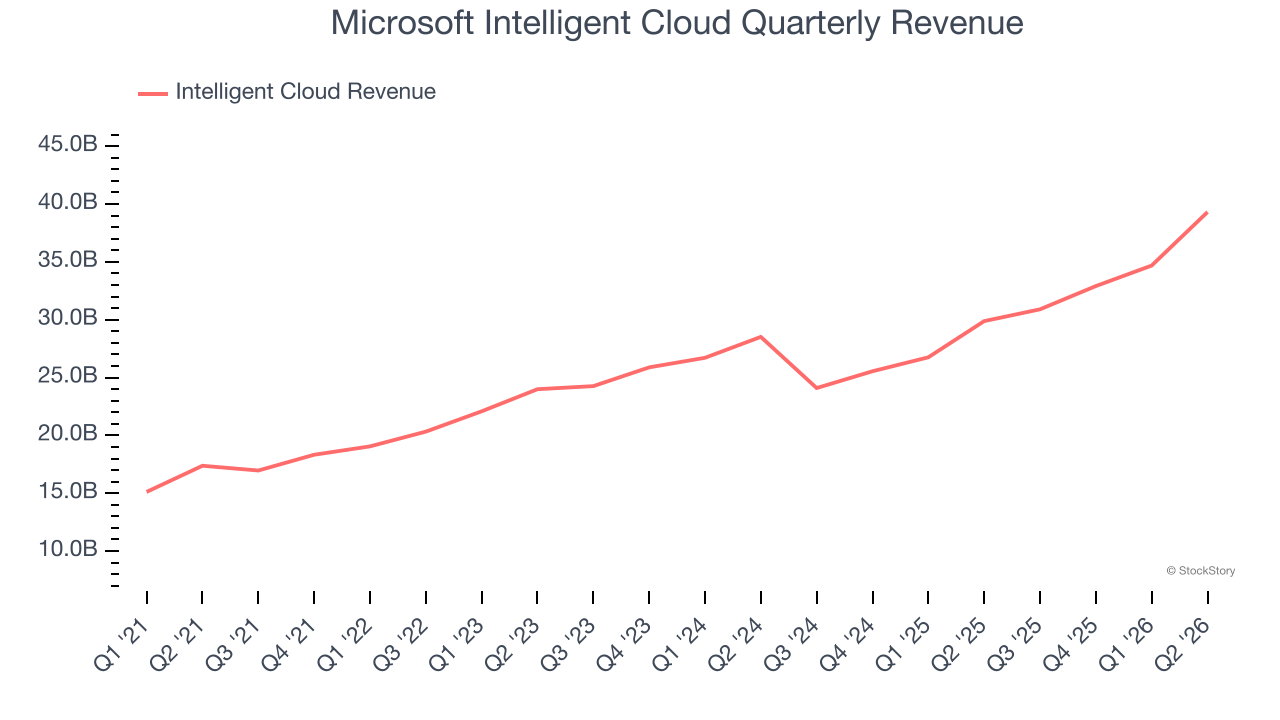
Intelligent Cloud put up 31.6% year-on-year revenue growth in Q2. Microsoft Azure, a business line the market watches with bated breath due to its AI exposure, sits within the Intelligent Cloud segment, but the company does not break out Azure revenue specifically.This was faster than AWS’s 28.4% increase but slower than Google Cloud’s 81.8%.
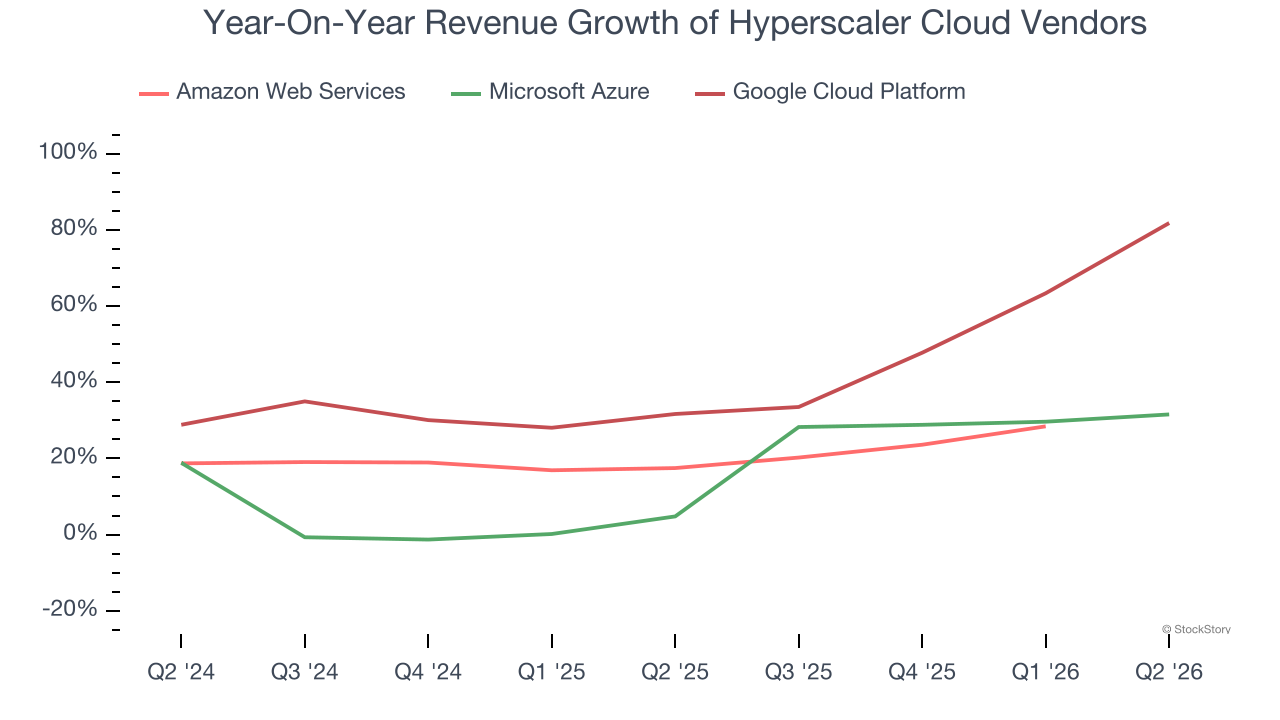
In terms of market share, Azure is a close second to AWS and ahead of Google Cloud in this public cloud provider market.If Azure can continue outgrowing AWS in the coming years, it certainly has a chance to overtake it as the top cloud provider.
Comparisons and peers aside, Azure’s 30%+ growth this quarter is strong evidence that the AI impact is indeed moving the needle.
Key Takeaways from Microsoft’s Q2 Results
We enjoyed seeing Microsoft beat analysts’ revenue expectations this quarter. We were also glad its EPS outperformed Wall Street’s estimates. Zooming out, we think this was a solid print. The stock traded up 2.7% to $400.99 immediately following the results.
Sure, Microsoft had a solid quarter, but if we look at the bigger picture, is this stock a buy? The latest quarter does matter, but not nearly as much as longer-term fundamentals and valuation, when deciding if the stock is a buy. We cover that in our actionable full research report which you can read here (it’s free).