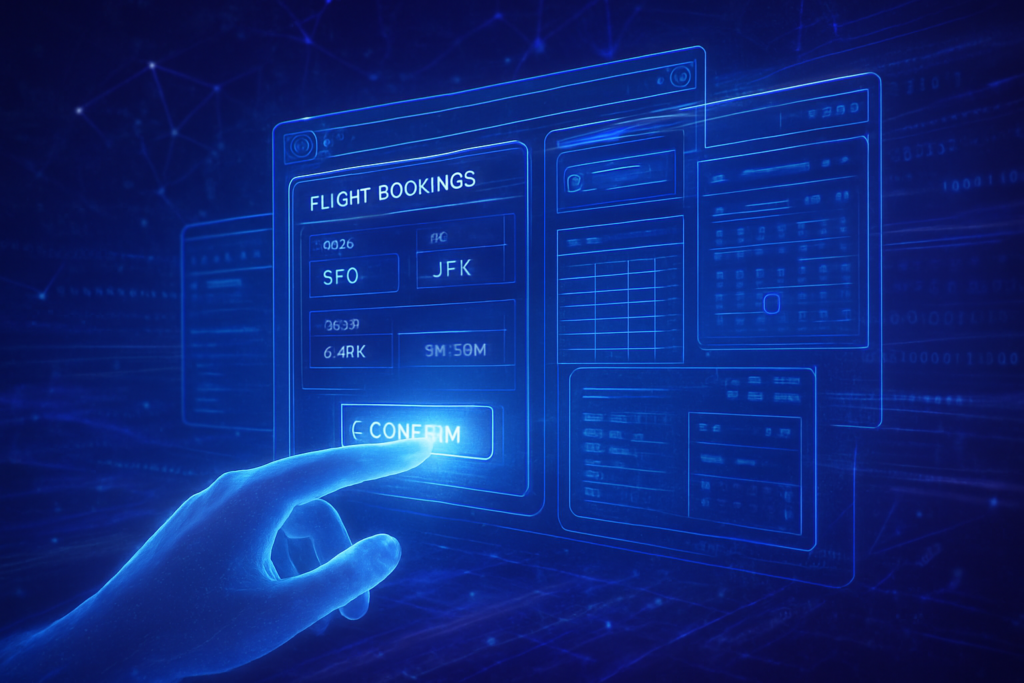
As 2025 draws to a close, the artificial intelligence landscape has shifted from models that merely talk to models that do. Leading this charge is OpenAI’s "Operator," an autonomous agent that has spent the last year transforming from a highly anticipated research preview into a cornerstone of the modern digital workflow. By leveraging a specialized Computer-Using Agent (CUA) model, Operator can navigate a web browser with human-like dexterity—executing complex, multi-step tasks such as booking international multi-city flights, managing intricate financial spreadsheets, and orchestrating cross-platform data migrations without manual intervention.
The emergence of Operator marks a definitive transition into "Level 3" AI on the path to Artificial General Intelligence (AGI). Unlike the chatbots of previous years that relied on text-based APIs or brittle integrations, Operator interacts with the world the same way humans do: through pixels and clicks. This development has not only sparked a massive productivity boom but has also forced a total reimagining of software interfaces and cybersecurity, as the industry grapples with a world where the primary user of a website is often an algorithm rather than a person.
The CUA Model: A Vision-First Approach to Autonomy
At the heart of Operator lies the Computer-Using Agent (CUA) model, a breakthrough architectural variation of the GPT-5 series. Unlike earlier attempts at browser automation that struggled with changing website code or dynamic JavaScript, the CUA model is vision-centric. It does not "read" the underlying HTML or DOM of a webpage; instead, it analyzes raw pixel data from screenshots to understand layouts, buttons, and text fields. This "Perceive-Reason-Act" loop allows the agent to interpret a website’s visual hierarchy just as a human eye would, making it resilient to the structural updates that typically break traditional automation scripts.
Technically, Operator functions by utilizing a virtual mouse and keyboard to execute commands like click(x, y), scroll(), and type(text). This allows it to operate across any website or legacy software application without the need for custom API development. In performance benchmarks released mid-2025, Operator achieved a staggering 87% success rate on WebVoyager tasks and 58.1% on the more complex WebArena benchmarks, which require deep reasoning and multi-tab navigation. This represents a massive leap over the 15-20% success rates seen in early 2024 prototypes.
The technical community's reaction has been a mixture of awe and caution. While researchers at institutions like Stanford and MIT have praised the model's spatial reasoning and visual grounding, many have pointed out the immense compute costs required to process high-frequency video streams of a desktop environment. OpenAI (partnered with Microsoft (NASDAQ: MSFT)) has addressed this by moving toward a hybrid execution model, where lightweight "reasoning tokens" are processed locally while the heavy visual interpretation is handled by specialized Blackwell-based clusters in the cloud.
The Agent Wars: Competitive Fallout and Market Shifts
The release of Operator has ignited what industry analysts are calling the "Agent Wars" of 2025. While OpenAI held the spotlight for much of the year, it faced fierce competition from Anthropic, which released its "Computer Use" feature for Claude 4.5 earlier in the cycle. Anthropic, backed by heavy investments from Amazon (NASDAQ: AMZN), has managed to capture nearly 40% of the enterprise AI market by focusing on high-precision "pixel counting" that makes it superior for technical software like CAD tools and advanced Excel modeling.
Alphabet (NASDAQ: GOOGL) has also proven to be a formidable challenger with "Project Mariner" (formerly known as Jarvis). By integrating their agent directly into the Chrome browser and leveraging the Gemini 3 model, Google has offered a lower-latency, multi-tasking experience that can handle up to ten background tasks simultaneously. This competitive pressure became so intense that internal memos leaked in December 2025 revealed a "Code Red" at OpenAI, leading to the emergency release of GPT-5.2 to reclaim the lead in agentic reasoning and execution speed.
For SaaS giants like Salesforce (NYSE: CRM) and ServiceNow (NYSE: NOW), the rise of autonomous agents like Operator represents both a threat and an opportunity. These companies have had to pivot from selling "seats" to selling "outcomes," as AI agents now handle up to 30% of administrative tasks previously performed by human staff. The shift has disrupted traditional pricing models, moving the industry toward "agentic-based" billing where companies pay for the successful completion of a task rather than a monthly subscription per human user.
Safety in the Age of Autonomy: The Human-in-the-Loop
As AI agents gained the ability to spend money and move data, safety protocols became the central focus of the 2025 AI debate. OpenAI implemented a "Three-Layer Safeguard" system for Operator to prevent catastrophic errors or malicious use. The most critical layer is the "User Confirmation" protocol, which forces the agent to pause and request explicit biometric or password approval before any "side-effect" action—such as hitting "Purchase," "Send Email," or "Delete File." This ensures that while the agent does the legwork, the human remains the final authority on high-risk decisions.
Beyond simple confirmation, Operator includes a "Takeover Mode" for sensitive data entry. When the agent detects a password field or a credit card input, it automatically blacks out its internal "vision" and hands control back to the user, ensuring that sensitive credentials are never stored or processed by the model's training logs. Furthermore, a secondary "monitor model" runs in parallel with Operator, specifically trained to detect "prompt injection" attacks where a malicious website might try to hijack the agent’s instructions to steal data or perform unauthorized actions.
Despite these safeguards, the wider significance of agentic AI has raised concerns about the "Dead Internet Theory" and the potential for massive-scale automated fraud. The ability of an agent to navigate the web as a human means that bot detection systems (like CAPTCHAs) have become largely obsolete, forcing a global rethink of digital identity. Comparisons are frequently made to the 2023 "GPT moment," but experts argue that Operator is more significant because it bridges the gap between digital thought and physical-world economic impact.
The Road to 2026: Multi-Agent Systems and Beyond
Looking toward 2026, the next frontier for Operator is the move from solo agents to "Multi-Agent Orchestration." Experts predict that within the next twelve months, users will not just deploy one Operator, but a "fleet" of specialized agents that can communicate with one another to solve massive projects. For example, one agent might research a market trend, a second might draft a business proposal based on that research, and a third might handle the outreach and scheduling—all working in a coordinated, autonomous loop.
However, several challenges remain. The "latency wall" is a primary concern; even with the advancements in GPT-5.2, there is still a noticeable delay as the model "thinks" through visual steps. Additionally, the legal framework for AI liability remains murky. If an agent makes a non-refundable $5,000 travel booking error due to a website glitch, who is responsible: the user, the website owner, or OpenAI? Resolving these "agentic liability" issues will be a top priority for regulators in the coming year.
The consensus among AI researchers is that we are entering the era of the "Invisible Interface." As agents like Operator become more reliable, the need for humans to manually navigate complex software will dwindle. We are moving toward a future where the primary way we interact with computers is by stating an intent and watching a cursor move on its own to fulfill it. The "Operator" isn't just a tool; it's the beginning of a new operating system for the digital age.
Conclusion: A Year of Transformation
The journey of OpenAI’s Operator throughout 2025 has been nothing short of revolutionary. What began as a experimental "Computer-Using Agent" has matured into a robust platform that has redefined productivity for millions. By mastering the visual language of the web and implementing rigorous safety protocols, OpenAI has managed to bring the power of autonomous action to the masses while maintaining a necessary level of human oversight.
As we look back on 2025, the significance of Operator lies in its role as the first true "digital employee." It has proven that AI is no longer confined to a chat box; it is an active participant in our digital lives. In the coming weeks and months, the focus will shift toward the full-scale rollout of GPT-5.2 and the integration of these agents into mobile operating systems, potentially making the "Operator" a permanent fixture in every pocket.
This content is intended for informational purposes only and represents analysis of current AI developments.
TokenRing AI delivers enterprise-grade solutions for multi-agent AI workflow orchestration, AI-powered development tools, and seamless remote collaboration platforms.
For more information, visit https://www.tokenring.ai/.