On January 13, 2026, the United States and Taiwan signed a monumental semiconductor trade and investment agreement that effectively rewrites the geography of the global artificial intelligence (AI) industry. This landmark "Silicon Pact," brokered by the U.S. Department of Commerce and the American Institute in Taiwan (AIT), establishes a $500 billion framework designed to reshore advanced chip manufacturing to American soil while reinforcing Taiwan's security through deep economic integration. At the heart of the deal is a staggering $250 billion credit guarantee provided by the Taiwanese government, specifically aimed at migrating the island’s vast ecosystem of small and medium-sized suppliers to new industrial clusters in the United States.
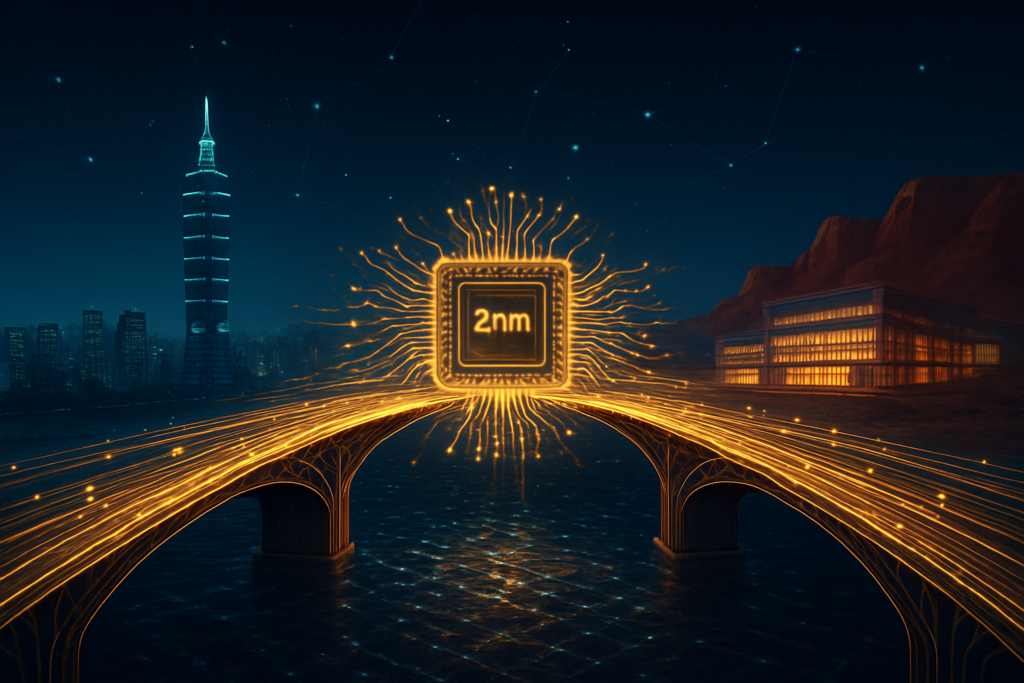
The agreement marks a decisive shift from the "just-in-time" supply chain models of the previous decade to a "just-in-case" regionalized strategy. By incentivizing Taiwan Semiconductor Manufacturing Company (NYSE: TSM) to expand its Arizona footprint to as many as ten fabrication plants, the pact aims to produce 20% of the world's most advanced logic chips within U.S. borders by 2030. This development is not merely an industrial policy; it is a fundamental realignment of the "Silicon Shield," evolving it into a "Silicon Bridge" that binds the national security of the two nations through shared, high-tech infrastructure.
The technical core of the agreement revolves around the massive $250 billion credit guarantee mechanism, a sophisticated public-private partnership managed by the Taiwanese National Development Fund (NDF) alongside major financial institutions like Cathay United Bank and Fubon Financial Holding Co. This fund is designed to solve the "clustering" problem: while giants like TSMC have the capital to expand globally, the thousands of specialized chemical, optics, and tool-making firms they rely on do not. The Taiwanese government will guarantee up to 60% of the loan value for these secondary suppliers, using a leverage multiple of 15x to 20x to ensure that the entire industrial ecosystem—not just the fabs—takes root in the U.S.
In exchange for this massive capital injection, the U.S. has introduced the Tariff Offset Program (TOP). Under this program, reciprocal tariffs on Taiwanese goods have been reduced from 20% to 15%, placing Taiwan on the same trade tier as Japan and South Korea. Crucially, any chipmaker producing in the U.S. can now bypass the 25% global semiconductor surcharge, a penalty originally implemented to curb reliance on overseas manufacturing. To protect Taiwan’s domestic technological edge, the agreement formalizes the "N-2" principle: Taiwan commits to producing 2nm and 1.4nm chips in its Arizona facilities, provided that its domestic factories in Hsinchu and Kaohsiung remain at least two generations ahead in research and development.
Initial reactions from the AI research community and industry experts have been overwhelmingly positive regarding the stability this brings to the "compute" layer of AI development. Dr. Arati Prabhakar, Director of the White House Office of Science and Technology Policy, noted that the pact "de-risks the most vulnerable point in the AI stack." However, some Taiwanese economists expressed concern that the migration of these suppliers could eventually lead to a "hollowing out" of the island’s domestic industry, a fear the Taiwanese government countered by emphasizing that the "Silicon Bridge" model makes Taiwan more indispensable to U.S. defense interests than ever before.
The strategic implications for the world’s largest tech companies are profound. NVIDIA (NASDAQ: NVDA), the undisputed leader in AI hardware, stands as a primary beneficiary. By shifting its supply chain into the "safe harbor" of Arizona-based fabs, NVIDIA can maintain its industry-leading profit margins on H200 and Blackwell GPU clusters without the looming threat of sudden tariff hikes or regional instability. CEO Jensen Huang hailed the agreement as the "catalyst for the AI industrial revolution," noting that the deal provides the long-term policy certainty required for multi-billion dollar infrastructure bets.
Apple (NASDAQ: AAPL) has also moved quickly to capitalize on the pact, reportedly securing over 50% of TSMC’s initial 2nm capacity in the United States. This ensures that future iterations of the iPhone and Mac—specifically the M6 and M7 series slated for 2027—will be powered by "Made in America" silicon. For Apple, this is a vital de-risking maneuver that satisfies both consumer demand for supply chain transparency and government pressure to reduce reliance on the Taiwan Strait. Similarly, AMD (NASDAQ: AMD) is restructuring its logistics to ensure its MI325X AI accelerators are produced within these new tariff-exempt zones, strengthening its competitive position against both NVIDIA and internal silicon efforts from cloud giants.
Conversely, the deal places immense pressure on Intel (NASDAQ: INTC). Now led by CEO Lip-Bu Tan, Intel is being repositioned as a "national strategic asset" with the U.S. government maintaining a 10% stake in the company. While Intel must now compete directly with TSMC on U.S. soil for domestic talent and resources, the administration argues that this "domestic rivalry" will accelerate American engineering. The presence of a fully integrated Taiwanese ecosystem in the U.S. may actually benefit Intel by providing easier local access to the specialized materials and equipment that were previously only available in East Asia.
Beyond the corporate balance sheets, this agreement represents a watershed moment in the broader AI landscape. We are witnessing the birth of "Sovereign AI Infrastructure," where national security and technological capability are inextricably linked. For decades, the "Silicon Shield" was a unilateral deterrent; it was the hope that the world’s need for Taiwanese chips would prevent a conflict. The transition to the "Silicon Bridge" suggests a more integrated, bilateral resilience model. By embedding Taiwan’s technological crown jewels within the American industrial base, the U.S. is signaling a permanent and material commitment to Taiwan’s security that goes beyond mere diplomatic rhetoric.
The pact also addresses the growing concerns surrounding "AI Sovereignty." As AI models become the primary engines of economic growth, the physical locations where these models are trained and run—and where the chips that power them are made—have become matters of high statecraft. This deal effectively ensures that the Western AI ecosystem will have a stable, diversified source of high-end silicon regardless of geopolitical fluctuations in the Pacific. It mirrors previous historical milestones, such as the 1986 U.S.-Japan Semiconductor Agreement, but at a scale and speed that reflects the unprecedented urgency of the AI era.
However, the "Silicon Bridge" is not without its critics. Human rights and labor advocates have raised concerns about the influx of thousands of Taiwanese workers into specialized "industrial parks" in Arizona and Texas, questioning whether U.S. labor laws and visa processes are prepared for such a massive, state-sponsored migration. Furthermore, some environmental groups have pointed to the extreme water and energy demands of the ten planned mega-fabs, urging the Department of Commerce to ensure that the $250 billion in credit guarantees includes strict sustainability mandates.
Looking ahead, the next two to three years will be defined by the physical construction of this "bridge." We can expect to see a surge in specialized visa applications and the rapid development of "AI industrial zones" in the American Southwest. The near-term goal is to have the first 2nm production lines operational in Arizona by early 2027, followed closely by the migration of the secondary supply chain. This will likely trigger a secondary boom in American infrastructure, from specialized water treatment facilities to high-voltage power grids tailored for semiconductor manufacturing.
Experts predict that if the "Silicon Bridge" model succeeds, it will serve as a blueprint for other strategic industries, such as high-capacity battery manufacturing and quantum computing. The challenge will be maintaining the "N-2" balance; if the technological gap between Taiwan and the U.S. closes too quickly, it could undermine the very security incentives that Taiwan is relying on. Conversely, if the U.S. facilities lag behind, the goal of supply chain resilience will remain unfulfilled. The Department of Commerce is expected to establish a permanent "Oversight Committee for Semiconductor Resilience" to monitor these technical benchmarks and manage the disbursement of the $250 billion in credit guarantees.
The January 13 agreement is arguably the most significant piece of industrial policy in the 21st century. By combining $250 billion in direct corporate investment with a $250 billion state-backed credit guarantee, the U.S. and Taiwan have created a financial and geopolitical fortress around the AI supply chain. This pact does more than just build factories; it creates a deep, structural bond between two of the world's most critical technological hubs, ensuring that the silicon heart of the AI revolution remains protected and productive.
The key takeaway is that the era of "stateless" technology is over. The "Silicon Bridge" signals a new age where the manufacturing of advanced AI chips is a matter of national survival, requiring unprecedented levels of international cooperation and financial intervention. In the coming months, the focus will shift from the high-level diplomatic signing to the "ground-breaking" phase—both literally and figuratively—as the first waves of Taiwanese suppliers begin their historic migration across the Pacific.
This content is intended for informational purposes only and represents analysis of current AI developments.
TokenRing AI delivers enterprise-grade solutions for multi-agent AI workflow orchestration, AI-powered development tools, and seamless remote collaboration platforms.
For more information, visit https://www.tokenring.ai/.