As the sun sets on 2025, Wall Street is unwrapping a holiday gift from the Federal Reserve that has sent markets into a sustained rally. With the Federal Open Market Committee (FOMC) signaling a "cautious normalization" path for 2026, investors are betting that the era of restrictive borrowing costs is finally drawing to a close. This optimism has propelled the S&P 500 toward historic highs, as the market front-runs a 2026 calendar that promises to balance a resilient economy with a steady decline in interest rates.
The immediate implications of this shift are profound. By moving the federal funds rate to a range of 3.50%–3.75% in their December 10, 2025 meeting, the Fed has effectively signaled that the "higher for longer" regime has been replaced by a "lower for growth" strategy. For the public, this means a likely easing of mortgage rates and corporate borrowing costs, while for the markets, it represents the green light to price in a "soft landing" that many economists once thought impossible.
A Measured Descent: The 2026 Roadmap
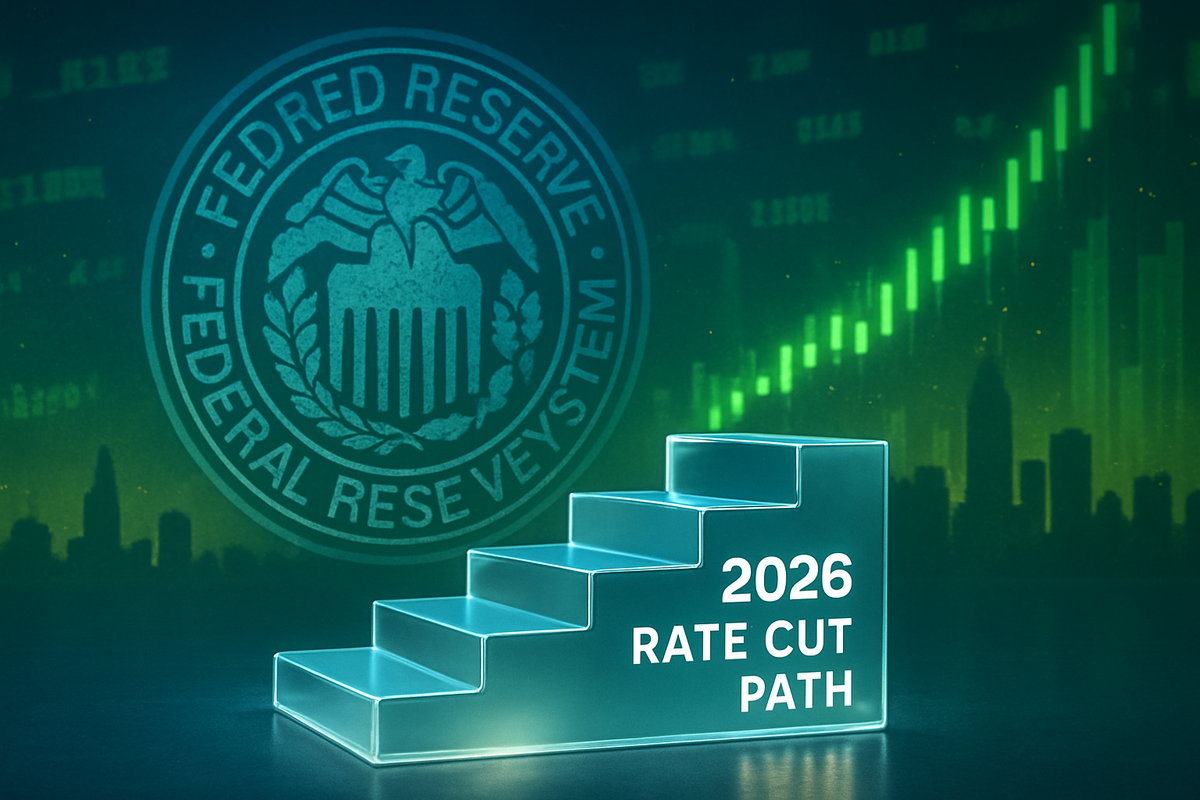
The Federal Reserve's December 2025 policy meeting served as the definitive pivot point for the coming year. While the central bank delivered a 25-basis-point cut to close out 2025, the real story lies in the Summary of Economic Projections (SEP) for 2026. The "dot plot" revealed a median projection of one additional 25-basis-point cut in 2026, aiming for a terminal rate of 3.25%–3.50%. However, the internal debate within the FOMC is far from settled; four members projected no cuts at all, while more dovish participants, including recent appointee Stephen Miran, have argued for more aggressive easing to counter a labor market that saw unemployment tick up to 4.6% following a brief government shutdown in late 2025.
The timeline leading to this moment has been characterized by a "sticky" descent in inflation. Throughout 2025, the Personal Consumption Expenditures (PCE) price index hovered near 2.9%, stubbornly above the Fed's 2% target. Yet, with GDP growth projected to remain robust at 2.3% in 2026, the Fed has found the confidence to begin easing. The market’s reaction has been one of "aggressive alignment," with Fed funds futures currently pricing in two to three cuts for 2026—more than the Fed’s median forecast—reflecting a belief that the central bank will be forced to act more quickly if the labor market continues to cool.
Key stakeholders, including outgoing Fed Chair Jerome Powell, whose term expires in May 2026, have emphasized a "wait-and-see" approach for the first quarter of the new year. This looming leadership transition at the world’s most powerful central bank adds a layer of uncertainty, as the market anticipates a potential shift in policy philosophy depending on who is tapped to lead the Fed into the late 2020s.
Winners and Losers in a Lower-Rate Regime
The prospect of lower rates in 2026 is creating a distinct "broadening" of market leadership. Technology giants, particularly those at the forefront of the AI revolution, remain primary beneficiaries. NVIDIA (NASDAQ: NVDA) and Microsoft (NASDAQ: MSFT) have seen renewed interest as lower discount rates boost the present value of their long-term cash flows. Analysts expect these firms to maintain double-digit earnings growth in 2026, though high valuations mean they remain sensitive to any "hawkish" surprises from the Fed.
Conversely, the traditional banking sector faces a more complex outlook. JPMorgan Chase & Co. (NYSE: JPM) may see a compression in net interest margins—the difference between what they earn on loans and pay on deposits—as rates decline. However, this could be offset by an increase in loan demand and a resurgence in investment banking activity as corporate deal-making becomes cheaper to finance. Meanwhile, interest-sensitive sectors like real estate are already showing signs of life. Prologis (NYSE: PLD), a leader in industrial logistics, stands to benefit from lower capital costs and a potential rebound in the housing and construction sectors.
Small-cap stocks, represented by the iShares Russell 2000 ETF (NYSEARCA:IWM), are perhaps the most significant "winners" in this environment. These companies, which often carry higher levels of floating-rate debt, have been disproportionately squeezed by the Fed’s tightening cycle. As the path to 3.25% becomes clearer, the Russell 2000 is expected to outperform its large-cap peers for the first time in years, as the "cost of capital" burden begins to lift.
The Macro Significance: A Soft Landing in Sight?
The Fed’s 2026 path is a critical chapter in the broader narrative of the post-pandemic economy. If successful, this "cautious normalization" will be remembered as a classic soft landing, comparable to the mid-1990s pivot under Alan Greenspan. It signals that the central bank believes the structural inflationary shocks of the early 2020s have been sufficiently absorbed, and that productivity gains—largely driven by the integration of AI across the economy—are allowing for higher growth without triggering a price spiral.
This event also highlights a shift in global monetary policy. As the U.S. Fed moves toward easing, it provides "policy cover" for other central banks, such as the European Central Bank and the Bank of England, to follow suit without risking significant currency devaluation against the dollar. However, the "last mile" of inflation remains a risk; if service-sector costs or potential trade tariffs push CPI back toward 3%, the Fed’s 2026 plans could be abruptly halted, leading to a "no-landing" scenario that could catch markets off guard.
Historically, the end of a tightening cycle has been a precursor to strong equity returns, provided a recession is avoided. With the Fed raising its 2026 GDP forecast to 2.3%, the consensus view is that the U.S. economy is entering a period of "Goldilocks" growth—not too hot to fuel inflation, but not too cold to trigger a downturn.
The Road to 2026: What Comes Next
In the short term, all eyes are on the March 2026 FOMC meeting. This will be the final major policy signal before Jerome Powell’s term ends in May, and it will likely dictate the pace of cuts for the remainder of the year. Investors should prepare for a period of high volatility as the market digests every piece of labor market data. A strategic pivot toward "value" and "cyclical" stocks may be required if the broadening of the rally continues to gain steam at the expense of the "Magnificent 7" tech leaders.
Longer-term, the primary challenge will be the "neutral rate" debate. If the Fed finds that the economy can handle rates at 3.5% without slowing down, they may stop cutting sooner than the market expects. This would create a "floor" for interest rates that is significantly higher than the near-zero levels seen in the 2010s, forcing a permanent shift in how investors value assets and manage risk.
Summary and Investor Outlook
The Federal Reserve’s projected rate cut path for 2026 has provided the fuel for a powerful year-end rally, but the journey is far from over. The key takeaways for investors are clear: the Fed is committed to easing, but the pace will be gradual and data-dependent. The "soft landing" remains the base case, supporting a bullish outlook for both large-cap tech and long-suffering small-cap and real estate sectors.
Moving forward, the market will be hyper-focused on two things: the succession plan for the Fed Chair and the "stickiness" of service-sector inflation. While the tailwinds of lower rates are undeniable, the risk of a policy mistake—either cutting too fast and reigniting inflation or cutting too slow and stifling growth—remains the primary threat to the current rally. For now, the "Santa Claus rally" of 2025 appears to have a long runway into the new year.
This content is intended for informational purposes only and is not financial advice