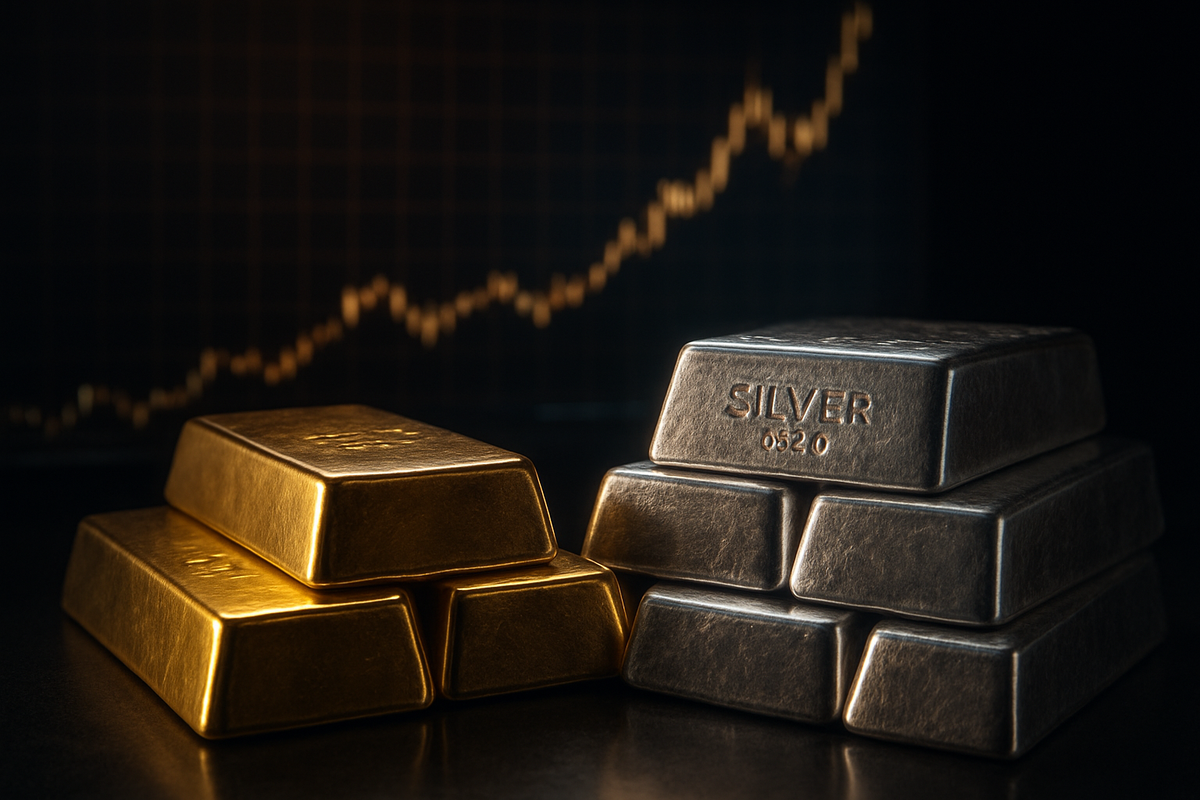
As the final trading days of 2025 draw to a close, the financial world is witnessing a historic realignment of capital. After years of being overshadowed by the meteoric rise of artificial intelligence and digital assets, precious metals have reclaimed their throne, delivering their best annual performance in over a decade. Gold has surged past the once-unthinkable $4,500 per ounce mark, while silver has more than doubled in value, fueled by a perfect storm of fiscal instability, geopolitical friction, and a fundamental shift in global monetary policy.
The implications for the broader market are profound. This "Golden Renaissance" marks a departure from the speculative fervor of the early 2020s, signaling a return to tangible stores of value. Investors, ranging from retail enthusiasts to the world’s largest sovereign wealth funds, have piled into bullion as a primary defense against a weakening US dollar and a global economy grappling with the aftershocks of a prolonged federal government shutdown and escalating trade wars.
A Year of Parabolic Ascents and Policy Pivots
The journey to these record highs began in early 2025, following a steady but quiet accumulation period throughout 2024. The catalyst for the breakout was a decisive pivot by the Federal Reserve, which, after maintaining a "higher-for-longer" stance, finally aggressive cut interest rates three times in the latter half of the year. By December 30, 2025, the federal funds rate has settled into a target range of 3.50%–3.75%, significantly reducing the opportunity cost of holding non-yielding assets like gold and silver.
The momentum reached a fever pitch during the 41-day federal government shutdown that paralyzed Washington from October through mid-November. With key economic data delayed and the US national debt ballooning to a staggering $38.5 trillion, the "safe haven" trade became the only trade for many institutional desks. During this period of information vacuum, gold acted as a barometer for systemic risk, climbing nearly 15% in six weeks. Meanwhile, silver benefited from a "double-tailwind": its role as a monetary hedge and its critical necessity in the burgeoning AI infrastructure and green energy sectors, where supply deficits have reached their fifth consecutive year.
Key players in this rally extended beyond the trading floors of New York and London. Central banks remained the bedrock of demand, with total annual purchases estimated at a record 1,200 tonnes. Poland emerged as a surprise leader in the first half of the year, aggressively diversifying its reserves, while China and India continued their multi-year accumulation strategies. The repatriation of 100 tonnes of gold by the Reserve Bank of India from the UK earlier this year served as a symbolic turning point, underscoring a global trend toward financial sovereignty and de-dollarization.
Mining Giants and the Leverage Play
The primary beneficiaries of this price surge have been the major mining corporations, which have seen their operational leverage translate into explosive stock performance. Newmont Corporation (NYSE: NEM), the world's largest gold miner, has been a standout performer, posting a year-to-date total return of approximately 186%. After successfully integrating the Newcrest portfolio and shedding non-core assets, Newmont’s focus on "Tier 1" jurisdictions allowed it to capture the full upside of the $4,500 gold price, reporting a record $1.6 billion in free cash flow in the fourth quarter alone.
Barrick Gold (NYSE: GOLD) also staged a powerful comeback after a period of relative stagnation. By tripling its free cash flow in the second half of 2025, Barrick was able to authorize a massive $500 million share buyback and increase its base dividend by 25% in November. The company’s ability to maintain stable production costs while spot prices soared has made it a favorite among value investors looking for "hard asset" exposure.
In the silver sector, the performance has been even more dramatic. Pan American Silver (NASDAQ: PAAS) solidified its dominance by acquiring a major stake in the high-grade Juanicipio mine through its strategic moves involving MAG Silver (NYSE: MAG). This acquisition helped Pan American Silver slash its All-In Sustaining Costs (AISC) by over 20%, allowing it to reap massive profits as silver prices tested the $80 range. Conversely, smaller explorers and high-cost producers in politically unstable regions have struggled to keep pace, as rising labor and energy costs in some jurisdictions have eaten into the margins provided by the higher metal prices.
De-Dollarization and the Industrial Squeeze
The wider significance of the 2025 rally lies in its reflection of a changing global order. The aggressive move into gold by central banks is no longer just a hedge against inflation; it has become a strategic move toward de-dollarization. As trade wars escalated and 100% tariffs became a common geopolitical tool in 2025, the neutrality of gold became its most attractive feature. This shift has forced competitors in the financial services sector to adapt, with major banks like JPMorgan Chase (NYSE: JPM) and Goldman Sachs (NYSE: GS) significantly expanding their precious metals desks to accommodate the surge in institutional client demand.
Furthermore, the "silver squeeze" of 2025 has highlighted a critical vulnerability in the global tech supply chain. Silver's essential role in photovoltaic cells for solar energy and its conductivity requirements in AI data centers have created a structural deficit that mining supply cannot currently meet. This has led to calls for increased recycling initiatives and potential regulatory shifts in how "critical minerals" are stockpiled by Western governments. The historical precedent often cited this year is the bull run of 1979-1980, but with a modern twist: the industrial demand of the 21st century is providing a floor for prices that didn't exist in previous cycles.
The Road to 2026: Momentum or Mean Reversion?
Looking ahead to 2026, the primary question for investors is whether this momentum is sustainable. Short-term, the market appears overbought, and a period of consolidation would be healthy after such a parabolic year. However, the long-term fundamentals remain robust. The Federal Reserve's commitment to a more accommodative stance, combined with the unresolved nature of the US fiscal deficit, suggests that the "debasement trade" still has room to run.
Strategic pivots are already underway. Many mining companies are shifting their 2026 budgets toward exploration and brownfield expansions to capitalize on the high-price environment. We may also see a wave of mergers and acquisitions as larger players seek to replenish their reserves with high-grade assets. The challenge for the sector will be managing the "resource nationalism" that often accompanies high commodity prices, as host governments in mining-heavy nations may look to increase royalties or taxes to bolster their own budgets.
Final Thoughts for the Year-End
The 2025 year-end review for gold and silver is one for the history books. Gold’s 72% gain and silver’s staggering 158% rise have redefined the "safe haven" narrative for a new generation of investors. The key takeaway from this year is that precious metals are no longer just "insurance" for a portfolio; they have become active engines of growth in an era of unprecedented global uncertainty.
As we move into 2026, investors should watch for the stability of the US dollar and any further signs of central bank diversification. While the extreme volatility of 2025 may subside, the structural shifts in the global economy—ranging from the AI-driven silver demand to the fiscal realities of the US debt—suggest that the "Golden Renaissance" is far from over. For the first time in over a decade, the "permabulls" of the precious metals world have been vindicated, and the market is now forced to price in a world where hard assets are once again the ultimate arbiter of value.
This content is intended for informational purposes only and is not financial advice.