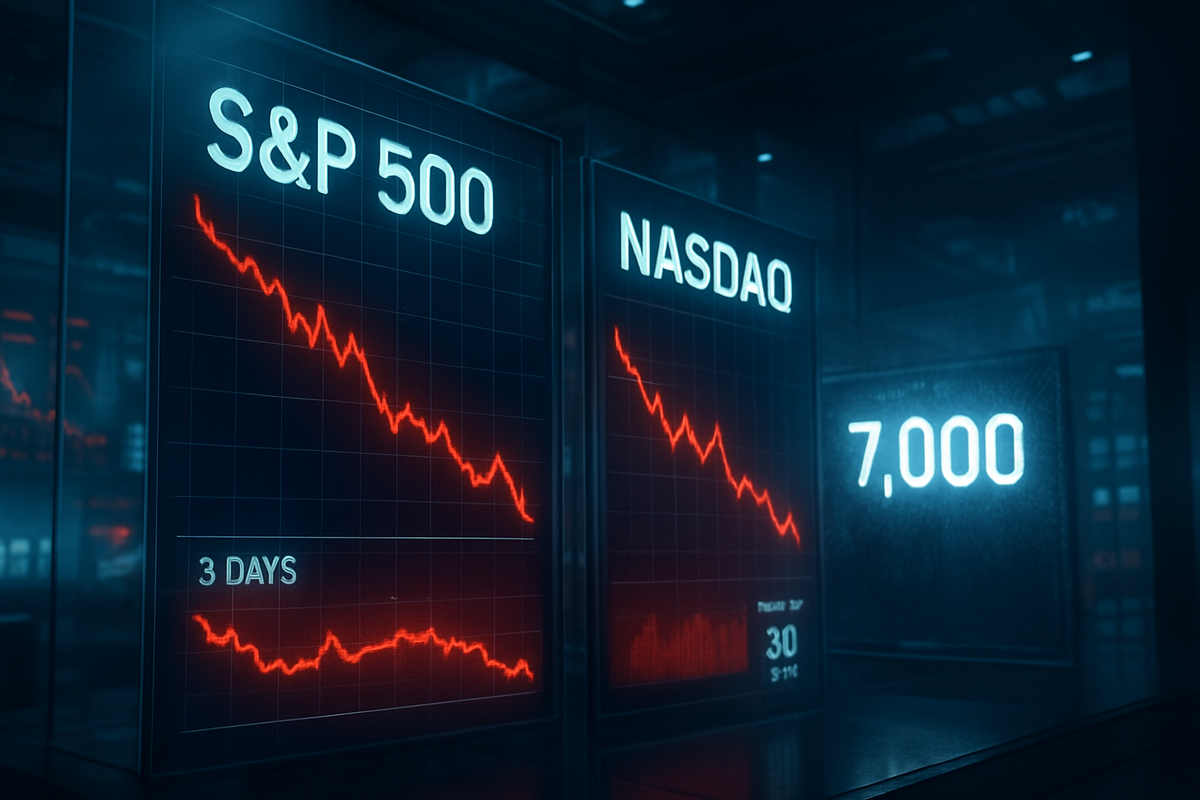
As the 2025 trading calendar winds down to its final hours, the festive atmosphere on Wall Street has been replaced by a clinical, high-stakes battle for technical support. On this Tuesday, December 30, 2025, the S&P 500 and the tech-heavy Nasdaq Composite are struggling to snap a three-day losing streak that has threatened to dampen one of the strongest annual performances in recent memory. While the broader market remains up nearly 20% for the year, a wave of institutional profit-taking and a "hawkish" pivot from the Federal Reserve have turned the traditional "Santa Claus Rally" into a tactical retreat.
The immediate implications are more than just psychological. With the S&P 500 hovering precariously around the 6,900 level and the Nasdaq 100 testing its 50-day moving average, the current slide represents a significant "de-risking" event. Investors are grappling with the reality that the "triple-peat"—three consecutive years of double-digit gains—may have pushed valuations to a breaking point. As fund managers move to lock in annual bonuses and rebalance portfolios for 2026, the market is witnessing a sharp rotation out of high-flying artificial intelligence (AI) stocks and into defensive havens, leaving retail investors wondering if the bull market is finally catching its breath or gasping for air.
A Perfect Storm: From Record Highs to Year-End Fatigue
The current downturn began in earnest following a record-setting session on Christmas Eve, December 24, when optimism regarding a "soft landing" reached a fever pitch. However, the reopening of markets on December 26 brought a sobering realization: the Federal Reserve’s mid-December decision to cut interest rates by 25 basis points to a range of 3.50%–3.75% was not the "dovish" signal many had hoped for. Fed officials accompanied the cut with a stern warning that core inflation, currently sitting at a "sticky" 2.7%, would limit further easing in 2026. This "hawkish cut" effectively capped the market's upside, prompting a massive sell-off in interest-rate-sensitive growth stocks.
The timeline of this week's slide has been exacerbated by the lingering scars of the 43-day government shutdown that paralyzed Washington earlier this fall. While the shutdown ended in mid-November, the delayed release of critical Q4 economic data has created an information vacuum that high-frequency trading algorithms have filled with volatility. On Monday and Tuesday, the selling pressure intensified as the S&P 500 failed to clear the psychological 7,000 millennium mark, a level that has become a formidable wall of resistance. Technical analysts point to the heavy concentration of "call-wall" options at this strike price, which forced market makers to sell underlying shares to remain delta-neutral, adding fuel to the downward momentum.
Key stakeholders, including major institutional players like Goldman Sachs (NYSE: GS) and JPMorgan Chase & Co. (NYSE: JPM), have noted that the "Great De-Risking" of late December is also a response to the "Liberation Day" tariffs implemented in April 2025. As corporations finalize their 2026 guidance, the cumulative impact of these 10% universal tariffs on supply chain costs is beginning to weigh on earnings projections. The initial reaction from the trading floor has been one of cautious recalibration, as the "buy the dip" mentality that dominated the first half of 2025 is being tested by a "sell the rip" reality in the final week of December.
Winners and Losers in the Great Rebalancing
The primary victims of this year-end slide are the members of the "Magnificent Seven," who have seen their valuations stretched to levels reminiscent of the 1999 tech bubble. NVIDIA (NASDAQ: NVDA), the undisputed leader of the AI revolution, has faced significant pressure as investors demand more than just "visionary" growth; they are now looking for concrete return on investment (ROI) from AI infrastructure. Similarly, Microsoft (NASDAQ: MSFT) and Alphabet (NASDAQ: GOOGL) have seen their shares retreat as the market scrutinizes the massive capital expenditure required to maintain their AI dominance. Apple (NASDAQ: AAPL) has also struggled to find footing this week, as concerns over global consumer spending and the aforementioned tariff impacts weigh on its hardware margins.
Conversely, the "losers" of the 2025 AI rally are emerging as the "winners" of this year-end rotation. Defensive sectors, particularly Healthcare and Utilities, have seen a late-December surge as investors seek shelter from the volatility. Companies like UnitedHealth Group (NYSE: UNH) and Johnson & Johnson (NYSE: JNJ) have outperformed the broader market over the last three sessions, acting as a stabilizer for the Dow Jones Industrial Average. These "value" plays are benefiting from a flight to quality as the Shiller P/E ratio for the S&P 500 hovers above 40, a level that historically precedes a period of underperformance for high-multiple growth stocks.
Tesla (NASDAQ: TSLA) and Meta Platforms (NASDAQ: META) find themselves in a unique middle ground. While both have been caught in the Nasdaq’s broader slide, their aggressive cost-cutting measures earlier in the year have provided a slight cushion compared to their peers. However, Amazon (NASDAQ: AMZN) has faced headwinds as the holiday shopping season’s final numbers suggest a slight deceleration in consumer discretionary spending, largely attributed to the inflationary pressures of the spring tariffs. For these tech giants, the struggle to avoid a 3-day losing streak is a battle to maintain the momentum that has added trillions to their market caps over the past 36 months.
The Broader Significance: A Shift in the Market Paradigm
The current market struggle is more than just a seasonal blip; it represents a fundamental shift in the 2025 market narrative. For most of the year, the "AI-at-any-price" trade was the dominant force, but as we approach 2026, the focus is shifting toward "profitable growth" and "macro resilience." This event fits into a broader industry trend where the "Magnificent Seven" are no longer viewed as a monolithic block of safety. Instead, the market is becoming more discerning, punishing companies that fail to show a clear path to margin expansion in a higher-for-longer interest rate environment.
The ripple effects are already being felt across the competitive landscape. Smaller AI startups, which rely on the "trickle-down" venture capital from the success of the big tech firms, are seeing their funding rounds tighten. Furthermore, the 43-day government shutdown has left a lasting impact on policy implications. The delay in regulatory approvals for several major tech mergers has created a bottleneck that is weighing on the M&A market. Historically, periods of such extreme valuation divergence—where the top few stocks trade at massive premiums to the rest of the index—often resolve through a "mean reversion" process, and the current 3-day slide may be the first tremor of that correction.
The 2025 market also bears striking similarities to the year-end dynamics of 2021, where a period of record highs was met with a sudden pivot in Fed policy and rising inflation. However, the 2025 version is complicated by the "Liberation Day" tariffs, which have introduced a structural inflationary component that wasn't present in previous cycles. This has created a "ceiling" on how much the Fed can intervene to support the market, leaving the S&P 500 and Nasdaq to find their own floors without the safety net of a "Fed Put."
What Comes Next: Navigating the 2026 Transition
In the short term, the market's ability to hold key support levels—6,848 for the S&P 500 and 25,275 for the Nasdaq 100—will be critical. If these levels fail to hold by the close of the final trading day on December 31, we could see a "cascading" effect into the first week of January, often referred to as a "reverse January Effect." Strategic pivots will be required for fund managers who have been overweight tech; many are already signaling a shift toward mid-cap stocks and international markets that have been undervalued during the U.S. tech surge.
Long-term, the market faces the challenge of a "valuation reset." If the S&P 500 cannot break through the 7,000 mark in early 2026, the risk of a formal correction (a 10% drop) increases significantly. However, this also creates market opportunities. A cooling of the AI hype could allow for more sustainable growth in sectors like biotechnology and renewable energy, which have been overshadowed by the "Magnificent Seven." The potential scenario of a "sideways" market in the first half of 2026 is becoming increasingly likely as the economy absorbs the full impact of the 2025 tariffs and the Fed’s limited rate-cut path.
Investors should also watch for a potential "rebound" in the second half of January as tax-loss harvesting ends and new capital allocations for the 2026 fiscal year begin. The primary challenge will be navigating the "ROI Gap"—the period between the massive capital investments in AI and the realization of actual profits. Those companies that can bridge this gap will likely lead the next leg of the bull market, while those that cannot may face a prolonged period of underperformance.
Final Thoughts: A Year of Records Ends with a Warning
As we close the books on 2025, the key takeaway is that while the bull market remains intact, its character is changing. The struggle to avoid a 3-day losing streak at the end of December is a reminder that even the most powerful rallies require periods of digestion. The S&P 500’s dance with the 7,000 mark and the Nasdaq’s retreat from its peaks suggest that the "easy money" phase of the AI rally has concluded. Moving forward, the market will likely be driven by earnings quality, supply chain efficiency, and the ability to navigate a complex geopolitical and tariff-laden landscape.
For the individual investor, the significance of this year-end volatility lies in the transition from a "momentum-driven" market to a "fundamental-driven" one. The lasting impact of 2025 will be the recognition that AI is a long-term structural shift, not a short-term speculative bubble, but that even structural shifts are subject to the laws of valuation and interest rates. In the coming months, watch the 10-year Treasury yield and the monthly PCE inflation prints; these will be the true north for a market that is currently searching for its next direction.
The 2025 trading year may be ending on a cautious note, but the underlying strength of the U.S. economy—despite the shutdown and tariffs—suggests that the resilience of the American market should not be underestimated. As the clock strikes midnight on New Year's Eve, the question won't be whether the market can go higher, but rather which companies have the stamina to stay there.
This content is intended for informational purposes only and is not financial advice.